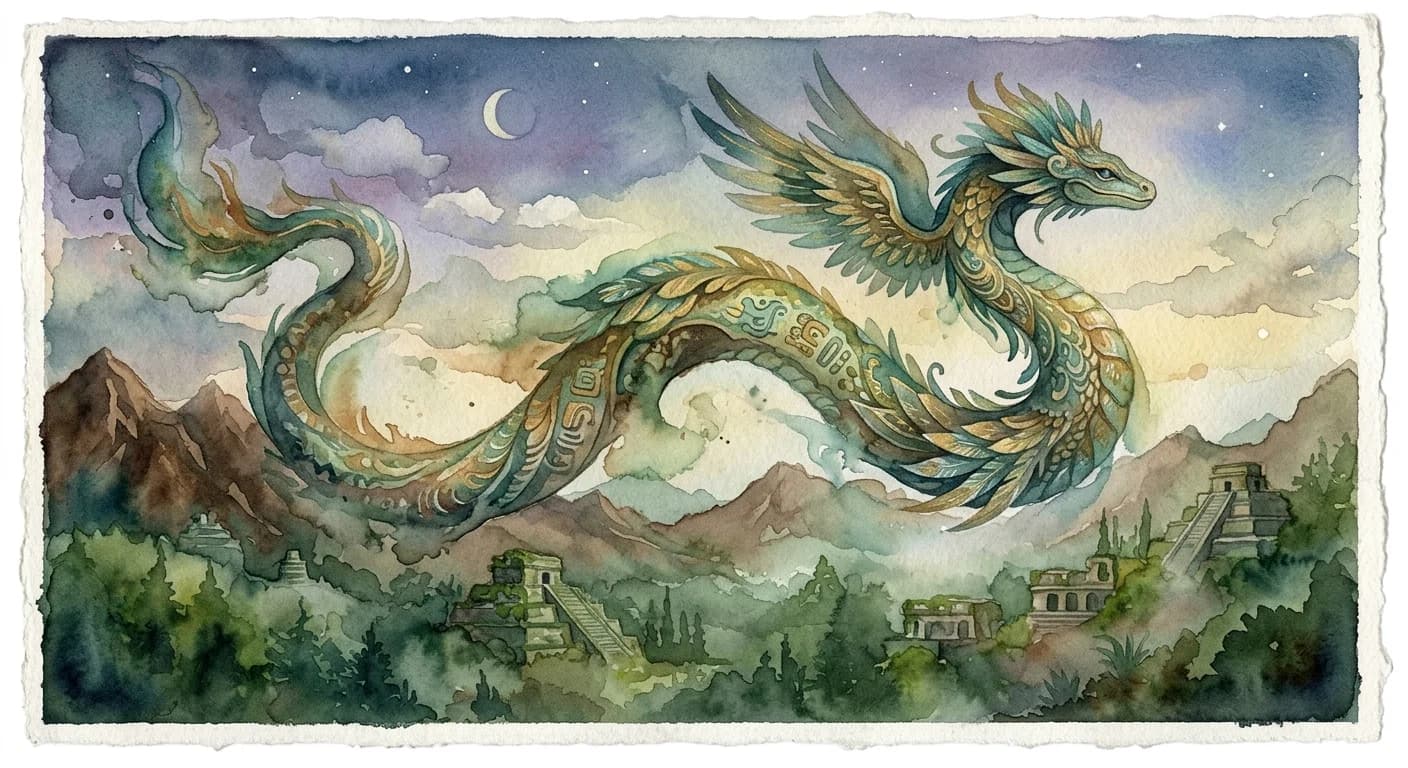
Coatl
/KO-aht-l/
Meaning
In Nahuatl, 'coatl' transcends the mere zoological definition of a serpent, embodying a profound cosmic principle. It represents the intertwined forces of duality – life and death, earth and sky, creation and destruction – essential to Mesoamerican understanding of existence. This sacred creature symbolizes transformation, regeneration, and the fertile earth, acting as a vital conduit between the terrestrial realm and the divine. Its image is a powerful glyph for the cyclical nature of time and the constant rebirth inherent in the cosmos.
Literal Translation
serpent, snake
The Story Behind the Word
The word 'coatl' is deeply woven into the fabric of Mesoamerican civilization, reflecting a worldview where the sacred permeates all aspects of life. Its existence highlights a profound respect for nature and an understanding of the interconnectedness of all things. The serpent's ability to shed its skin made it a potent metaphor for rebirth and renewal, informing concepts of agricultural cycles, human destiny, and divine intervention. It reveals a culture that perceived the earth as a living, breathing entity, with the serpent as its animating spirit and a guardian of its mysteries. The duality embodied by 'coatl' – both destructive and life-giving – was not seen as contradictory, but as a necessary balance for cosmic harmony, shaping their mythology, rituals, and urban planning, such as the design of pyramids mimicking mountains, which were often associated with serpents.
Experience It
Ancient Ritual Offering
A priest stood before the temple, offering incense to the rising sun. He invoked the spirit of 'coatl,' asking for fertile rains to nourish the maize fields, acknowledging the serpent's connection to life-giving water and the earth's bounty.
Storytelling by Firelight
Grandmother wove tales of creation by the hearth, describing how the great 'coatl' coiled around the world, holding the cosmos together. Her words taught the children about the balance of nature and the sacred power inherent in all living things.
What Gets Lost in Translation
English speakers often reduce 'coatl' to simply 'snake,' missing its immense symbolic weight. It's not just an animal; it's a deity, a cosmic force, and a representation of sacred knowledge. The idea of a 'feathered serpent' (Quetzalcoatl) is also frequently oversimplified, losing the nuance that 'coatl' itself carries deep meaning even without the 'quetzal' (feather) prefix, signifying earth-bound power and chthonic energy.
Across Cultures
Similar concepts of cosmic serpents appear across many cultures. The Ouroboros in ancient Egypt and Greece represents cycles and eternity, much like 'coatl.' In Aboriginal Australian mythology, the Rainbow Serpent is a creator deity associated with water and life. The Hindu Naga are divine or semi-divine, powerful serpentine beings linked to water, fertility, and protection, echoing 'coatl's' multifaceted roles.
The Deeper Meaning
The concept of 'coatl' reveals a philosophy of immanent divinity, where the sacred is not distant but deeply embedded within the natural world. It underscores a worldview that embraces paradox and duality as fundamental to existence, seeing life and death, creation and destruction, as inseparable components of a continuous cosmic cycle. This perspective encourages reverence for natural processes and an understanding of transformation as a constant, essential force.
Did You Know?
The iconic Feathered Serpent deity, Quetzalcoatl, combines 'quetzal' (the iridescent green tail feathers of the quetzal bird, symbolizing sky and preciousness) with 'coatl' (serpent, symbolizing earth and wisdom), creating a powerful union of sky and earth, spirit and matter.
How It's Used
Used in ancient Nahuatl texts, mythology, and place names. It is also a common element in modern Nahuatl vocabulary and cultural references.