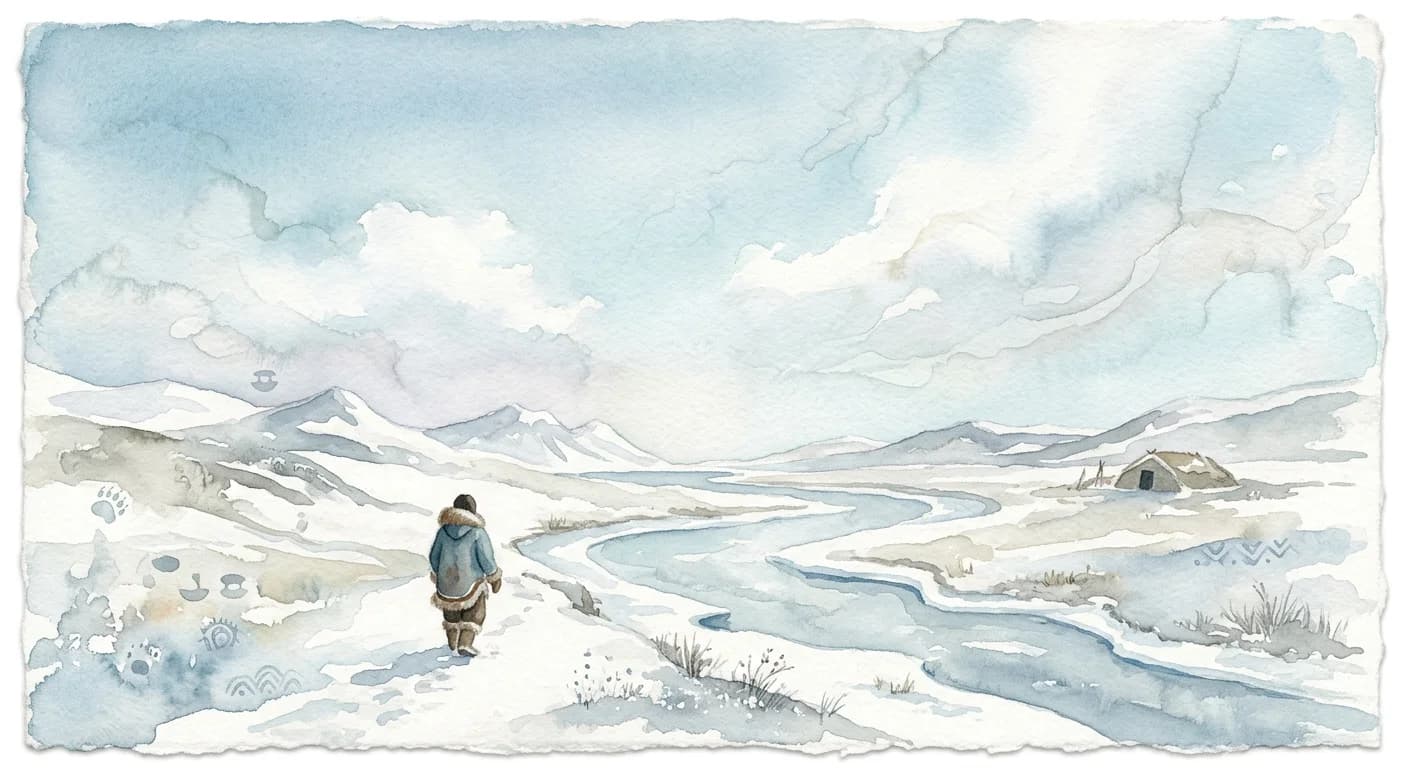
Sila
/SEE-lah/
Meaning
Sila is a profound Inuktitut concept, encapsulating not only the physical weather, atmosphere, and the vastness of the universe, but also the very essence of intelligence, consciousness, and the deep interconnectedness of all existence. It represents the sentient, living force that permeates the natural world, from the smallest snowflake to the cosmic expanse. To live in harmony with Sila means to acknowledge this pervasive sentience and maintain a respectful, balanced relationship with every aspect of the environment, recognizing its inherent wisdom and power.
Literal Translation
Weather, atmosphere, world, intelligence, consciousness
The Story Behind the Word
Sila emerged from millennia of Arctic survival, where the environment's power dictates life and death. The Inuit developed a worldview where the land, sea, sky, and weather are not passive resources but active, sentient participants in existence. This concept underpins traditional hunting practices, spiritual beliefs, and social structures, emphasizing humility, observation, and respect. It reveals a culture deeply attuned to its surroundings, where human well-being is inextricably linked to cosmic balance. The sustained existence of Inuit culture in one of the planet's harshest environments is a testament to the wisdom embedded in understanding and living by Sila's principles, fostering a profound sense of responsibility towards the living world.
Experience It
Respecting the Wind's Wisdom
An elder watches the shifting ice and a sudden, fierce wind. He tells his grandson, 'Sila is speaking to us today; we must listen carefully before we set out.' This isn't just a weather forecast, but an acknowledgment of the wind's inherent knowledge and the need to align human actions with its powerful will.
Consciousness of the Land
A hunter, after a successful catch, offers a small piece of food back to the earth. He whispers, 'Thank you, Sila, for providing.' This act isn't superstition; it's a profound expression of gratitude to the living, conscious environment for its sustenance, recognizing the interconnectedness of all life and the earth's generosity.
What Gets Lost in Translation
English speakers often reduce Sila to merely 'weather' or 'the environment,' missing its crucial spiritual and philosophical dimensions. The idea of the atmosphere or a storm possessing 'consciousness' or 'intelligence' is alien to many Western frameworks, leading to a superficial understanding. It's not just a physical phenomenon, but a living, aware entity that demands respect, gratitude, and a reciprocal relationship.
Across Cultures
While direct equivalents are rare, some concepts touch upon aspects of Sila. The Māori concept of 'mana' can refer to spiritual authority or power inherent in nature and beings. Japanese Shintoism's 'kami' are spirits dwelling in natural elements, suggesting inherent life. In some Indigenous Australian cultures, 'Country' is understood as a living entity with spirit and memory, demanding deep respect and reciprocal care, echoing Sila's holistic view of environment and consciousness.
The Deeper Meaning
Sila reveals a profound biocentric and panpsychic worldview, where consciousness is not exclusive to humans but pervades the entire cosmos. It challenges anthropocentric notions, positing that intelligence resides in the wind, the ice, and the very fabric of existence. This philosophy fosters deep ecological responsibility and reciprocity, as humans are seen as integral, respectful participants in a vast, living system, rather than its masters.
Did You Know?
The word 'Sila' is also the root for 'silap Inua,' often translated as 'Owner of the Weather' or 'Spirit of the Air,' emphasizing the personified, intelligent force behind natural phenomena.
How It's Used
Sila is used in everyday conversation and philosophical discourse to refer to the natural world, its phenomena, and the underlying spiritual essence of existence. It's invoked when discussing weather patterns, spiritual beliefs, or the importance of maintaining balance with nature.