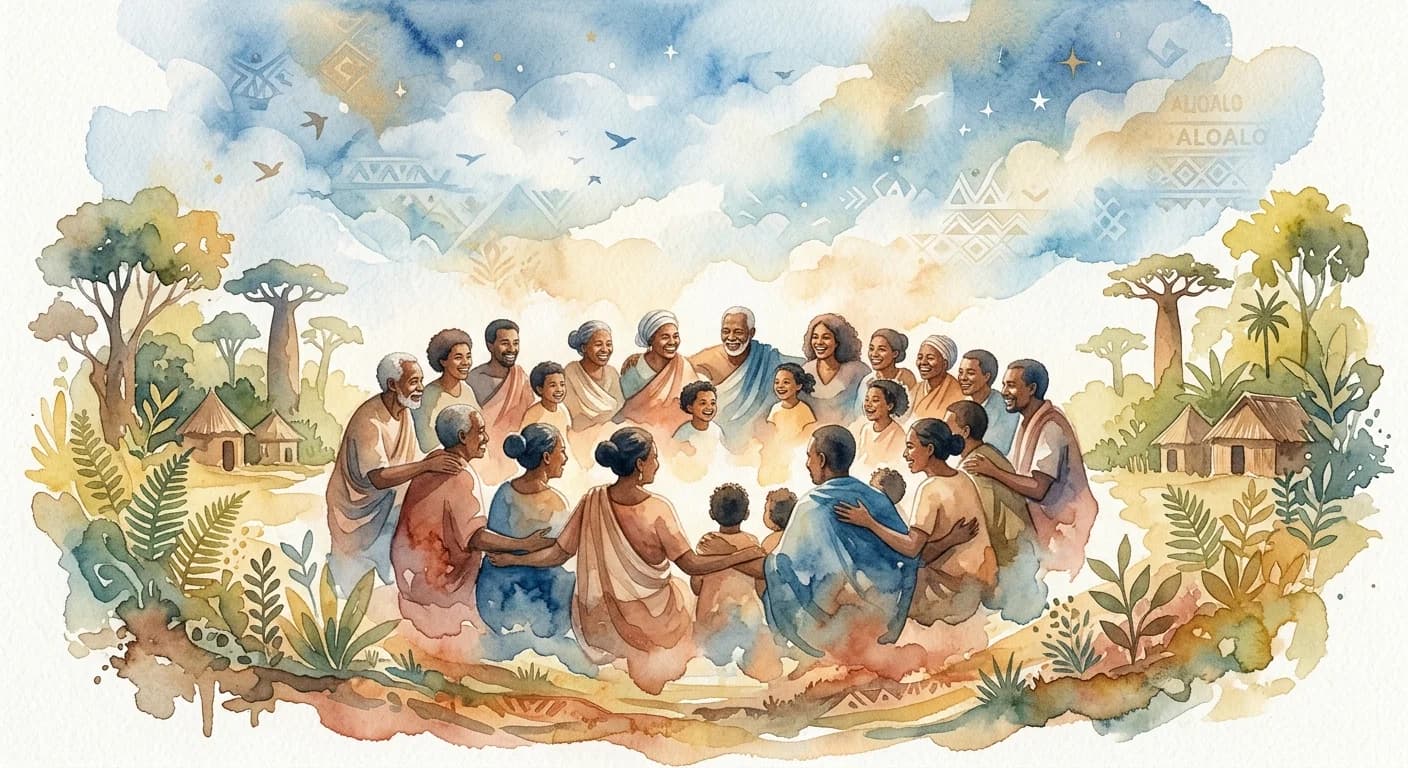
Fihavanana
/fee-hah-vah-NAHN-nah/
Meaning
Fihavanana transcends mere friendship or familial ties; it is the vital lifeblood of Malagasy society, an intricate web of interdependence and mutual obligation. It signifies a profound, active commitment to one another's well-being, where every individual is an integral thread woven into the collective tapestry. This concept fosters an unwavering social safety net, ensuring that no one stands isolated, and prioritizes communal harmony and reciprocal support above all else.
Literal Translation
Kinship, friendship, solidarity
The Story Behind the Word
Fihavanana is deeply rooted in ancestral traditions and the historical communal living patterns of Madagascar. In a land historically prone to natural disasters and where collective survival was paramount, 'fihavanana' emerged as an essential social contract. It reflects the Malagasy worldview that humanity is inherently interconnected, and individual prosperity is inextricably linked to the prosperity of the community. This philosophy is evident in traditional practices like 'fady' (taboos) that often reinforce communal harmony, and 'dina' (social conventions) which are established and upheld through consensus. It’s not just an ideal, but a practical mode of existence that shapes decision-making, conflict resolution, and daily interactions, revealing a society that values collective resilience and shared destiny over individual ambition.
Experience It
Community Rice Harvest
During harvest season, families without enough hands for their rice paddies are never alone. Neighbors, distant relatives, and even friends arrive unasked, offering their labor, sharing meals, and singing together, embodying the collective spirit of fihavanana.
Funeral Support
When a death occurs, the entire community mobilizes. Relatives from far-flung villages travel to offer comfort and resources, while neighbors take over household chores and prepare food, demonstrating unwavering fihavanana in times of profound sorrow.
The Deeper Meaning
This word reveals a profound collectivist philosophy where identity is largely communal. It suggests that true humanity ('maha-olona') is achieved through actively participating in and upholding these reciprocal relationships. The individual is understood not as a standalone entity, but as a vital part of a larger, interconnected whole, where mutual respect and solidarity are the highest virtues.
Did You Know?
The Malagasy proverb 'Ny olombelona toy ny akoholahy, ka raha mandeha irery dia tsy misy mpiaro' translates to 'A person is like a rooster; if he walks alone, he has no protector,' perfectly encapsulating the essence of fihavanana.
How It's Used
Used to describe the bond between friends, family, and community members, emphasizing mutual support and solidarity.