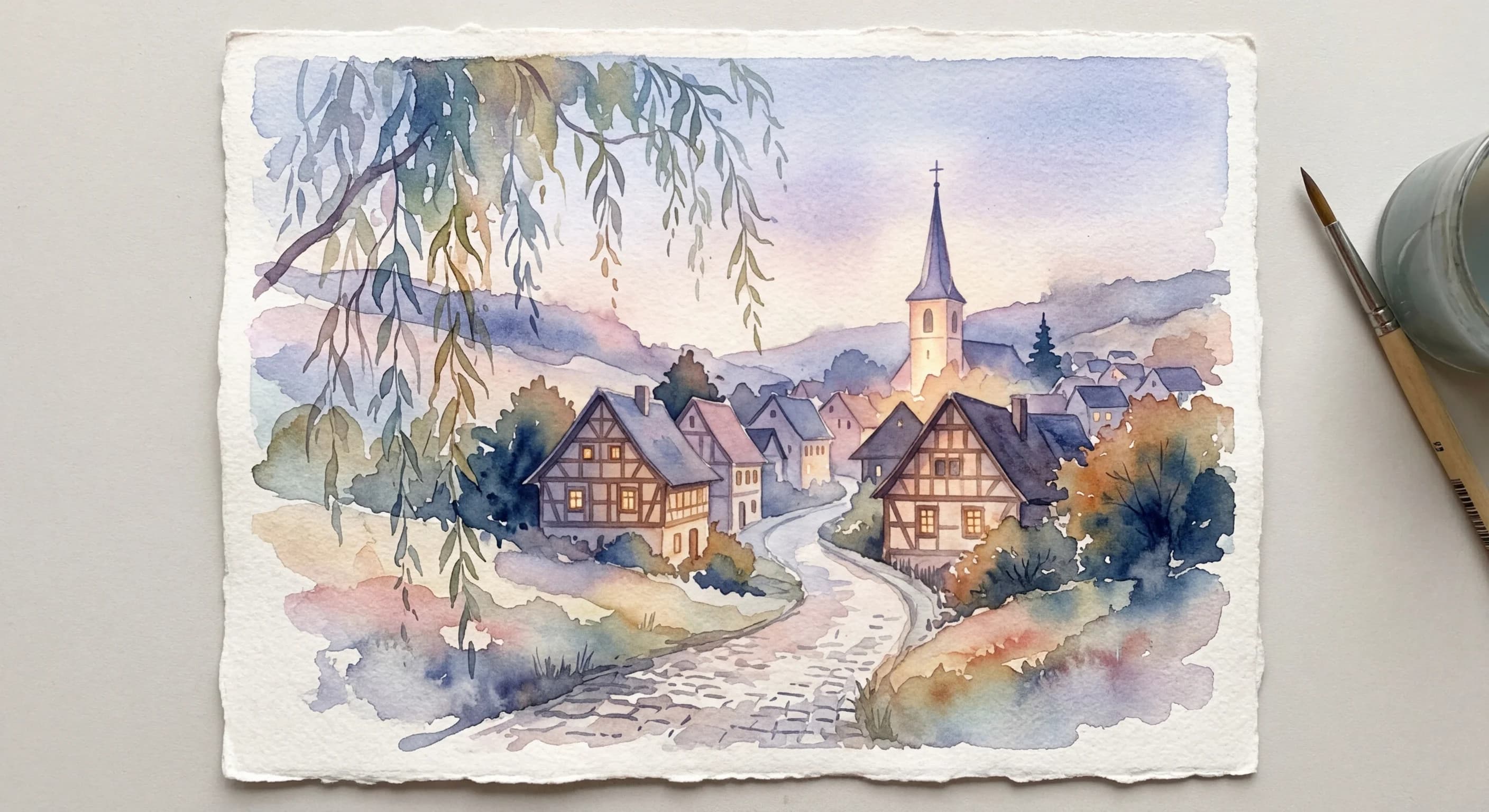
Lebenswelt
/LAY-bens-velt/
Meaning
Lebenswelt, or 'lifeworld,' describes the intuitive, pre-reflective reality we inhabit every day—the shared, common-sense backdrop against which all experiences gain meaning. It’s the invisible foundation of our social interactions, shaped by language, cultural norms, and historical layers, providing a sense of stability and belonging. This concept highlights how our individual consciousness is deeply interwoven with a collective, taken-for-granted reality, allowing us to navigate life without constant, explicit questioning. It's the silent agreement on how the world works, enabling coherent action and mutual understanding.
Literal Translation
life-world
The Story Behind the Word
The emergence of 'Lebenswelt' in German thought, particularly through Husserl and Schutz, reflects a deep-seated philosophical tradition grappling with the nature of reality and human experience. Germany’s intellectual landscape, known for its rigorous phenomenology and critical theory, provided fertile ground for a concept that delves beyond empirical observation into the structures of consciousness and intersubjectivity. It highlights a cultural inclination to question foundational assumptions, seeking to understand the underlying conditions that make human experience possible. This word reveals a German intellectual drive to dissect and articulate the implicit, often unacknowledged, dimensions of existence, recognizing that our 'world' is not merely objective but profoundly shaped by shared human understanding and interpretation.
Experience It
Navigating a New City
Moving to a foreign country, Sarah felt her familiar Lebenswelt crumble. Simple acts like buying groceries or understanding social cues became monumental tasks, as the unspoken rules and shared assumptions of her home culture were no longer valid, forcing her to consciously learn a new way of being in the world.
Family Dinner Ritual
Around the dinner table, generations of a German family share stories, jokes, and arguments, each member intuitively understanding the underlying dynamics and unspoken hierarchy. This shared ritual, with its specific language and traditions, forms a stable part of their collective Lebenswelt, reinforcing their sense of belonging and identity without anyone needing to explicitly state the 'rules'.
What Gets Lost in Translation
English speakers often equate 'lifeworld' with mere 'lifestyle' or 'personal experience,' missing its profound philosophical and sociological dimensions. It's not just about individual habits but the intersubjective, shared framework that makes any individual experience comprehensible. The nuance of its 'taken-for-grantedness' and its role as the unexamined ground of all meaning is frequently overlooked, reducing it to a simpler, more superficial understanding.
Across Cultures
While 'Lebenswelt' is a distinctly German philosophical term, similar concepts resonate across cultures. The Japanese concept of 'sekai' (世界) can also refer to 'world' or 'society,' encompassing a shared perceived reality. In some indigenous cultures, the idea of a deeply interconnected 'web of life' or 'sacred ecology' reflects a similar pre-reflective understanding of one's place within a larger, shared reality, where the separation between individual and environment is less pronounced than in Western thought.
The Deeper Meaning
The concept of Lebenswelt reveals a profound philosophical insight: that our individual consciousness is not isolated but always already embedded in a shared, intersubjective world. It challenges purely objective views of reality, positing that meaning is not inherent in things themselves but emerges from our collective, pre-reflective engagement with the world. This underscores the idea that human reality is fundamentally social and culturally constructed, emphasizing the deep interconnectedness of individual experience with a communal ground of meaning.
Did You Know?
Edmund Husserl, the philosopher who popularized 'Lebenswelt,' initially developed the concept to address the perceived crisis of meaning in modern science, arguing that science had lost touch with the everyday human experience it was meant to explain.
How It's Used
Used in philosophy, sociology, and psychology to describe the subjective, everyday world of experience that forms the basis of our understanding and interaction with reality.