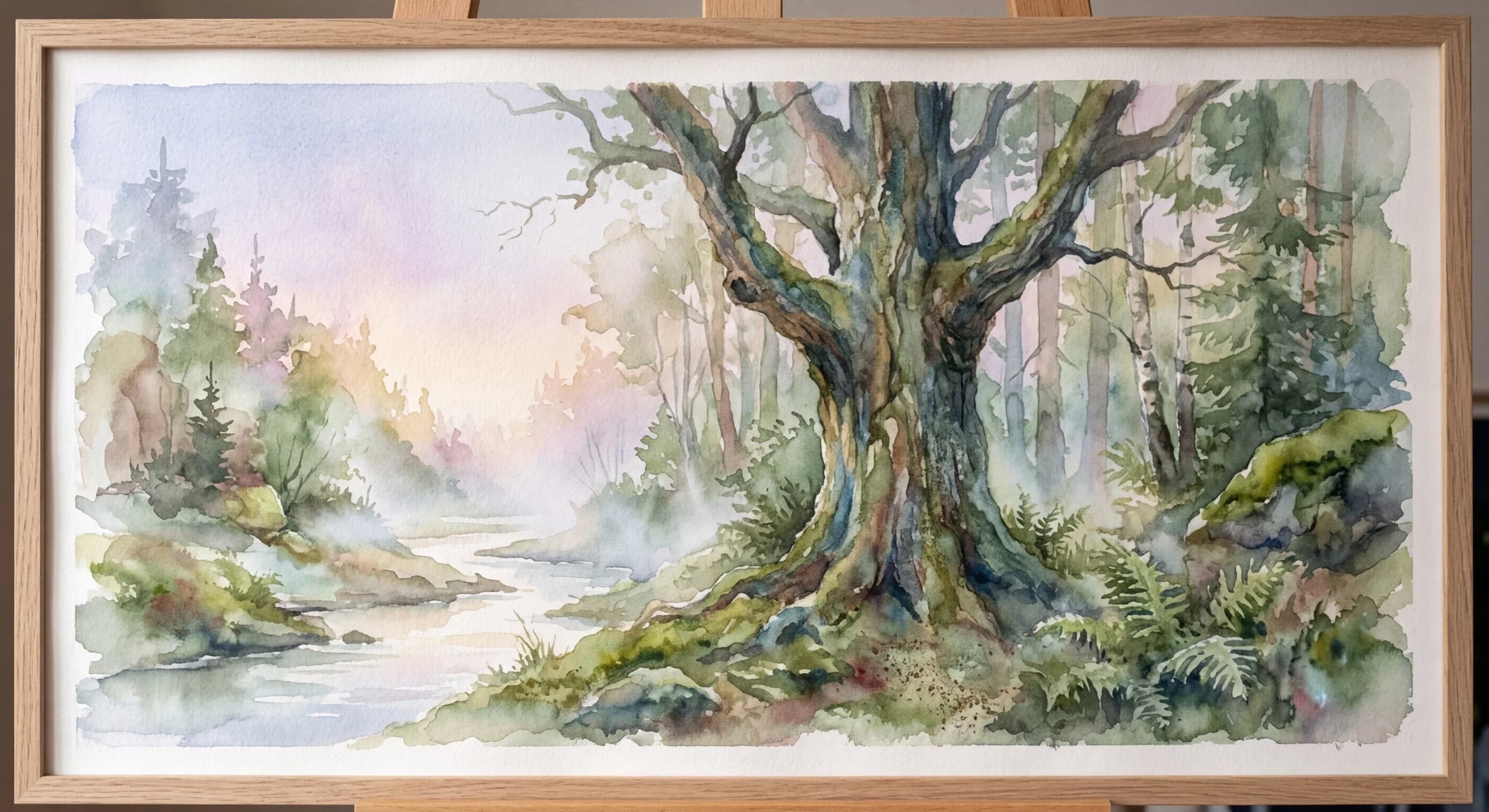
Umwelt
/OOM-velt/
Meaning
Umwelt delves beyond the objective 'environment' to describe an organism's unique, subjective world of perception. It's the self-centered bubble of reality, shaped by an organism's sensory apparatus, needs, and evolutionary history, where only what is relevant for survival and interaction registers. This concept profoundly illustrates that every creature, from a tick sensing butyric acid to a human navigating a city, inhabits a fundamentally distinct reality, making true interspecies understanding a complex, often impossible, endeavor. It highlights the deeply personal and often hidden dimensions of existence.
Literal Translation
environment, surrounding world
The Story Behind the Word
The concept of Umwelt was formalized by the Baltic German biologist Jakob von Uexküll in the early 20th century, emerging from a rich German tradition of philosophical inquiry into subjectivity, perception, and the nature of reality. Thinkers like Kant, Goethe, and Schopenhauer had already laid groundwork pondering how our internal states shape our experience of the external world. Uexküll's work, bridging biology and philosophy, resonated deeply with a culture that valued introspection and a systematic approach to understanding complex phenomena. It reflects a profound German intellectual curiosity about the limits of human knowledge and the inherent subjectivity of experience, extending philosophical rigor to the natural sciences. The word itself, combining "Um" (around) and "Welt" (world), perfectly encapsulates this idea of a surrounding world intimately tailored to an individual's perception.
Experience It
Dog's Olfactory World
A human sees a park as a green space with trees and paths. A dog, however, experiences the same park through an intricate tapestry of scents – the history of every creature that passed by, a narrative written in urine and pheromones, creating a rich, invisible 'Umwelt' utterly distinct from its owner's visual one.
Bat's Echo-Location
For a bat, the world is a symphony of echoes, a detailed three-dimensional map painted by sound waves. A moth, to the bat, is not a fluffy insect but a distinct echo signature, a moving target within its unique 'Umwelt' of sonic perception, incomprehensible to visual-dominant species.
The Deeper Meaning
Umwelt offers a potent philosophical challenge to anthropocentric views, forcing us to acknowledge the inherent subjectivity of reality itself. It suggests that there is no single, objective 'world' but rather a multitude of 'worlds,' each privately constructed by an organism's sensory and cognitive apparatus. This insight deeply impacts discussions on consciousness, interspecies communication, and the very nature of existence, emphasizing that our understanding is always mediated and partial.
Did You Know?
Jakob von Uexküll, who coined 'Umwelt,' was a pioneer in semiotics and ethology, influencing thinkers from Heidegger to Deleuze with his revolutionary ideas about how organisms construct their realities.
How It's Used
Used in biology, ethology, philosophy, and semiotics to describe the unique sensory and cognitive environment of an organism.