Flaneuse
/flah-NUHZ/
Meaning
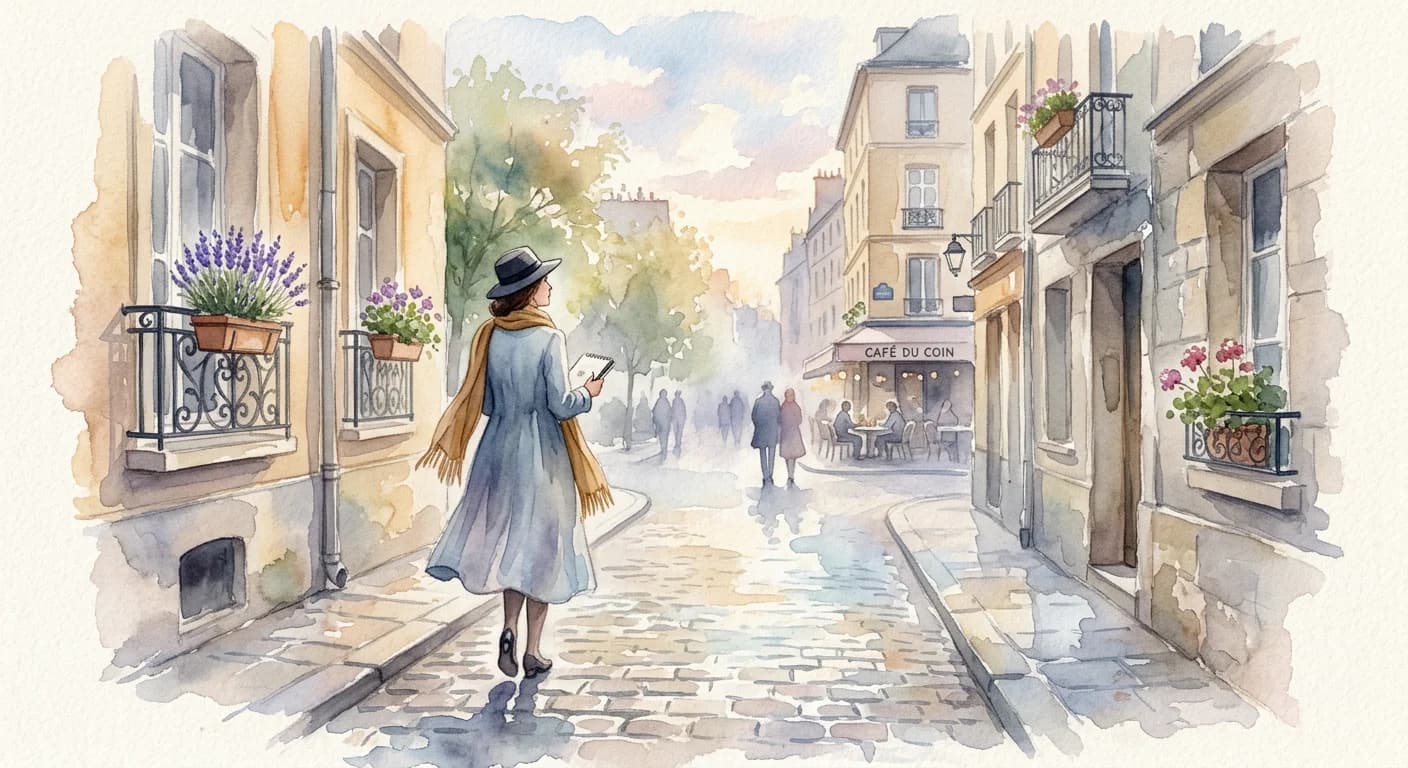
A flâneuse is an urban wanderer, a woman who deliberately embraces the city as her canvas for observation and self-discovery. She moves through public spaces not as a mere pedestrian, but as an active participant in the urban drama, absorbing its rhythms, details, and hidden narratives. Her stroll is an intellectual and sensory journey, a reclamation of space that historically excluded women, transforming the act of seeing into a profound engagement with her surroundings and her own subjectivity.
Literal Translation
Female stroller/idler
The Story Behind the Word
The concept of the flâneur emerged in 19th-century Paris, closely tied to Baudelaire's reflections on modernity and the burgeoning urban landscape. However, the flâneuse is a more recent and complex construct, born from feminist re-readings of urban history. Historically, women's presence in public spaces was often scrutinized or confined to specific roles, making unchaperoned, aimless wandering a transgressive act. The existence of the flâneuse as a recognized archetype reveals a cultural shift, acknowledging women's right to occupy and interpret the city on their own terms. It speaks to a French appreciation for intellectual curiosity, aesthetic engagement, and a subtle defiance of societal norms, celebrating the individual's subjective experience of the urban environment.
Experience It
Rue de Rivoli Reverie
Amidst the bustling arcades of Rue de Rivoli, Camille slows her pace. She observes the intricate ironwork balconies, the shifting reflections in shop windows, and the subtle interactions between strangers, sketching mental notes for her next short story. Her walk is a deliberate act of absorption, a flâneuse's communion with the city's pulse.
Café Terrace Observations
Sitting at a small café table, Anne sips her coffee, her gaze sweeping across the passersby. She notices the worn elegance of an elderly woman's coat, the hurried steps of a businessman, and the fleeting expressions on people's faces. For Anne, this is not just people-watching; it's a deep, empathetic study of urban life, a flâneuse's quiet research.
The Deeper Meaning
The flâneuse embodies a philosophy of active contemplation and subjective engagement with the world. It suggests that true understanding comes not from hurried consumption, but from leisurely observation and interpretation. Her existence challenges traditional power dynamics, asserting a woman's right to agency, intellectual freedom, and the unmediated experience of urban life, transforming passive presence into profound participation.
Did You Know?
While the flâneur was largely a male literary figure of the 19th century, the flâneuse gained prominence in academic and literary discourse in the late 20th and 21st centuries, re-evaluating women's historical relationship with public spaces.
How It's Used
Used to describe a woman who enjoys leisurely walks through urban environments, observing and absorbing the city's atmosphere and culture.