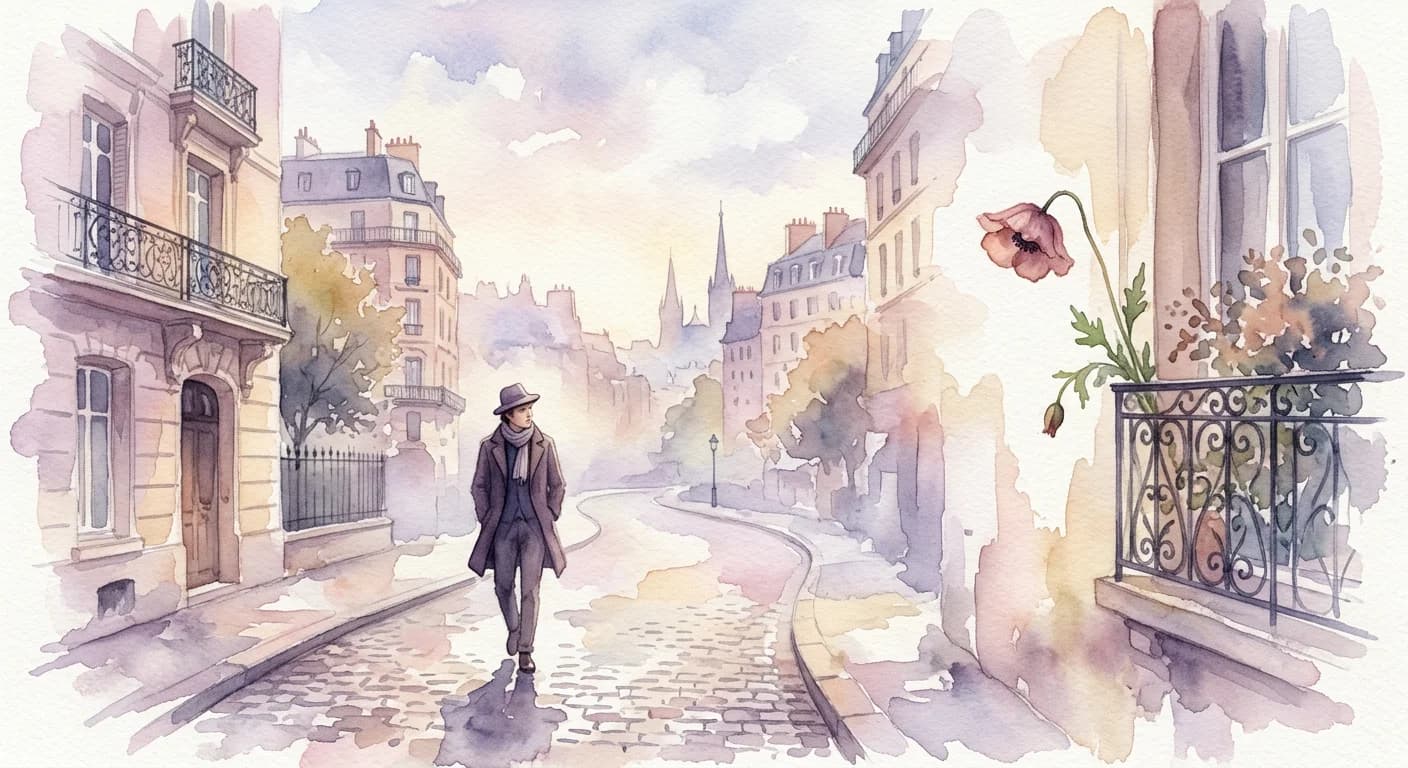
Flâneur
/flah-NUR/
Meaning
A 'flâneur' is more than a mere idler; he is a connoisseur of the urban experience, an artist of observation who wanders the city's arteries without agenda, absorbing its rhythms and narratives. This deliberate, unhurried exploration transforms the mundane into a spectacle, allowing for a profound, albeit detached, engagement with the human tapestry unfolding around him. It is a contemplative practice, a mindful immersion in the fleeting beauty and hidden dramas of city life, turning the act of strolling into a form of aesthetic and sociological inquiry.
Literal Translation
Stroller, idler, lounger
The Story Behind the Word
The concept of the 'flâneur' emerged in 19th-century Paris, particularly with the modernization and Haussmannization of the city, which created grand boulevards and arcades perfect for public display and observation. It represents a uniquely Parisian response to modernity, a way to navigate and make sense of the burgeoning, anonymous crowds and the accelerating pace of urban life. The 'flâneur' embodies a certain intellectual and artistic temperament, valuing observation, contemplation, and a critical distance from the commercial bustle. This figure became central to the works of Baudelaire and Walter Benjamin, symbolizing a resistance to industrial alienation and a celebration of subjective experience within the urban spectacle. It reveals a culture that values subtle perception, the poetry of everyday life, and a certain elegant detachment.
Experience It
Rue de Rivoli Reverie
Pierre spent his afternoon ambling down Rue de Rivoli, not to shop, but to watch the reflections dance in shop windows, catching glimpses of hurried tourists and the timeless Parisian light. He paused to observe an old man meticulously arranging postcards, finding a quiet narrative in the everyday transaction.
Café Terrace Observer
From his perch at a café terrace, Jean-Luc sipped his espresso, letting conversations drift past him like smoke. He wasn't listening intently, but rather absorbing the collective murmur, the gestures of lovers, and the fleeting expressions of passersby, constructing an invisible tapestry of urban existence.
The Deeper Meaning
The 'flâneur' embodies a philosophy of attentive presence and aesthetic detachment. It suggests that profound meaning can be found not in purposeful action, but in the contemplative observation of the world, particularly the urban environment. This worldview elevates the act of seeing and experiencing to a form of knowledge, proposing that understanding comes from immersing oneself in the chaos of life while maintaining a critical, artistic distance.
Did You Know?
The original 'flâneur' of the 19th century was often associated with specific public spaces like the Parisian arcades, which offered sheltered, curated environments for leisurely strolling and people-watching.
How It's Used
Used to describe someone who enjoys aimlessly strolling through city streets, observing life and engaging with the urban environment.