Flâneuse
/flah-NUHZ/
Meaning
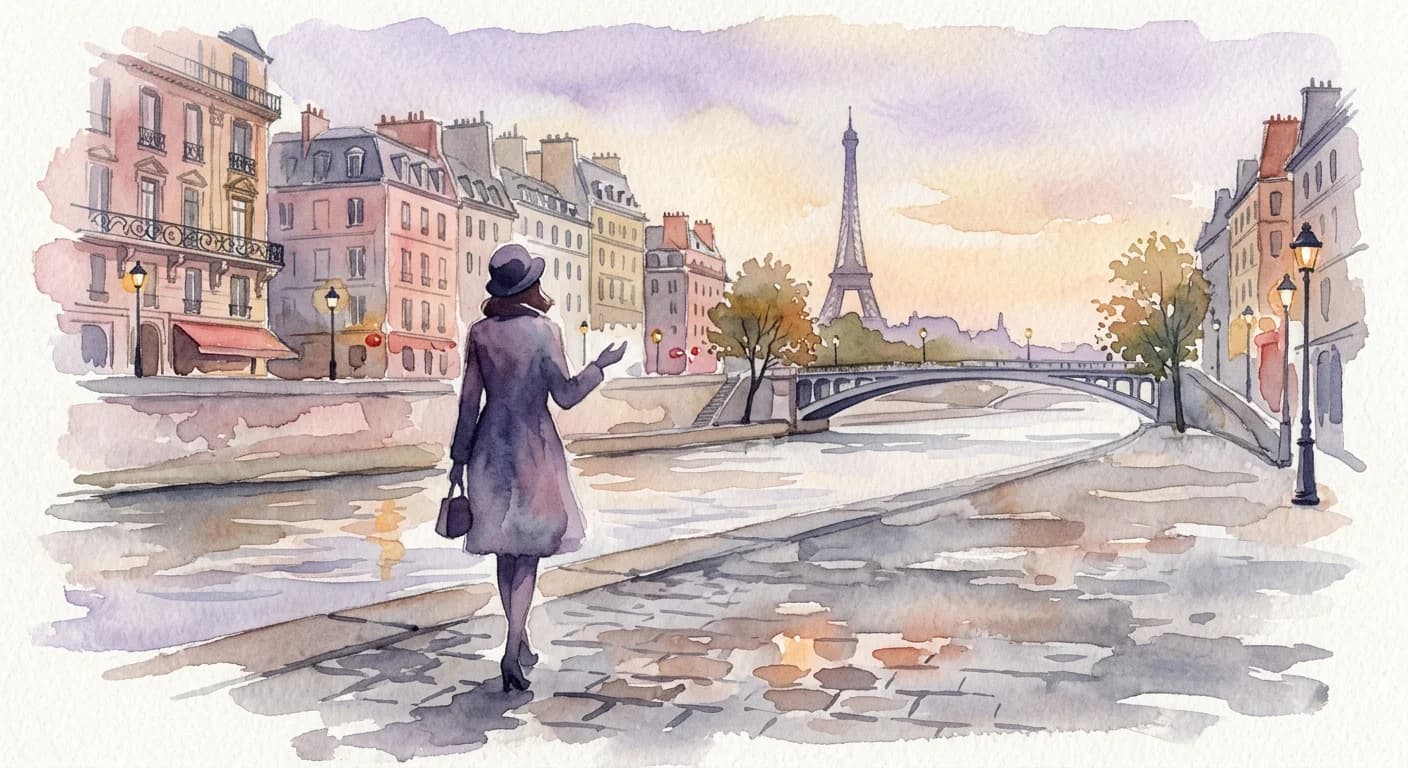
A 'flâneuse' is a woman who deliberately embraces the art of urban wandering, transforming the city street into her personal domain of observation and contemplation. Unlike her male counterpart, her presence in public space is often an implicit act of defiance, challenging historical constraints placed on women's mobility and visibility. She moves with an intellectual curiosity, absorbing the city's rhythms, architecture, and inhabitants, not as a passive observer but as an active participant in the urban dialogue, reclaiming space and asserting her subjective experience.
Literal Translation
female stroller/loafer
The Story Behind the Word
The 'flâneuse' emerges from a deeply gendered history of urban life in 19th-century Paris, where the public sphere was largely the domain of men. While the male 'flâneur' could wander with relative anonymity and privilege, a woman in public without a clear purpose was often viewed with suspicion, associated with prostitution or idleness. The concept of the 'flâneuse' thus represents a crucial reclaiming of urban space and leisure for women, a conscious act of observation and engagement that transcends societal expectations. Its existence highlights a culture grappling with evolving gender roles and the right of women to inhabit and interpret the city on their own terms, transforming a potentially vulnerable position into one of intellectual and artistic agency. It reveals a society where the act of seeing and being seen in the city is imbued with social and political significance.
Experience It
Rue de Rivoli Musings
Élodie spent her afternoon as a flâneuse along Rue de Rivoli, not shopping, but observing the subtle ballet of tourists and Parisians. She paused to sketch a gargoyle on a Haussmannian building, then continued, mentally composing a poem inspired by the reflections in a shop window, entirely absorbed in the city's unfolding narrative.
Café Terrace Observations
Sitting at a small café table, Marianne wasn't waiting for anyone; she was simply being a flâneuse. With her notebook open, she watched the nuanced interactions of passersby, the changing light on the cobblestones, and the quiet dignity of an elderly woman tending her window box, finding inspiration in every detail.
The Deeper Meaning
The 'flâneuse' embodies a philosophy of active engagement with one's environment, transforming mere presence into profound observation and intellectual pursuit. It champions the right to subjective experience and the subversive power of leisure, particularly for those historically denied such freedoms. Her stroll is not just a physical movement, but a mental and emotional journey that asserts agency and challenges the patriarchal mapping of public space, highlighting the political dimension of perception and urban existence.
Did You Know?
While the 'flâneur' was extensively theorized by male writers like Baudelaire, the 'flâneuse' was largely overlooked or dismissed in academic discourse until feminist scholars rediscovered and championed her in the late 20th century.
How It's Used
Used to describe a woman who enjoys strolling through urban environments, observing society and architecture, often with an artistic or intellectual bent.