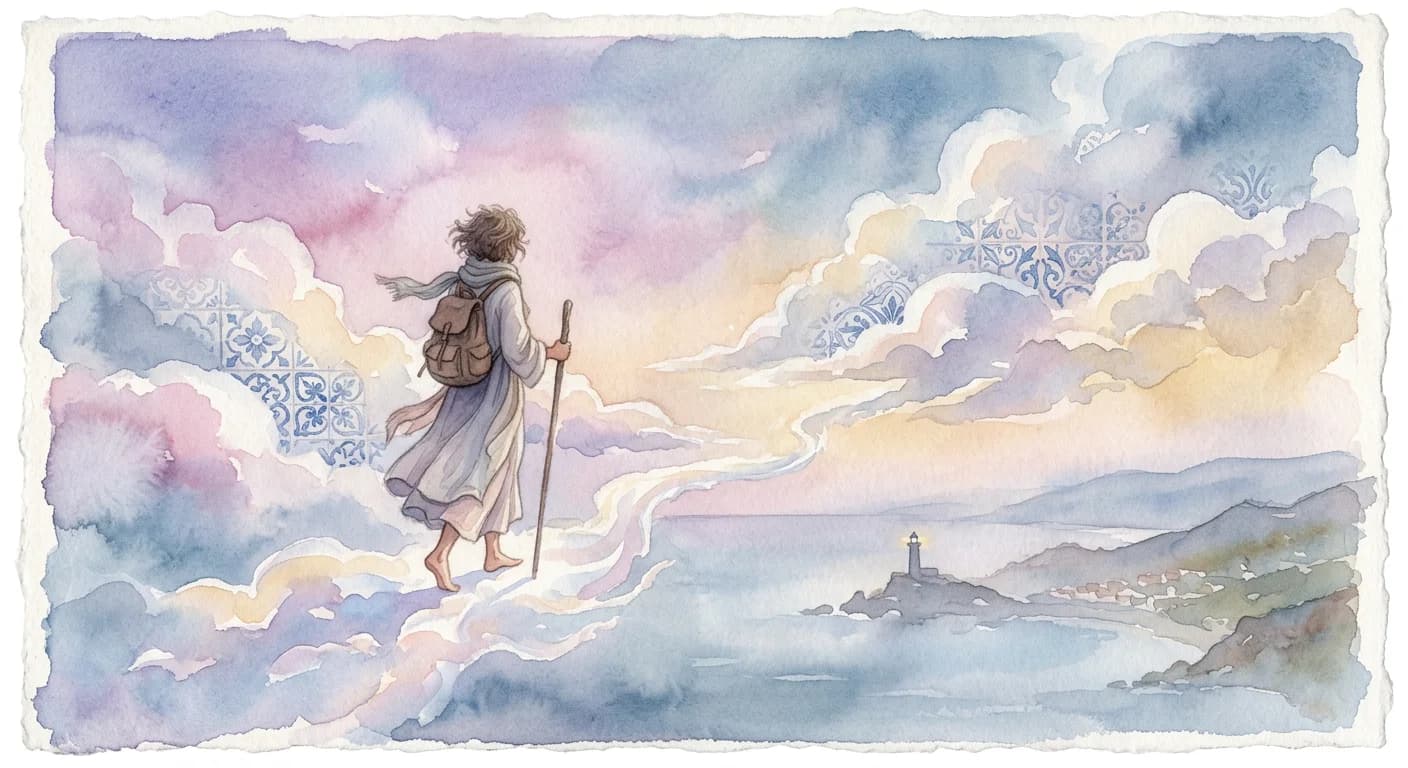
Nefelibata
/neh-feh-lee-BAH-tah/
Meaning
Nefelibata describes an individual whose mind perpetually floats above the prosaic concerns of daily life, inhabiting a realm shaped by their inner world, dreams, and profound contemplation. It's not merely absentmindedness, but a deliberate or inherent detachment, a gentle eccentricity that sees them 'walking on clouds' while others tread the earth. This term beautifully encapsulates the romantic ideal of an artist, a poet, or an introspective soul, whose most profound engagement is often with their own rich imagination rather than external reality, finding beauty and meaning in their unique, self-constructed universe.
Literal Translation
Cloud-walker (from Greek 'nephele' meaning cloud and Portuguese 'bata' which can imply walking or acting)
The Story Behind the Word
The existence of 'nefelibata' in Portuguese culture, particularly prominent in Portugal, speaks to a historical appreciation for introspection, melancholy, and the poetic ideal. The Lusitanian soul often embraces 'saudade,' a deep, untranslatable longing, which complements the nefelibata's dreamy disposition. This word emerged from a culture that values profound thought and emotional depth, often expressed through literature and Fado music, where the internal landscape is as significant as the external. It reflects a society that, while practical, also makes space for the contemplative, the artistic, and those who find solace and purpose in their own mental worlds, rather than exclusively in material pursuits. It suggests a tolerance, even admiration, for individuals who march to the beat of their own drum, provided their detachment isn't detrimental but rather a source of unique perspective or creative output.
Experience It
The Artist's Retreat
Mariana, the painter, spent hours gazing out her window, not at the bustling street below, but at the shifting patterns of light on the distant hills. Her friends often called her a nefelibata, as she'd frequently miss social cues, lost in the intricate worlds forming on her canvas long before they ever took physical shape. Her art, however, was breathtaking precisely because it channeled these ethereal visions.
The Absent-Minded Professor
Professor Silva, known for his brilliant theories, once famously wore two different shoes to a lecture. His students affectionately considered him a nefelibata; his mind was always so deeply immersed in complex philosophical concepts that the trivialities of dressing or remembering appointments often slipped his notice. Yet, his lectures were profoundly inspiring, connecting abstract ideas with poetic eloquence.
What Gets Lost in Translation
English speakers might confuse 'nefelibata' with simple absentmindedness or being out of touch. However, it's more profound than that; it implies a deliberate or inherent choice to reside in an inner world, often with rich imaginative or intellectual activity, rather than a mere lack of attention. It doesn't necessarily carry a negative connotation of impracticality, but rather a romanticized view of deep introspection and creative existence.
Across Cultures
While not a direct translation, concepts like the German 'Weltfremd' (world-alienated) or the Japanese 'Ukiyo' (floating world, though more about transient pleasure) touch on aspects of detachment. English might use 'dreamer' or 'head in the clouds,' but these lack the poetic depth and specific nuance of a 'cloud-walker' who actively inhabits their own mental space rather than merely being distracted.
The Deeper Meaning
'Nefelibata' reveals a worldview that values internal reality as much, if not more, than external reality. It suggests that true wisdom or creativity might emerge from a detachment from the mundane, allowing for a unique perspective on existence. This word champions the individual's subjective experience, implying that living in one's own world is not an escape, but a legitimate, even profound, way of being and perceiving truth.
Did You Know?
The term 'nefelibata' gained particular prominence in Brazilian Modernism, where it was embraced by poets and artists to describe themselves and their artistic peers, celebrating their detachment from conventional reality as a source of creative power.
How It's Used
Used to describe dreamers, idealists, or people who seem to be detached from reality and live in their own world.