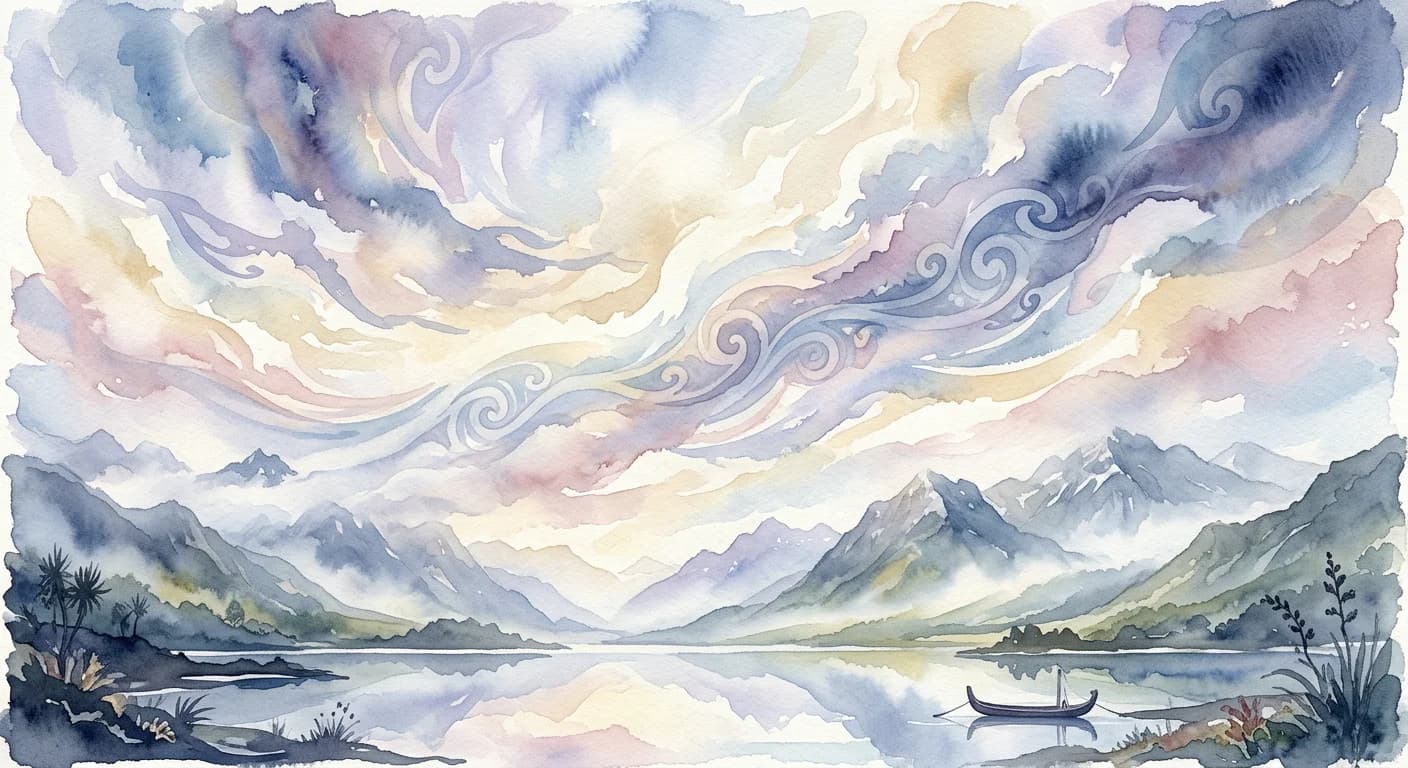
Rangi
/RAH-ngee/
Meaning
Rangi is far more than just the 'sky'; it embodies the vast, celestial expanse and is inextricably linked to Ranginui, the Sky Father, a primal deity in Māori cosmology. It represents the upper realm, the source of light, life, and the divine breath that permeates all existence. This word evokes a profound spiritual connection to the cosmos, serving as a constant reminder of the ancestral origins and the sacred relationship between the heavens and the earthly realm, Te Ao Mārama (the world of light).
Literal Translation
Sky
The Story Behind the Word
The concept of Rangi is foundational to Māori worldview, originating from the creation myth of Ranginui (Sky Father) and Papatūānuku (Earth Mother). Their primordial embrace enveloped the world in darkness, and their children, the atua (gods), yearned for light and space. The most powerful of their children, Tāne Mahuta, eventually separated Rangi and Papa, allowing light to enter the world and life to flourish. This act of separation is not one of violence but a necessary, sacred division that brought forth the universe as Māori know it. Rangi thus symbolizes the origin point, the male principle, and the vast, unknowable divine. It exists in karakia (prayers), waiata (songs), and pepeha (tribal sayings), anchoring Māori identity to their cosmic lineage and reminding them of their place within a sacred, interconnected universe. The constant presence of Rangi overhead reinforces the enduring connection to ancestors and the spiritual realm.
Experience It
A Dawn Karakia
As the first light touches the eastern horizon, an elder stands on the marae, gazing up. He begins a karakia, his voice resonating: 'E Rangi e tū nei, tēnā koe...' (O Sky standing above, greetings to you...). He acknowledges the Sky Father, asking for blessings for the new day and for the people gathered below.
Navigating by Stars
A waka hourua (double-hulled canoe) sails across the vast Pacific, guided by the stars. The navigator looks up, not just seeing pinpricks of light, but reading the ancient stories woven into Rangi's tapestry. He feels the presence of his ancestors, understanding the celestial path as a direct connection to the divine expanse above.
The Deeper Meaning
Rangi encapsulates a worldview where the physical and spiritual realms are not distinct but deeply intertwined. It reveals a philosophy of interconnectedness, where humanity is born from the gods and the natural world is imbued with sacred essence. The act of looking up at Rangi is an act of acknowledging ancestry, divinity, and the source of all life, fostering a profound sense of belonging and reverence for the cosmic order.
Did You Know?
The separation of Rangi and Papa is often described as Tāne Mahuta pushing Ranginui upwards with his strong legs, creating the space for humanity to thrive.
How It's Used
Used in traditional Māori storytelling, place names, and as a personal name. It is also part of the concept of Ranginui (Sky Father) and Tāne Mahuta (God of forests and birds), who separated them.