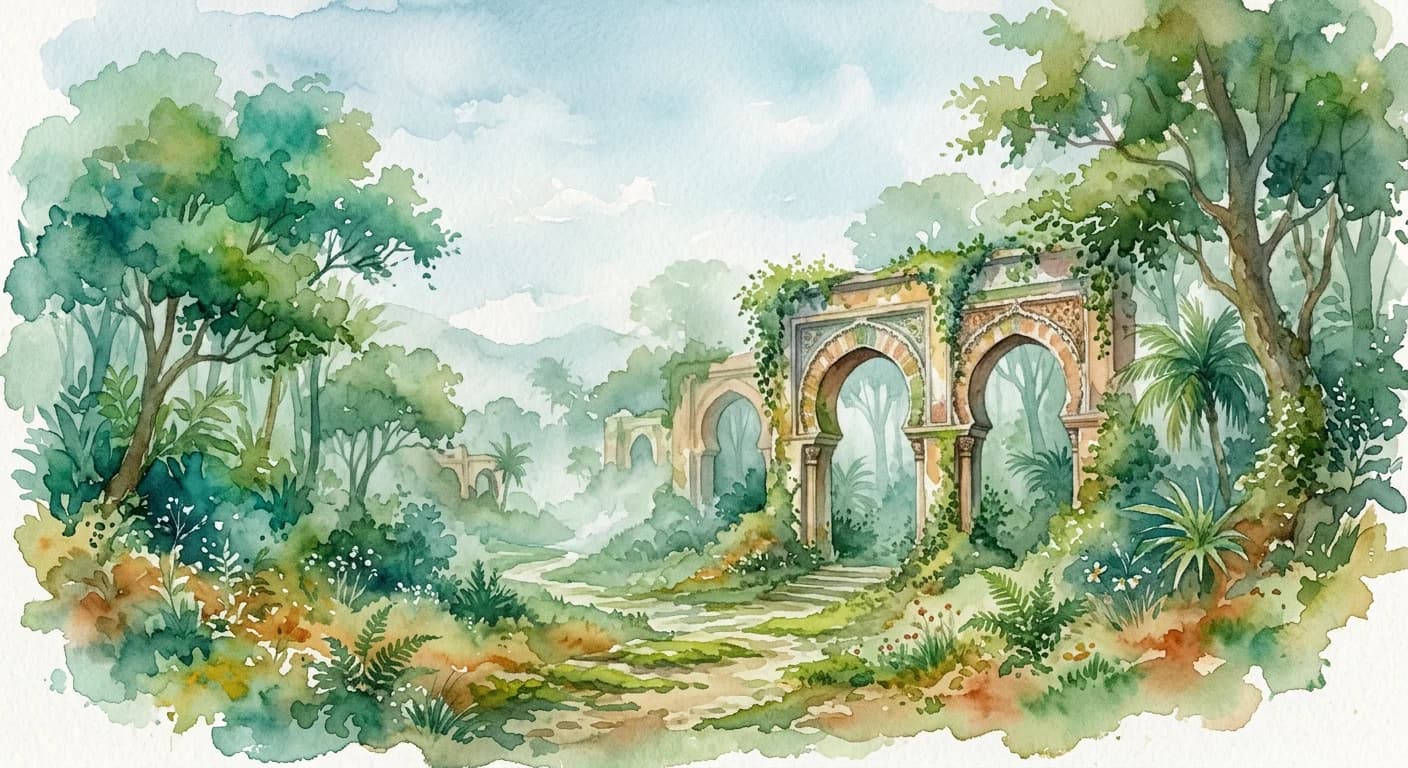
Selva
/SEL-vah/
Meaning
The term 'selva' transcends a mere description of a jungle or rainforest; it evokes a primal, formidable wilderness, vast and teeming with an almost overwhelming force of life. It conjures images of impenetrable density, a symphony of exotic sounds, and an inherent mystery that hints at both awe-inspiring beauty and lurking danger. This word encapsulates a powerful, untamed natural realm that exists beyond human dominion or easy comprehension, representing nature in its most raw and magnificent form.
Literal Translation
Jungle, rainforest, forest
The Story Behind the Word
In Spanish culture, 'selva' carries a deep historical and literary weight, often associated with the 'New World' and the awe, fear, and fascination it inspired in European explorers. It became a symbol of the unknown, the exotic, and the limits of human control. While Spain itself doesn't possess vast rainforests, the concept was central to the colonial experience and the rich literature that emerged from it. It reflects a worldview where nature, in its most extreme forms, is perceived as a powerful, almost sentient entity, capable of both sustaining and consuming, contrasting sharply with the more ordered, cultivated landscapes of much of Europe. This cultural resonance means 'selva' is not just a geographic term, but a descriptor for a profound encounter with wildness.
Experience It
Lost in the Selva
The explorer gazed out at the endless green canopy, the 'selva' stretching to the horizon, an intimidating labyrinth of life. Every rustle and distant cry seemed to warn him of its immense power, reminding him how small he truly was within its embrace.
Urban Selva
The city's financial district at rush hour was a true 'selva' of concrete and ambition. People pushed and vied for space, each navigating their own path through the chaotic, teeming environment, a concrete jungle where only the fittest seemed to thrive.
The Deeper Meaning
The word 'selva' reveals a profound respect, perhaps even a primal fear, for nature's unbridled power. It underscores a worldview where humanity is not necessarily at the apex of control, but rather exists within, and is often humbled by, the immense, chaotic, and self-sustaining forces of the natural world. It speaks to an understanding of ecosystems as complex, interconnected entities that operate on their own terms, independent of human will.
Did You Know?
While 'selva' implies a dense, tropical forest, its Latin root 'silva' simply meant 'forest' or 'woodland,' evolving to specifically denote the more wild and untamed regions in Spanish.
How It's Used
Used to describe rainforests, dense forests, or jungle environments. Can also be used metaphorically to describe a chaotic or overwhelming situation.