Drishti
/DRISH-tee/
Meaning
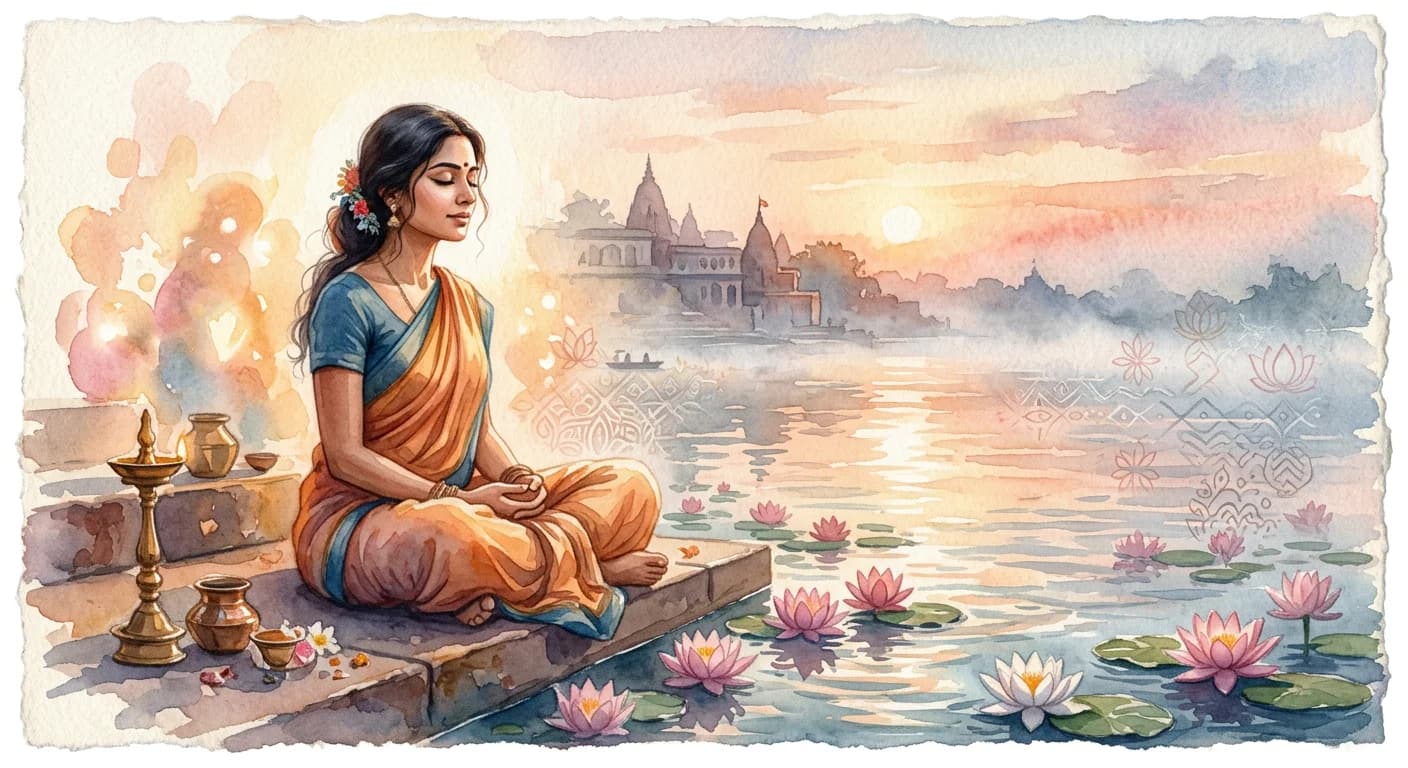
Drishti is far more than mere physical sight; it embodies the profound act of seeing with intention, insight, and spiritual awareness. It encompasses the quality of one's gaze, the knowledge gleaned through observation, and the transformative power embedded within perception. This multifaceted concept is deeply woven into Indian philosophy, where the intentionality of 'seeing' can bless, influence, or even inadvertently harm, revealing a universe interconnected through visual energy and understanding. It's about how one truly 'looks' at the world and the impact of that gaze.
Literal Translation
Sight, vision, look, gaze
The Story Behind the Word
The concept of Drishti is foundational to Indian thought, deeply embedded in spiritual practices, philosophical discourse, and daily life. Its origins trace back to ancient Vedic texts, where the act of seeing was often imbued with divine power and cosmic significance. In yoga, specific 'drishtis' (gazing points) are vital for focusing the mind and deepening meditative states, transforming physical posture into spiritual practice. Philosophically, a 'drishti' can represent a particular school of thought or a unique perspective on reality. Furthermore, the pervasive belief in the 'evil eye' (nazar or buri नजर) in India is a direct manifestation of the power attributed to Drishti, where an envious or malevolent gaze can cause harm, necessitating protective rituals and amulets. This reveals a culture that perceives the visual act not as passive reception, but as an active, potent force capable of shaping reality and conveying profound spiritual or energetic influence.
Experience It
Yogic Gaze
During her Ashtanga practice, Maya held her 'drishti' on her fingertips in Triangle Pose. This focused gaze wasn't just about balance; it helped quiet her mind, drawing her awareness inward and deepening her connection to the present moment, transforming the physical posture into a moving meditation.
Blessing through Sight
At the temple, the priest offered a 'drishti' to the devotee, a direct, benevolent gaze imbued with blessings after the puja. The devotee felt a profound sense of peace and spiritual upliftment, believing the divine energy had been transmitted and received through this sacred visual connection.
What Gets Lost in Translation
English speakers often reduce 'drishti' to simply 'gaze' or 'focus,' missing its profound spiritual and energetic implications. It's not just visual direction, but the channeling of intention, energy, and even power through the eyes. The idea that a gaze can carry blessings or curses, or that a yogic 'drishti' transforms consciousness, is often lost in translation, making it seem like a purely physical act rather than a holistic one.
Across Cultures
While direct equivalents are rare, many cultures recognize the power of the eye. The 'evil eye' (mal de ojo in Spanish, ayin hara in Hebrew, nazar in Arabic/Persian) is a widespread belief across the Mediterranean, Middle East, and parts of Asia, sharing the concept of a gaze carrying negative energy. Similarly, focused attention in meditation practices across various traditions involves a directed internal or external 'gaze' to achieve altered states of consciousness, echoing the yogic 'drishti'.
The Deeper Meaning
Drishti reveals a worldview where perception is not merely a sensory input but a dynamic, transformative force. It underscores the belief that reality is not passively observed but actively shaped by our intention, focus, and spiritual awareness. This concept suggests that true 'seeing' involves a holistic engagement of mind, body, and spirit, implying that the quality of our inner state directly influences how we perceive and interact with the world, and vice versa.
Did You Know?
In traditional Indian classical dance forms like Bharatanatyam, there are nine specific 'drishti bhedas' (types of gaze) that are meticulously taught and practiced, each conveying a distinct emotion, character, or narrative element without a single word being spoken.
How It's Used
Used to refer to the act of seeing, the gaze, a particular perspective in philosophy or spirituality, and in rituals like the 'evil eye' protection.