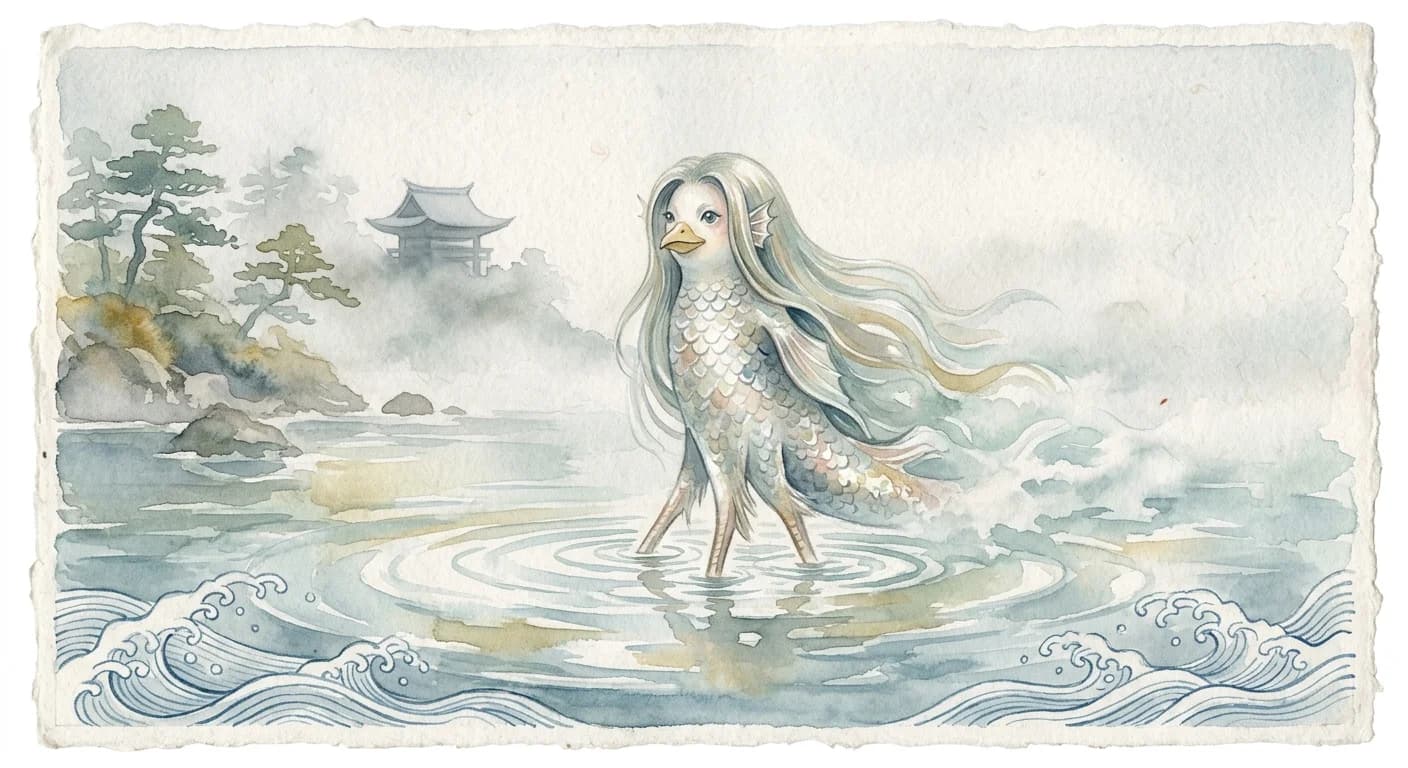
Amabie
/AH-mah-beh-eh/
Meaning
Amabie is a captivating Japanese yokai, a mythical aquatic creature often imagined as a mermaid with flowing hair and three distinct legs. Emerging from the depths during the Edo period, it possesses the uncanny ability to foretell either a bountiful harvest or a devastating epidemic. Legend dictates that by drawing and sharing its image, one can invoke its protective essence, warding off illness and disease, thus becoming a potent symbol of hope and communal resilience against unseen threats. Its resurgence in modern times underscores a deep-seated cultural impulse to seek comfort and protection through traditional iconography amidst contemporary crises.
Literal Translation
Sea-nun
The Story Behind the Word
The concept of Amabie is deeply rooted in Japan's rich folklore tradition, where the natural world is often imbued with spiritual significance and populated by a diverse pantheon of yokai—supernatural beings. Its emergence during the Edo period, a time of frequent epidemics and natural disasters, highlights a cultural tendency to personify unknown threats and seek symbolic countermeasures. The act of drawing and sharing Amabie images reflects a communal coping mechanism, blending spiritual belief with practical action. This practice speaks to a worldview where the visible and invisible realms are interconnected, and where art, ritual, and collective intention can influence outcomes. Amabie embodies the Japanese cultural value of finding strength and solace in shared traditions, particularly during times of vulnerability, and represents a continuous dialogue between the past and present in navigating uncertainty.
Experience It
A Community's Plea
As news of a new virus spread through the village, Mrs. Tanaka, remembering tales from her grandmother, carefully drew an Amabie on a piece of paper. She then posted it on the community board, hoping her neighbors would follow suit, creating a collective shield of protection against the unseen threat.
Digital Talisman
During a global pandemic, a young student, isolated at home, created a vibrant digital illustration of Amabie. She shared it across her social media, watching as friends and strangers reposted it, each share a silent prayer for health, transforming the ancient yokai into a contemporary symbol of solidarity.
The Deeper Meaning
Amabie reveals a profound philosophical insight into the human need for agency and comfort in the face of uncontrollable forces like disease. It underscores the power of collective belief and symbolic action to create a sense of control and hope when rational solutions are scarce or slow. This yokai embodies the idea that shared cultural narratives and visual representations can serve as powerful psychological and social anchors, fostering resilience and communal solidarity in times of crisis.
Did You Know?
Despite its ancient roots, Amabie experienced a massive resurgence in popularity during the COVID-19 pandemic, becoming a beloved mascot for public health campaigns and a viral sensation on social media.
How It's Used
The image of Amabie is drawn and shared as a protective talisman, particularly during outbreaks of infectious diseases. It is often depicted in drawings, woodblock prints, and digital art, and people share these images online to express a collective wish for health and safety.