U.
HomeRegionsLanguagesEmotionsCollections
Find Your Word

“The limits of my language mean the limits of my world.”

— Ludwig Wittgenstein, Philosopher

Untranslatable

A curated collection of the world's most beautiful expressions—words that remind us language is humanity's greatest invention.

  • Home
  • Collections
  • Regions
  • Countries
  • Emotions
  • Tags
  • Contexts
  • Finder
  • Europe
  • Asia
  • Americas
  • Africa
  • Middle East
  • About
  • Contact
  • Privacy Policy
  • Terms of Service

2026 © Untranslatable. All rights reserved.

    /
    /
    1. Home
    2. /
    3. Americas
    4. /
    5. Ayahuasca
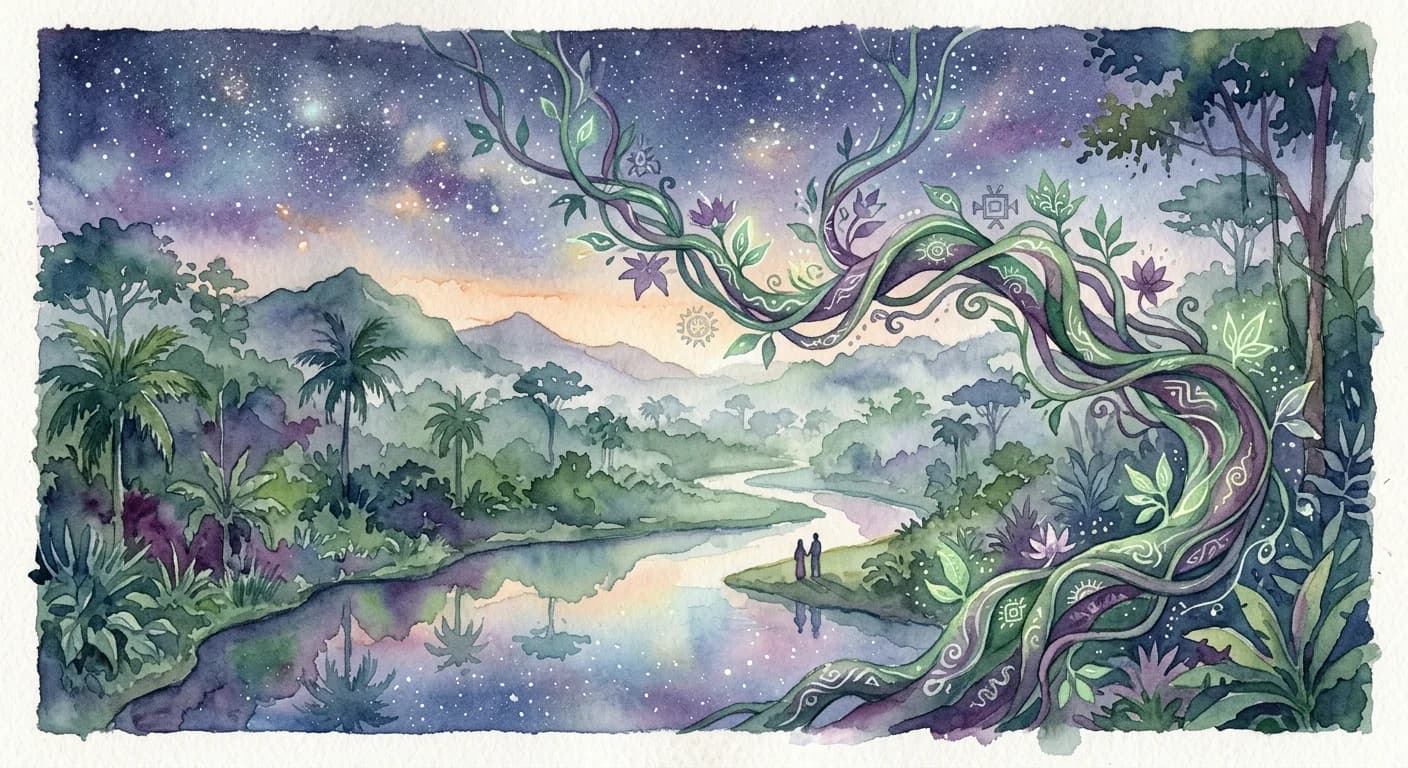
    Artistic representation of Ayahuasca
    Quechua•
    🇧🇷Brazil🇨🇴Colombia🇪🇨Ecuador🇵🇪Peru

    Ayahuasca

    /ah-yah-WAHS-kah/

    Meaning

    Ayahuasca, literally the "vine of the soul" or "vine of the dead" in Quechua, is a sacred, psychoactive plant medicine from the Amazon basin, revered by indigenous cultures as a conduit to profound spiritual realms. It is far more than a mere hallucinogen; it's a ceremonial tool for deep self-discovery, emotional catharsis, and healing, often facilitating vivid, introspective journeys that reveal hidden truths about oneself and the interconnectedness of existence. Participants seek guidance, clarity, and spiritual connection under the careful watch of experienced shamans, moving beyond the physical into the mystical.

    Literal Translation

    Vine of the soul / Vine of the dead

    The Story Behind the Word

    Ayahuasca is central to the cosmovision of numerous Amazonian indigenous groups, embodying their deep reverence for nature and the spiritual world. Its existence reflects a worldview where the boundaries between the physical and spiritual are permeable, and plants are seen as sentient teachers and healers. For centuries, it has been used not only for physical and psychological healing but also for divination, problem-solving, and maintaining social harmony. The plant's ability to induce visionary states is interpreted as a direct communication with ancestral spirits, plant spirits, and the very fabric of the universe, offering profound insights into life's mysteries and guiding individuals and communities in their spiritual and earthly paths.

    Experience It

    Seeking Ancestral Wisdom

    Deep in the Amazon, Maria joins a night-long Ayahuasca ceremony. As the brew takes effect, she sees visions of her ancestors, receiving guidance on a difficult family matter that has troubled her for years. She emerges with a profound sense of peace and clarity, understanding her place within her lineage.

    Healing Emotional Wounds

    After years of unresolved grief, David participates in an Ayahuasca ritual. During his journey, he confronts suppressed emotions, experiencing a powerful release and a renewed capacity for joy. The experience allows him to process his past traumas and begin a path toward emotional liberation.

    The Deeper Meaning

    Ayahuasca embodies a philosophy of holistic interconnectedness, suggesting that true healing and understanding come from recognizing the deep links between mind, body, spirit, and the natural world. It challenges Western dualistic thinking, proposing that profound truths are accessible through altered states of consciousness and direct communion with nature, revealing an animistic universe where all elements possess spirit and wisdom.

    Did You Know?

    The potent psychoactive effects of Ayahuasca come from a unique combination of two plants: one containing DMT (a powerful hallucinogen) and another containing MAOIs, which prevent the body from breaking down DMT, allowing it to become orally active.

    How It's Used

    Ayahuasca is used in ceremonial contexts, often guided by experienced shamans, for healing, divination, and spiritual exploration. It is consumed during rituals that can last for several hours, typically in a shamanic setting within the Amazon rainforest.

    Emotions
    gratitude,hope,peace,wonder
    Contexts
    celebration,nature,relaxation
    🇧🇷Brazil🇨🇴Colombia🇪🇨Ecuador🇵🇪Peru

    by Anya Petrova·Written Mar 14, 2026·Updated Apr 3, 2026

    Related Words

    Explore more
    Dolce far nienteItalian

    Dolce far niente captures the profound joy and effortless pleasure derived from simply existing without obligation or purpose. It's the art of savoring moments of pure, unadulterated idleness – lying in the sun, watching the clouds drift, or enjoying a leisurely coffee – not as a break from work, but as a valuable state in itself. This 'sweetness of doing nothing' is a conscious embrace of stillness and contentment, allowing the soul to breathe and the senses to fully engage with the present.

    Pura vidaSpanish

    More than just 'pure life,' "Pura vida" encapsulates a profound philosophy of embracing the present moment with unwavering optimism and gratitude. It's a daily commitment to finding joy in simple pleasures, accepting life's challenges with a positive spirit, and prioritizing well-being over material possessions. This ubiquitous phrase reflects a national identity built on resilience, community, and an deep appreciation for nature's bounty.

    MamihlapinatapaiYaghan

    Mamihlapinatapai encapsulates that profound, unspoken moment when two individuals lock eyes, each silently acknowledging a mutual desire or intention, yet both hesitate to be the first to act upon it. It's a delicate dance of anticipation, a shared gaze brimming with common understanding and a quiet longing for the other to break the ice. This intricate look carries the weight of a shared, uninitiated potential, a silent conversation where both parties are perfectly aware of what could happen, but neither makes the first move.

    TingoPascuense

    Tingo describes the subtle, insidious process of progressively appropriating a neighbor's belongings by habitually requesting to borrow them, only to 'forget' their return. It's not outright theft, but a slow, deliberate erosion of another's possessions, often under the guise of neighborly exchange. This gradual accumulation, piece by piece, ultimately results in a significant transfer of goods without any direct confrontation or formal acknowledgment of the loss. It speaks to a passive-aggressive form of acquisition, where social niceties are weaponized.