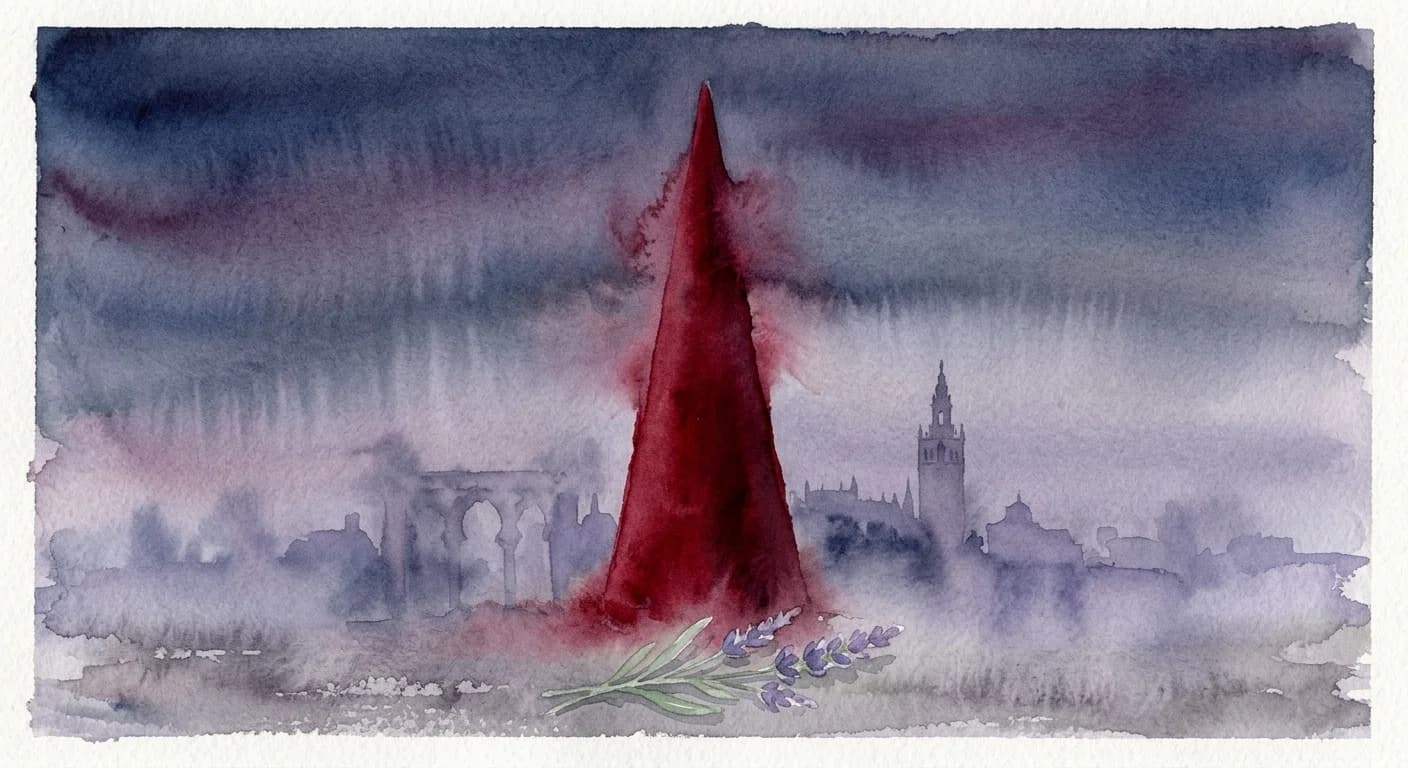
Capirote
/kah-pee-ROH-tay/
Meaning
The 'capirote' is far more than a simple conical hat; it is a profound symbol of penance and anonymity worn by Nazarenos during Spain's solemn Holy Week processions. Towering skyward, it obscures the wearer's face, stripping away individual identity to emphasize humility and collective devotion. This iconic headwear forces an inward journey of spiritual reflection, directing the penitent's focus heavenward while embodying the somber, sacred atmosphere of these deeply rooted religious displays.
Literal Translation
Conical hat
The Story Behind the Word
The capirote's origins trace back to medieval times, evolving from the 'coroza' or 'sambenito' – a conical hat worn by those condemned by the Inquisition as a mark of public shame. However, it was later adopted by penitential confraternities (hermandades) in the 17th century, transforming its meaning from infamy to humility and spiritual devotion. In Spain, particularly Andalusia, the capirote is inextricably linked to Semana Santa, one of the most significant cultural and religious events. Its presence reveals a culture that embraces public displays of faith, where personal sacrifice and anonymity are esteemed virtues, and where history, art, and deeply held religious beliefs converge in a powerful, emotionally charged spectacle. It signifies a collective journey of repentance and a connection to centuries of tradition.
Experience It
A Child's First Capirote
Little Mateo, barely tall enough to see over the shoulders of the adults, clutched his brand-new capirote. His father carefully placed it on his head, adjusting the cloth to cover his face, initiating him into the centuries-old tradition of the brotherhood.
Solemn Procession
Under the dim streetlights, a line of Nazarenos moved with agonizing slowness, their capirotes swaying gently. The anonymity granted by the tall hoods allowed each penitent to fully immerse themselves in silent prayer and reflection, undistracted by the gazing crowds.
The Deeper Meaning
The capirote embodies a profound philosophy of self-abnegation and the transcendence of individual ego in pursuit of collective spiritual devotion. By concealing the identity, it underscores the belief that true faith and repentance are internal, not external, and that personal humility before the divine is paramount. It reflects a worldview where tradition, sacrifice, and shared spiritual journey are central to communal identity.
Did You Know?
Historically, the height of the capirote could sometimes indicate the severity of the penance or the status within certain brotherhoods, with taller cones signifying deeper commitment or particular roles.
How It's Used
Used to describe the pointed hood worn during religious processions, especially during Semana Santa (Holy Week) in Spain.