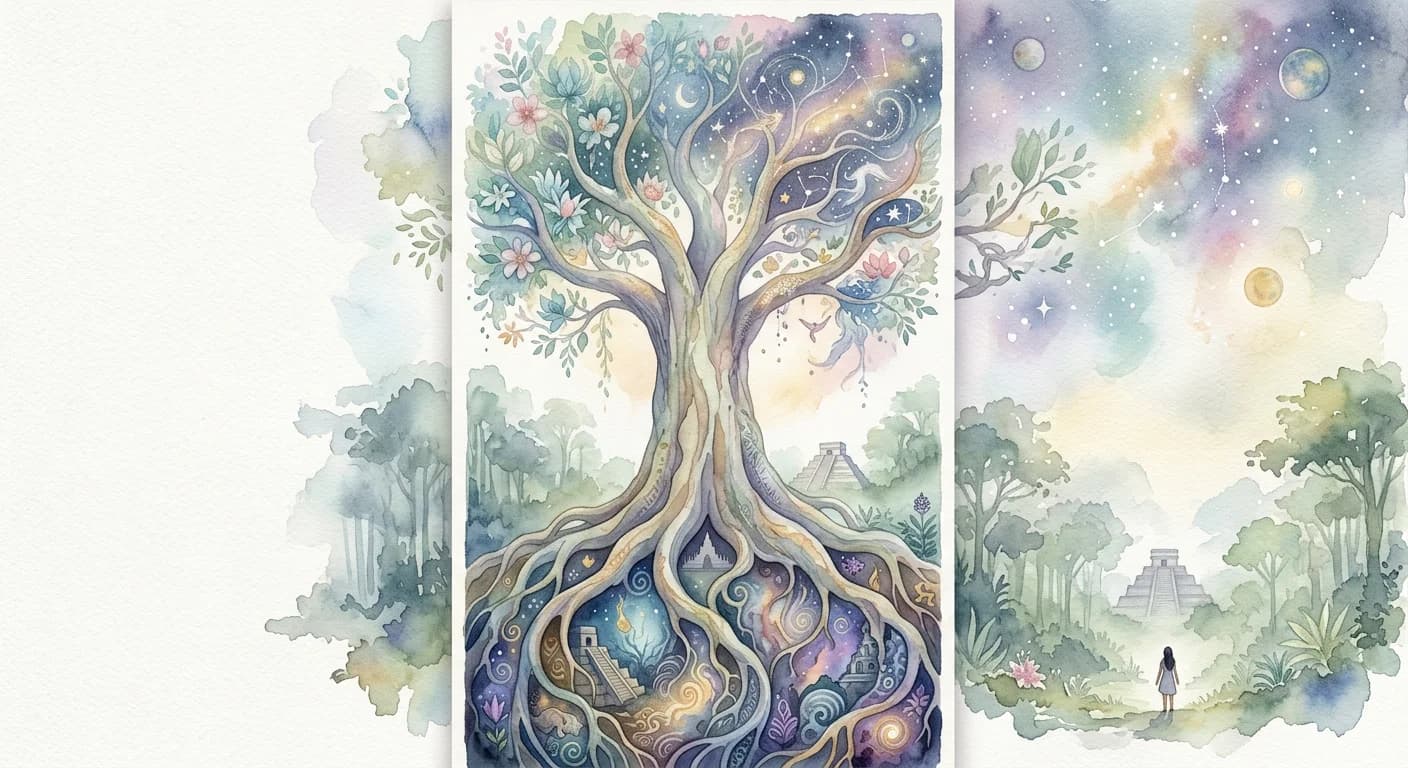
Ceiba
/SAY-bah/
Meaning
The Ceiba, known as the 'tree of life' in Yucatec Maya cosmology, is the cosmic axis that profoundly connects the three realms of existence: the underworld, the earthly plane, and the celestial heavens. Its colossal stature, with roots plunging deep into the earth and branches soaring skyward, embodies strength, stability, and the fundamental interconnectedness of all life. For the Maya, it is a sacred, living monument, a conduit of spiritual power, ancient wisdom, and the eternal cycle of creation, death, and rebirth, signifying a profound spiritual and natural bond within every community.
Literal Translation
tree of life
The Story Behind the Word
The Ceiba's profound significance stems from its central role in ancient Maya cosmology, where it literally forms the backbone of the universe. Its placement at the center of the world reflects a worldview where the cosmos is ordered and interconnected, with the tree serving as the conduit for communication between deities, ancestors, and the living. This belief system emphasizes cycles—of life and death, planting and harvesting, creation and destruction—all mirrored in the Ceiba's perennial life. Its widespread presence across Mesoamerica, often found in the central plazas of Maya towns, underscores its importance not just as a religious symbol, but as a community anchor and a physical manifestation of their spiritual geography. The Ceiba reveals a culture deeply attuned to nature, seeing divine order and spiritual power embedded within the natural world, rather than separate from it.
Experience It
Village Center Gathering
Under the vast canopy of the ancient Ceiba in the village plaza, elders gathered to discuss community matters. Its immense trunk, scarred with generations of time, offered a silent, grounding presence as decisions were made, reflecting the wisdom and stability it represented to the Maya people.
Sacred Offering
A young Maya woman approached a towering Ceiba at the edge of the forest, carrying a small offering of copal incense and corn tortillas. She placed them respectfully at its base, murmuring prayers for a bountiful harvest, believing the tree would carry her petitions to the heavens through its mighty branches.
The Deeper Meaning
The Ceiba embodies a profound Maya philosophical insight: that life is not linear but cyclical, and all existence is fundamentally interconnected. It reveals a worldview where the physical and spiritual realms are inseparable, and humanity is an integral part of a vast, living cosmos. This perspective fosters a deep respect for nature, viewing trees like the Ceiba not merely as resources, but as sacred beings and vital conduits of cosmic energy and ancestral wisdom.
Did You Know?
Did you know that the Ceiba tree's smooth bark is often covered in large, conical thorns when young? These thorns are thought to protect the young tree, which later sheds them as it grows into its majestic, sacred form.
How It's Used
The word 'Ceiba' is used to refer to the Ceiba tree (also known as the Kapok tree or Silk Cotton tree) and is deeply embedded in the cultural and spiritual landscape of Maya civilization and other Mesoamerican cultures. It is used in both everyday language when referring to the tree and in a profound, symbolic context within mythology, religion, and art.