Angelus
/AN-juh-luss/
Meaning
The "Angelus" is a profound Catholic devotion that marks three sacred moments each day – morning, noon, and evening – by the resonant peal of church bells. It calls the faithful to pause, wherever they are, and reflect on the Incarnation of Jesus Christ, the pivotal moment of God becoming human. This practice weaves a thread of spiritual discipline and communal reflection into the fabric of daily life, fostering a contemplative spirit and a continuous, conscious connection to divine mystery and the Virgin Mary's role in salvation.
Literal Translation
Angel
The Story Behind the Word
The Angelus emerged in medieval Europe, solidifying its form around the 16th century, though its roots trace back to earlier monastic prayer customs. In Italy, and indeed across Catholic Europe, the ringing of the Angelus bells wasn't merely a religious signal; it was an integral part of the temporal and social rhythm of life. It structured the day for farmers in the fields, merchants in the markets, and families in their homes, serving as an audible reminder of faith's omnipresence. This practice reveals a culture where the sacred and secular were deeply intertwined, where time itself was punctuated by divine remembrance, and where the community was bound by shared spiritual markers. It underscored a worldview where human existence was seen through the lens of divine intervention and grace, with Mary as a constant intercessor and guide.
Experience It
Village Bell Tolls
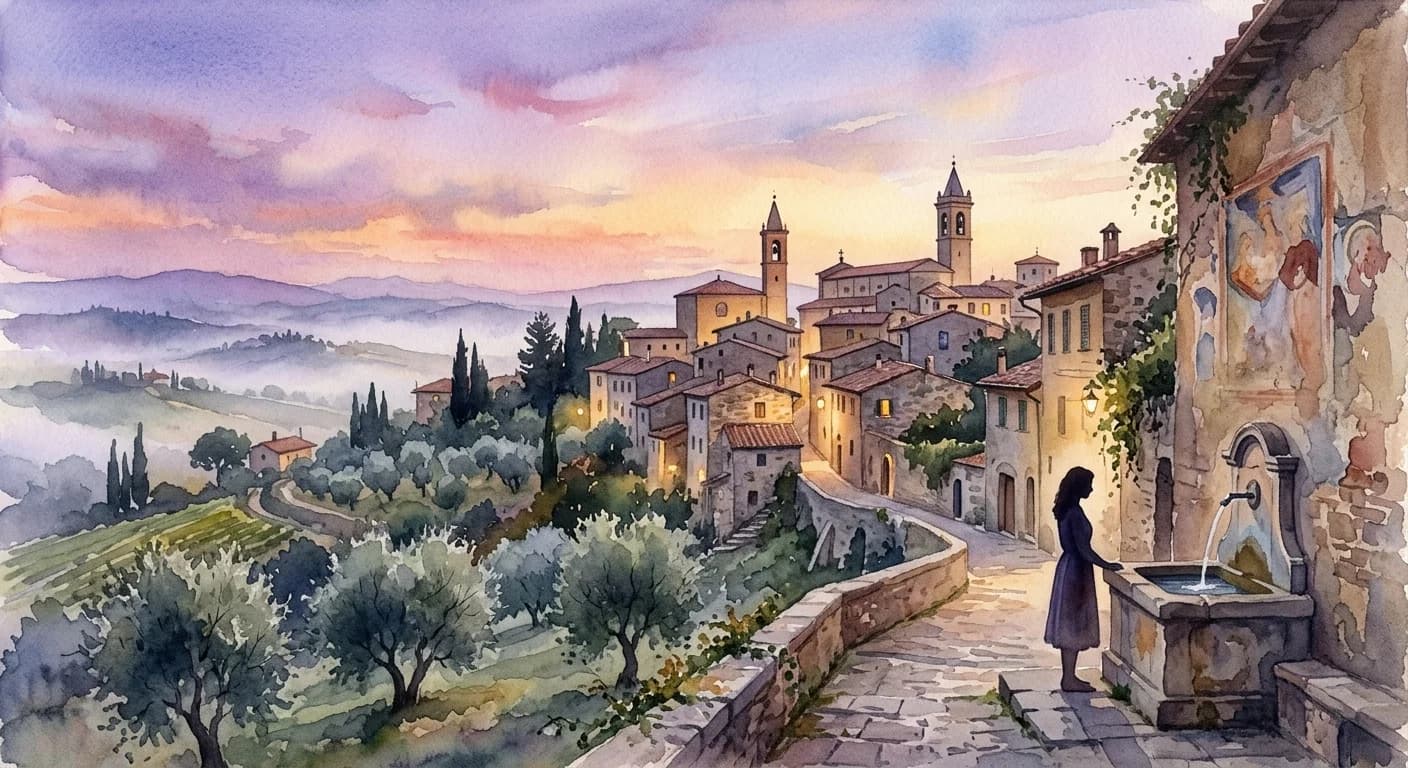
As the midday Angelus bells began to peal across the Tuscan valley, old Nonna Emilia paused her kneading, made the sign of the cross, and whispered the familiar prayers. Her grandson, playing in the piazza, instinctively stopped his game, momentarily bowing his head before resuming his joyful shouts.
City Commute Pause
On a bustling Roman street, a young student, headphones on, glanced up as the distant chime of an Angelus bell reached him. He paused his podcast, took a deep breath, and briefly closed his eyes, finding a moment of quiet reflection amidst the urban clamor.
The Deeper Meaning
The Angelus embodies a philosophy of sacralized time, suggesting that even the most mundane daily activities can be infused with spiritual significance. It posits that human life is not merely a linear progression of tasks but a series of opportunities for transcendent connection. By regularly interrupting the flow of secular time with sacred pauses, it encourages a continuous awareness of the divine, fostering humility, gratitude, and a recognition of a higher purpose in everyday existence.
Did You Know?
The Angelus inspired Jean-François Millet's famous 1857 painting, 'The Angelus,' depicting two peasants bowing in prayer in a field, which became an iconic representation of rural piety.
How It's Used
The term 'Angelus' is primarily used within the context of Catholic religious practice to refer to the specific devotion and the times of prayer associated with it.