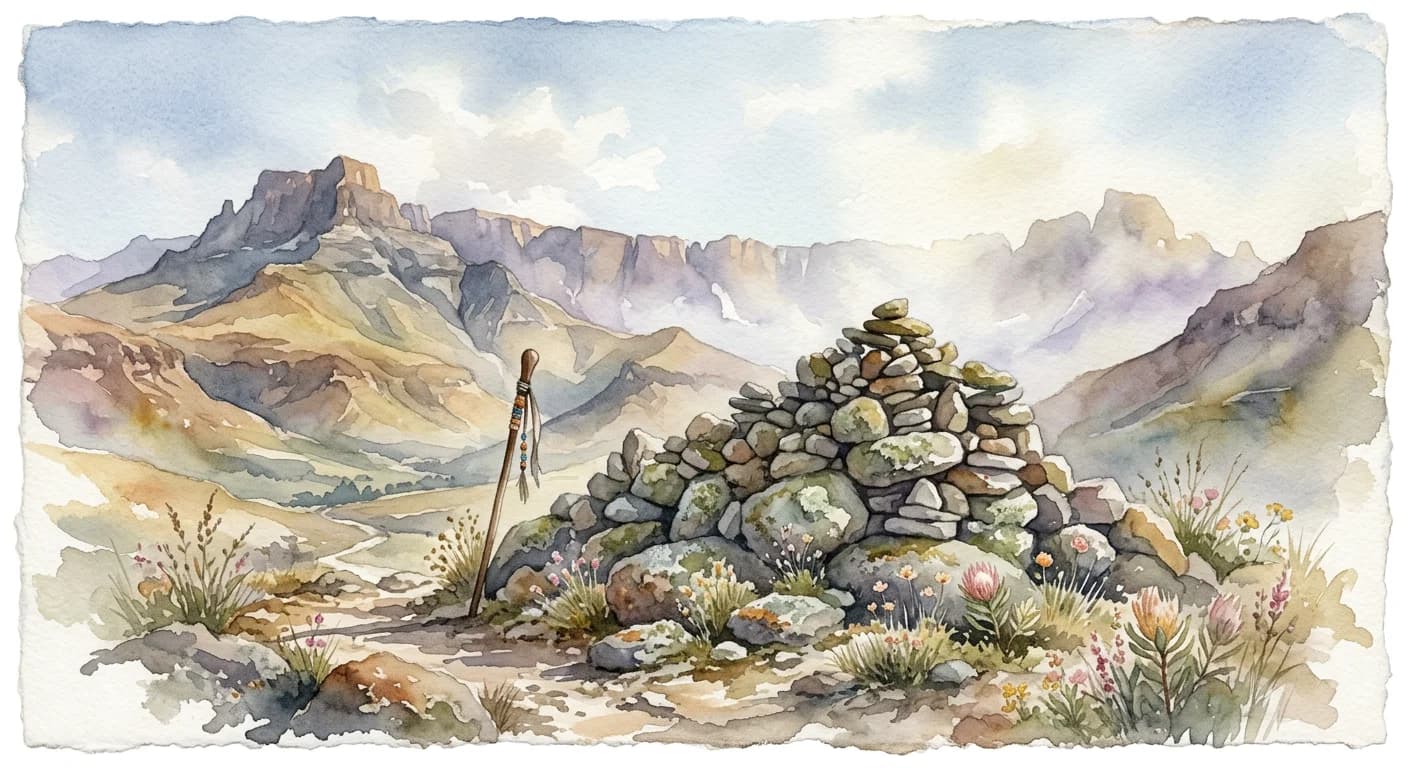
Isivivane
/ee-see-VEE-vah-neh/
Meaning
Isivivane refers to a venerable pile of stones, often found at mountain passes, river crossings, or other significant thresholds in the landscape. Each stone added by a traveler is a tangible repository for a prayer, a wish, or a memory, transforming the cairn into a collective, living archive of journeys and spiritual offerings. It symbolizes the unbroken chain of human experience, connecting the present wayfarer with the ancestral spirits and the countless footsteps that have traversed the land before. This practice imbues the landscape with a profound sense of continuity and shared humanity.
Literal Translation
Pile of stones / cairn
The Story Behind the Word
The practice of building an isivivane is deeply rooted in Zulu cosmology and an animistic worldview where the land is alive with spiritual energy and ancestral presence. It reflects a profound respect for the journey itself, acknowledging both the physical effort and the spiritual vulnerability of travel. For the Zulu, every journey is a passage, not just from one place to another, but often across spiritual thresholds. Placing a stone is an act of humility, seeking safe passage, giving thanks, or leaving a burden behind. It reinforces the communal bond, as each stone contributes to a monument built by generations, embodying the collective memory and shared experiences of a people connected to their land and their ancestors. It also reveals a belief in the ongoing interaction between the living and the spiritual realm, where tangible actions can have intangible, yet powerful, effects.
Experience It
Pilgrim's Offering
As Nandi approached the sacred mountain pass, a towering isivivane marked the path. With a deep breath, she carefully selected a smooth, grey stone, whispering her prayer for her ailing child before placing it gently on the ever-growing pile, feeling the weight of her hope join countless others.
Warrior's Return
Returning from a long and arduous journey, the young warrior paused at the familiar isivivane at the village's edge. He added a small, dark stone, a silent tribute to fallen comrades and a thank you for his safe return, acknowledging the spirits who watched over his passage.
The Deeper Meaning
Isivivane encapsulates a philosophy of interconnectedness and deep ecological awareness. It speaks to the understanding that individual lives are part of a larger continuum of human and spiritual journeys, indelibly linked to the land and to those who came before. It’s a physical manifestation of collective memory and shared spiritual responsibility, emphasizing humility, gratitude, and the enduring power of intention in shaping one's path through the world.
Did You Know?
Traditionally, spitting on the stone before adding it to the isivivane was a common practice, believed to further imbue the stone with one's personal essence and prayer.
How It's Used
Typically used when referring to a cairn or pile of stones built as a spiritual marker or offering along a path or at a significant location.