Kecak
/keh-CHAHK/
Meaning
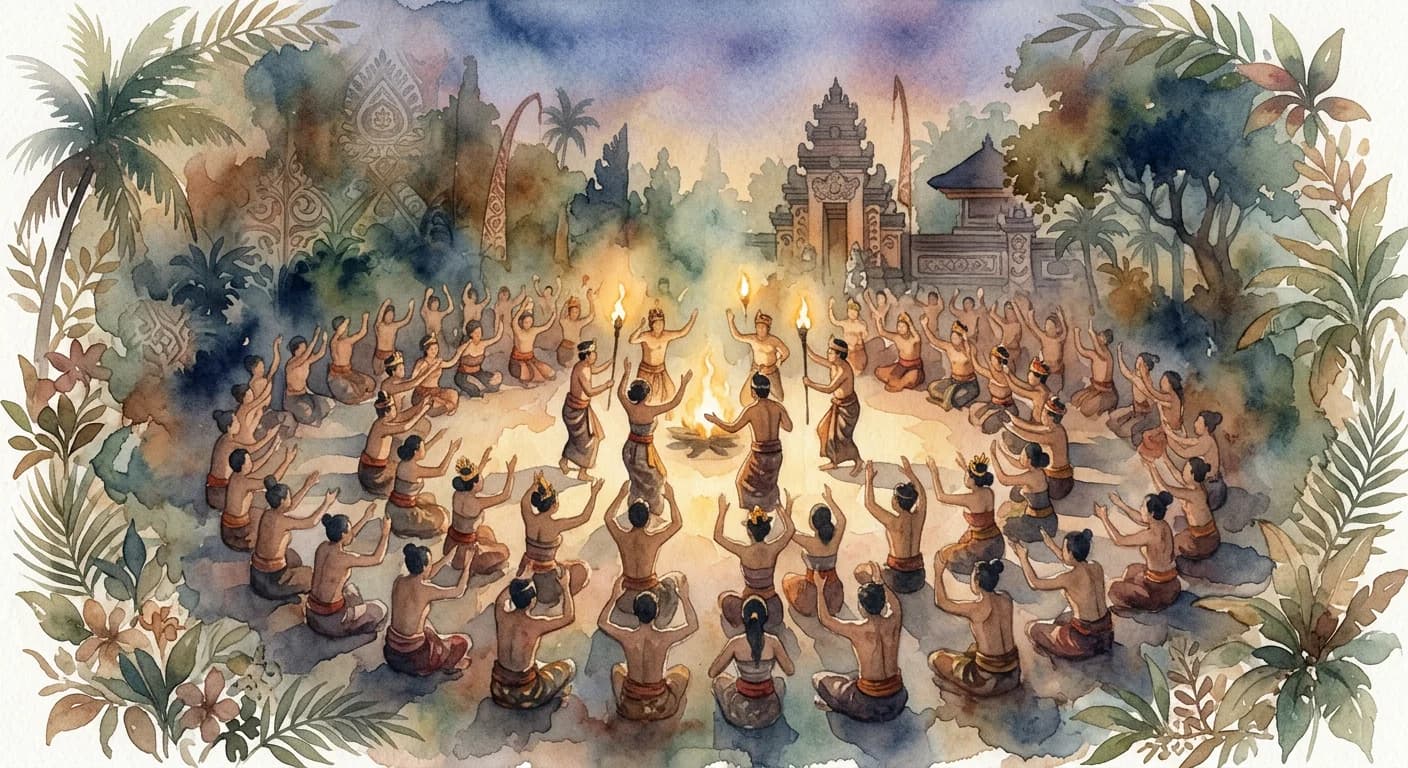
Kecak is not merely a word, but the thrumming heart of a captivating Balinese dance-drama, born from ancient Sanghyang trance rituals. Hundreds of bare-chested men, seated in concentric circles, become a living, breathing orchestra, their rhythmic, onomatopoeic chanting of "chak-achak-achak" forming an intoxicating, percussive soundscape. This powerful vocalization underpins dramatic storytelling, often depicting scenes from the Ramayana, creating an immersive, almost primal atmosphere that is deeply spiritual, communal, and visually stunning.
Literal Translation
The word 'Kecak' itself is an onomatopoeic representation of the rhythmic chanting sound made by the performers.
The Story Behind the Word
The existence of Kecak reveals Bali's profound connection to spiritualism, community, and the arts as intertwined forces. Originating from Sanghyang, a pre-Hindu trance ritual to ward off evil or heal, Kecak transformed in the 1930s to incorporate elements of the Ramayana epic, making it accessible while retaining its spiritual core. It embodies the Balinese concept of 'sekala' (the seen, tangible world) and 'niskala' (the unseen, spiritual world), where the performers, through their collective energy and trance-like chanting, bridge these realms. The sheer number of participants underscores the communal spirit ('gotong royong') vital to Balinese life, where individual identity merges into a powerful collective expression, aiming for harmony with the divine and within the community. It's a living testament to how ancient beliefs are adapted and preserved through dynamic artistic expression.
Experience It
Sunset Temple Performance
As the sun dipped below the horizon, painting the sky in fiery hues, the air at Uluwatu Temple grew thick with anticipation. Then, the rhythmic 'chak-achak-achak' began, a low hum that swelled into a powerful chorus as the Kecak dancers, their bodies gleaming, entered the arena, their collective voice becoming the very breath of the epic tale unfolding.
Village Ceremony Offering
In a village temple courtyard, a more intimate Kecak performance took place, not for tourists, but as an offering. The men, faces etched with reverence, chanted with a focused intensity, their unified voices a prayer, inviting the spirits to witness their devotion and bless their community, the rhythm a pulsating heartbeat of their faith.
The Deeper Meaning
Kecak embodies the Balinese worldview of 'Tri Hita Karana' – the three causes of well-being: harmony with God, harmony among people, and harmony with nature. The collective trance-like state and unified chanting foster human connection, while the spiritual origins and offerings connect them to the divine, all within the natural setting of Bali, illustrating a holistic philosophy of interconnectedness.
Did You Know?
Despite its ancient roots, the modern Kecak performance, featuring the Ramayana story, was largely developed in the 1930s by Balinese dancer Wayan Limbak and German painter Walter Spies, making it a relatively 'young' ancient tradition.
How It's Used
Kecak is used to refer to the Balinese dance and musical performance itself, often performed for tourists in Bali, but also as part of religious ceremonies and cultural events.