Kraal
/KRAHL/
Meaning
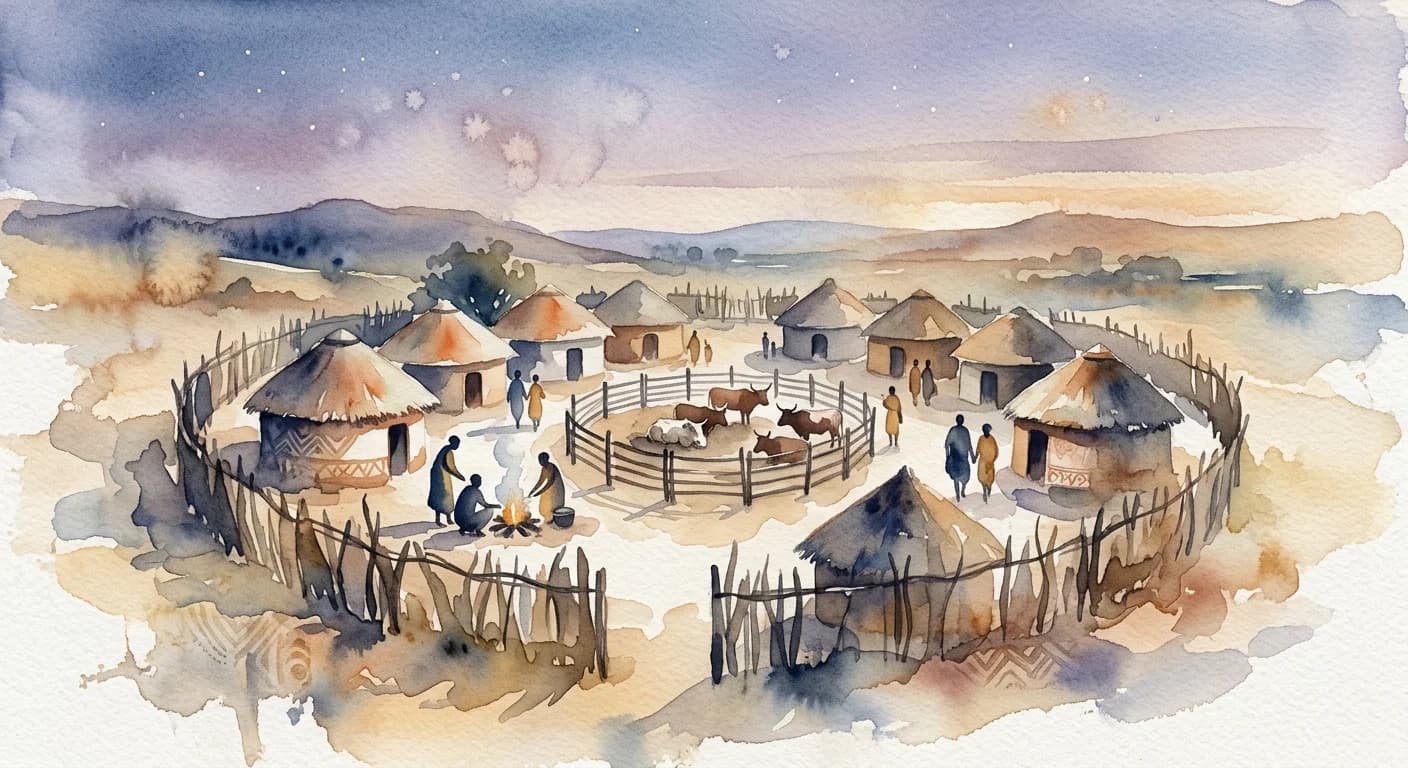
A kraal is far more than a mere enclosure; it's a vibrant, fortified heart of a traditional Southern African community. Typically circular and constructed from palisades or thorn bushes, it serves as a protective embrace for families, their livestock, and their heritage against the wild. This communal living space embodies safety, belonging, and a deep, ancestral connection to the land, reflecting ingenious adaptation and resilience in often challenging environments.
Literal Translation
Enclosure/stockade
The Story Behind the Word
The word 'kraal' encapsulates centuries of Southern African indigenous life and survival. Its existence reveals a worldview where community, protection, and sustainability are paramount. Historically, kraals were not just physical structures but social organisms, designed to foster collective responsibility and mutual aid. The circular form often symbolizes harmony and the cyclical nature of life, death, and regeneration, reflecting a deep respect for natural rhythms. It speaks to a past where security was paramount, and the well-being of livestock was intrinsically linked to the prosperity and survival of the human inhabitants. The kraal, therefore, is a testament to the ingenuity and communal spirit required to thrive in a demanding landscape.
Experience It
Evening at the Kraal
As the sun dipped below the horizon, Grandfather Sipho watched his cattle being herded into the protective embrace of the kraal. The familiar lowing and the scent of woodsmoke brought a deep sense of peace, knowing his family and their wealth were safe within its sturdy walls for the night.
Building a New Kraal
The young men of the village worked tirelessly, weaving thorn branches into the perimeter of their new kraal, preparing it for the upcoming season. Each intertwining branch was a promise of security and a continuation of their ancestors' way of life, a testament to their collective future.
The Deeper Meaning
The kraal embodies a philosophy of collective security and interdependence, where individual well-being is inextricably linked to the strength and safety of the community. It reflects a worldview that prioritizes harmony with nature, strategic resource management, and the cyclical rhythm of life, emphasizing that true prosperity stems from unity and protection of shared assets.
Did You Know?
The word 'kraal' likely originates from the Portuguese 'curral,' meaning 'corral' or 'pen,' later adopted into Afrikaans and other Southern African languages, highlighting early colonial influence on local terminology.
How It's Used
Used to describe a traditional African village or enclosure for livestock, particularly in Southern Africa.