Mudéjar
/moo-THAH-har/
Meaning
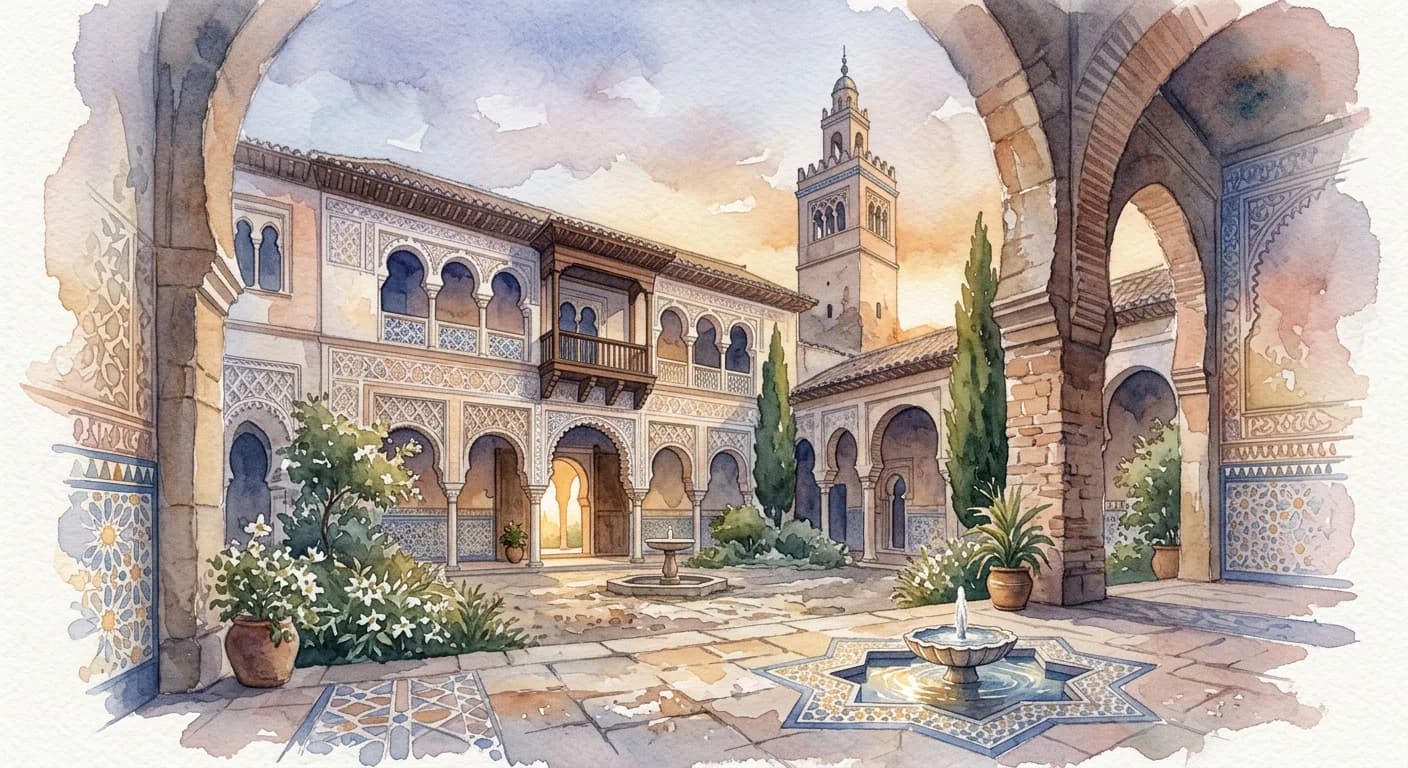
Mudéjar is not merely a style; it is a vibrant testament to cultural survival and syncretism in medieval Iberia. Born from the hands of Muslim artisans working for Christian patrons after the Reconquista, it masterfully blends intricate Islamic decorative arts—such as geometric patterns, dazzling azulejos, and horseshoe arches—with Christian architectural forms. This unique fusion creates spaces of breathtaking beauty, embodying a dynamic period of coexistence and artistic exchange where diverse traditions converged to forge a distinctively Iberian aesthetic.
Literal Translation
Derived from the Arabic word 'mudajjan' meaning 'tamed' or 'domesticated', referring to the Muslims who remained in Christian territories after the Reconquista.
The Story Behind the Word
The existence of Mudéjar reveals a profound chapter in Iberian history, showcasing a period of complex cultural entanglement rather than outright cultural eradication. After the Christian conquest, Muslim populations, though often marginalized, were not entirely expelled or forced to convert. Many remained, and their skilled craftsmanship, particularly in construction and decorative arts, was highly valued, even by their Christian rulers. This led to a unique patronage system where Islamic artistic traditions were preserved, adapted, and celebrated within a Christian context. The term 'Mudéjar' itself, deriving from 'mudajjan' ('tamed' or 'domesticated'), hints at the subordinate, yet essential, role these artisans played. It illustrates an era where pragmatism and aesthetic appreciation often transcended religious and political divides, highlighting a sophisticated understanding of cultural continuity and adaptation in a multi-ethnic society. It speaks to a world where identity was fluid and artistic expression could bridge seemingly insurmountable cultural chasms, leaving a legacy of unparalleled architectural beauty across Spain.
Experience It
Discovering a Mudéjar Church
Wandering through Teruel, Spain, a traveler steps into the Church of San Pedro. Inside, instead of typical Gothic austerity, they are met with a riot of intricate brickwork, glazed ceramic details, and geometric patterns adorning the tower and apse. 'This must be Mudéjar,' they whisper, recognizing the unmistakable fusion of Islamic artistry within a Christian structure.
Restoring an Old Palace
An architect is tasked with restoring a historic palace in Seville. Examining the crumbling plasterwork, she identifies delicate arabesques and calligraphic motifs beneath layers of paint. 'We must preserve these Mudéjar elements,' she instructs her team, 'they tell the story of the palace's original builders and its rich cultural heritage.'
The Deeper Meaning
Mudéjar embodies the philosophy of cultural resilience and the transformative power of hybridity. It demonstrates how artistic expression can transcend political and religious boundaries, allowing a conquered culture to persist and profoundly influence its conquerors. This fusion speaks to the inherent human capacity for adaptation and the universal appreciation for beauty, proving that even in times of conflict, shared aesthetic values can lead to extraordinary, enduring creations.
Did You Know?
Many of Spain's most iconic UNESCO World Heritage Sites, like the Alhambra's Nasrid Palaces, incorporate Mudéjar elements alongside earlier Islamic styles, showcasing its widespread influence and enduring appeal.
How It's Used
Used to describe a specific style of art, architecture, and decorative arts originating from the Iberian Peninsula.