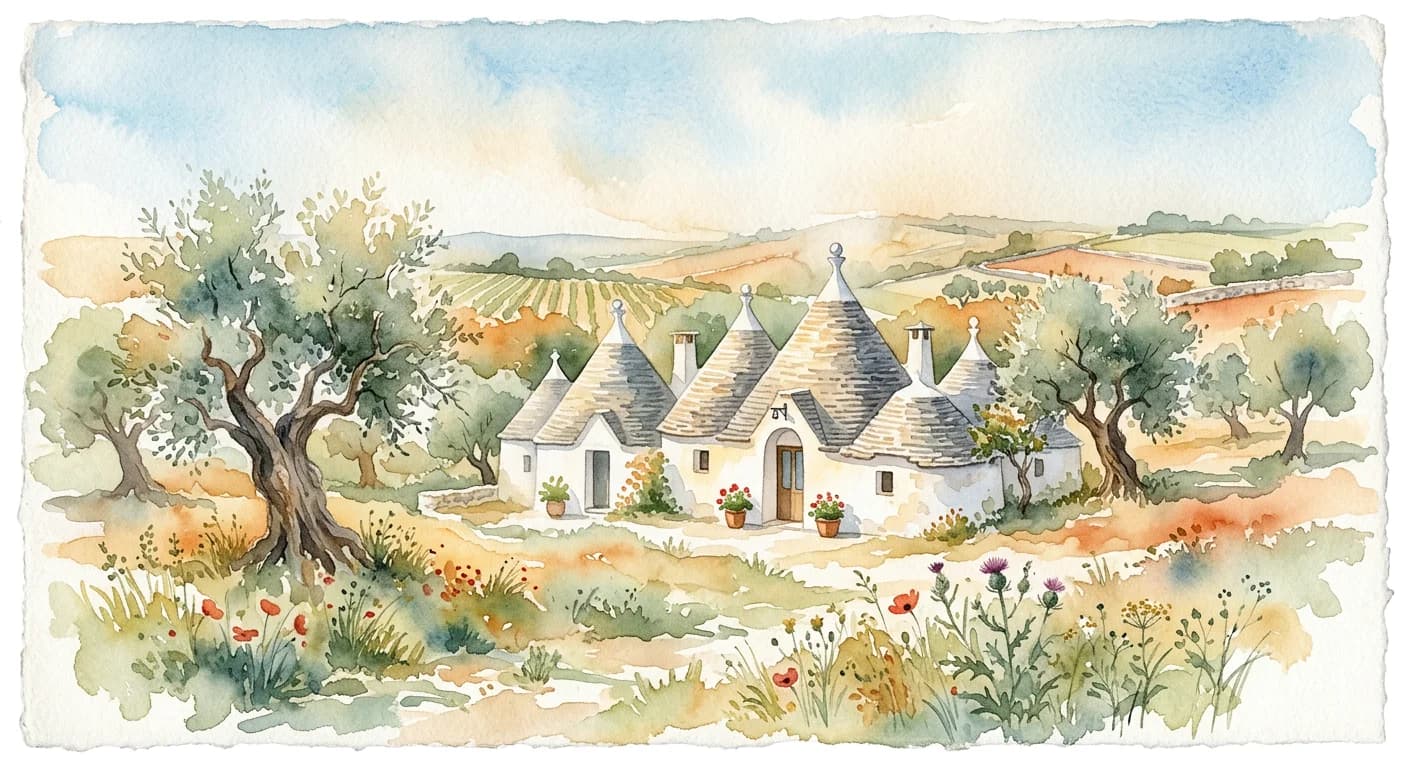
Trulli
/TROO-lee/
Meaning
Trulli are the iconic, whitewashed dry-stone huts crowned with distinctive conical roofs, emblematic of Puglia's Itria Valley. These ancient, ingenious structures are more than just dwellings; they are living testaments to a centuries-old rural architectural tradition, evoking a deep connection to the land and a simpler, agrarian way of life. To speak of 'trulli' is to conjure images of sun-drenched landscapes, olive groves, and charming, timeless villages like Alberobello, a UNESCO World Heritage site, where these unique buildings define the very fabric of the community.
Literal Translation
The etymology of 'trullo' (singular) is debated, possibly deriving from the Latin 'turris' (tower) or Greek 'tholos' (dome-shaped building).
The Story Behind the Word
The existence of trulli speaks volumes about ingenuity, frugality, and a deep respect for local materials in the arid landscape of Puglia. Historically, these structures were often built without mortar, allowing them to be easily dismantled and rebuilt, a practice sometimes linked to tax evasion on permanent dwellings in past centuries. This impermanence, however, belies their remarkable durability and thermal efficiency. The conical roof, often adorned with symbolic markings, not only shed water effectively but also provided a cool interior in summer and warmth in winter. The trullo represents a profound connection between humans and their immediate environment, showcasing a practical, sustainable architectural heritage born from necessity and perfected through generations, embodying a unique regional identity that values tradition and resourcefulness.
Experience It
A Puglian Evening
As the sun dipped below the horizon, casting long shadows across the olive groves, Maria and her family gathered outside their trullo. The whitewashed walls glowed softly, a comforting beacon in the gathering dusk, as they enjoyed the cool evening air after a day in the fields.
Exploring Alberobello
The tourist marveled at the labyrinthine streets of Alberobello, each turn revealing another cluster of trulli with their distinct conical roofs. He imagined the lives lived within these ancient walls, a continuous thread connecting past and present in this unique, fairytale-like town.
The Deeper Meaning
The trullo embodies a philosophy of 'less is more' and 'built to last,' born from an intimate understanding of local resources and environmental conditions. It reflects a worldview where human dwellings are seamlessly integrated into the landscape, not imposed upon it, celebrating sustainability, self-reliance, and an enduring connection to ancestral building wisdom. It's a testament to the beauty and practicality found in simplicity and tradition.
Did You Know?
Many trulli roofs were adorned with mystical or religious symbols painted in white ash, believed to protect the inhabitants or ward off evil, adding an extra layer of cultural significance to their design.
How It's Used
The word 'Trulli' is used to refer to the specific type of traditional Apulian dry stone hut with its characteristic conical roof. It is also used to refer to the regions or towns where these structures are most prevalent, such as Alberobello, a UNESCO World Heritage site.