Theoria
/thay-OH-ree-ah/
Meaning
Theoria transcends mere abstract thought; it is a profound, almost spiritual, engagement with the world through attentive observation and lived experience. It signifies a journey of discovery, where one actively seeks to comprehend the deeper truths and underlying order of things, particularly in nature or the cosmos. This concept embodies a state of receptive being, allowing for intuitive insights and a holistic understanding that emerges from direct, participatory involvement rather than detached analysis. It is about finding meaning and wisdom by truly seeing and connecting with the wonders around us.
Literal Translation
Contemplation, speculation, a looking at, a viewing
The Story Behind the Word
Theoria is deeply rooted in ancient Greek philosophy, particularly with figures like Plato and Aristotle. For Plato, it was the intellectual apprehension of the Forms, a divine and eternal reality beyond sensory perception, achieved through rigorous philosophical training. Aristotle, while also valuing intellect, emphasized theoria as the highest form of human activity, involving contemplative study of the natural world and the cosmos, leading to understanding and eudaimonia (flourishing). It was not just idle speculation but an active, disciplined pursuit of truth and wisdom, often associated with a life dedicated to learning and philosophical inquiry. This concept reveals a culture that highly valued intellectual pursuit, the search for universal principles, and the belief that true understanding came from a profound, engaged observation of existence, striving to perceive the underlying order of the universe.
Experience It
Astronomer's Contemplation
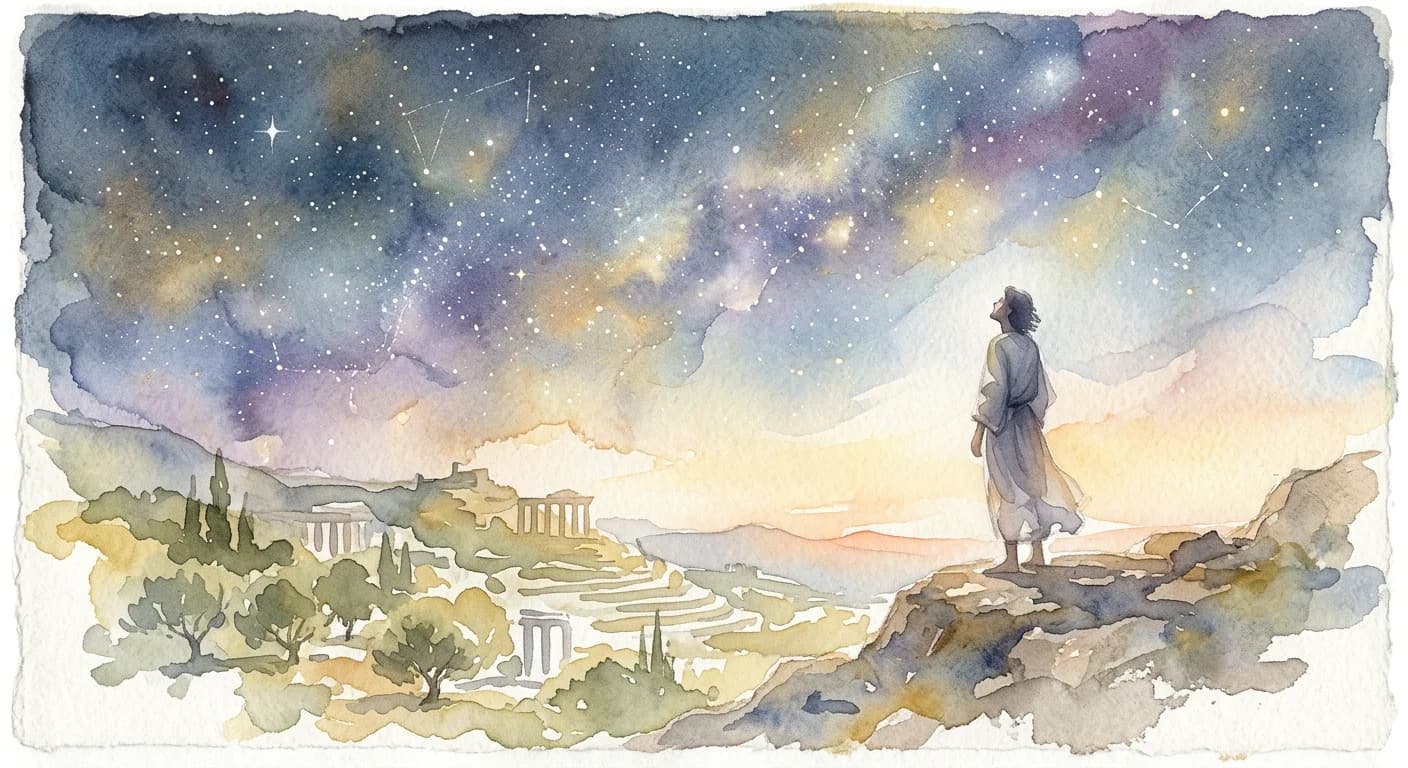
An ancient Greek astronomer spends countless nights under the stars, meticulously charting their movements and observing their patterns. His work isn't just about collecting data; it's a profound theoria, seeking to discern the divine order and harmonious mechanics of the cosmos, leading to an intuitive understanding of celestial rhythms.
Philosopher's Retreat
A philosopher retreats to a quiet grove, observing the growth of a tree, the flow of a stream, and the changing light. Through this sustained, focused observation, he engages in theoria, allowing the natural world to reveal its intrinsic principles and connections, deepening his understanding of life itself beyond mere intellectual definitions.
The Deeper Meaning
Theoria reveals a worldview where truth is not merely constructed but discovered through active, contemplative engagement with reality. It suggests that the universe possesses an inherent, discernible order and that human flourishing (eudaimonia) is intimately linked to understanding and aligning with this order. This concept prioritizes wisdom gained through deep observation and intellectual pursuit as the highest form of human endeavor, rather than solely practical or material achievements.
Did You Know?
The word 'theater' shares its etymological root with 'theoria,' both stemming from 'theasthai' (to behold or gaze). This connection highlights the shared ancient Greek idea of 'seeing' as a fundamental act of understanding and engagement.
How It's Used
Used in philosophical and academic contexts to describe a mode of understanding or contemplation, often related to observing the natural world or seeking deeper truths.