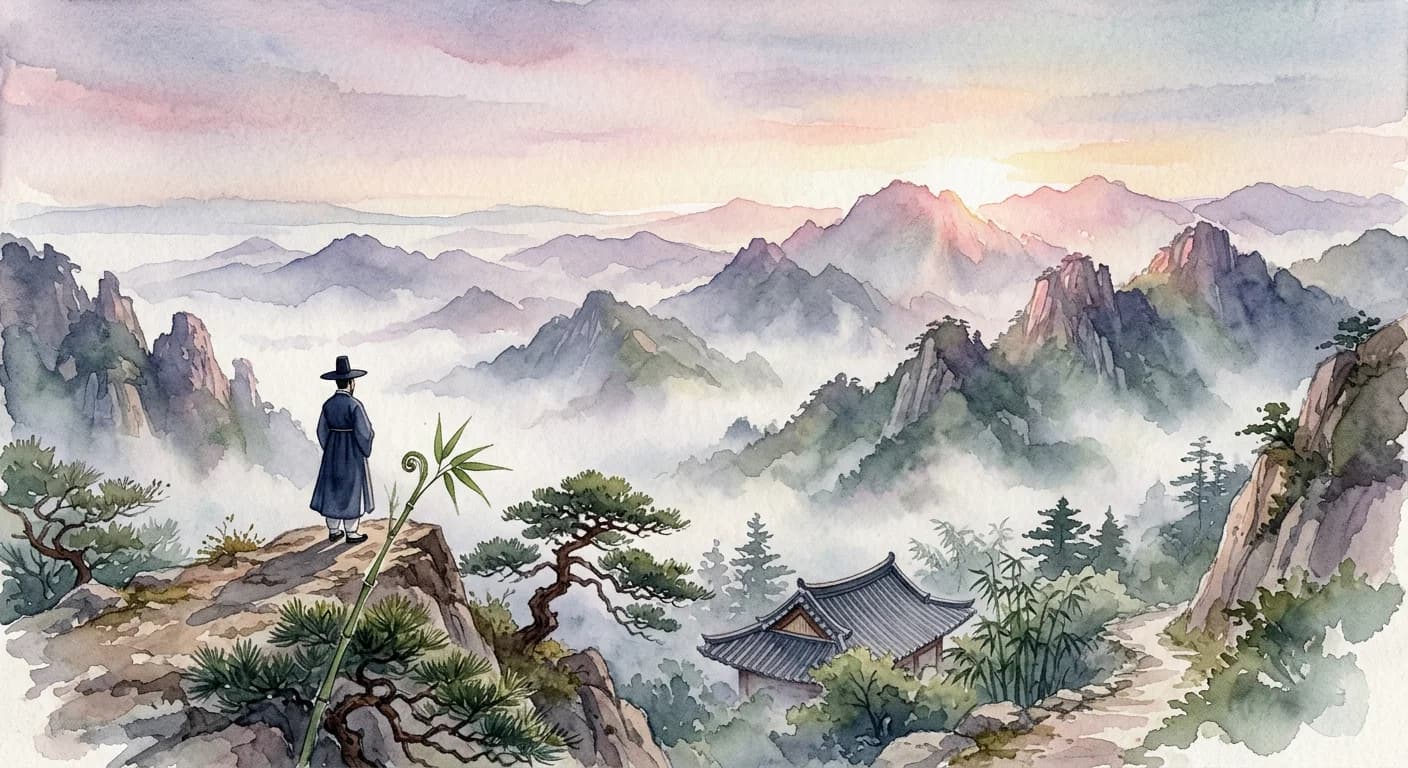
Sijo
/SEE-joh/
Meaning
Sijo is a classic Korean poetic form, typically comprising three lines, each meticulously crafted to contain 14-16 syllables, resulting in a total of 44-48 syllables. This highly structured yet remarkably adaptable verse form often delves into profound themes of nature's fleeting beauty, the complexities of human love, and the universal human condition. Its inherent conciseness compels poets to distill intricate emotions and keen observations into a potent, evocative expression, presenting a unique artistic challenge in capturing its nuanced essence across linguistic divides.
Literal Translation
Sijo translates to 'song of the moment' or 'tune'.
The Story Behind the Word
The sijo emerged during the Goryeo Dynasty (918-1392) and flourished during the Joseon Dynasty (1392-1910), becoming a cornerstone of Korean literary tradition. It was initially a form for the literati (yangban) to express scholarly reflections or courtly sentiments, but later embraced by commoners, expanding its thematic range to include everyday joys and sorrows. Its enduring appeal lies in its ability to encapsulate profound meaning within a strict yet elegant structure, mirroring the Confucian emphasis on discipline, balance, and harmony that permeated Korean society. Sijo reveals a cultural appreciation for brevity, subtlety, and the art of expressing deep emotion or philosophical insight through meticulously chosen words, often hinting at more than what is explicitly stated. It embodies a worldview where even a 'song of the moment' can carry the weight of eternity.
Experience It
Evening Reflection
An elderly scholar, gazing at the moon, quietly composes a sijo in his mind. He chooses words carefully, reflecting on the transient beauty of autumn leaves and the passage of time, distilling his lifelong observations into three perfect lines.
Modern Expression
A young poet, feeling the rush of city life, encounters a moment of stillness in a bustling cafe. She opens her notebook, trying to capture the paradox of modern loneliness amidst connection, channeling her feelings into the structured yet freeing form of a sijo.
The Deeper Meaning
Sijo embodies a philosophy of profound introspection and the beauty of restraint. It reflects a worldview where the essence of truth or emotion can be found in brevity, encouraging both the creator and the audience to engage in deep contemplation. The form's balance and structure mirror an ideal of harmonious existence, suggesting that even within life's complexities, there is an underlying order and beauty to be discovered and artfully expressed.
Did You Know?
Did you know that sijo were traditionally sung, not just recited? They were often accompanied by instruments like the gayageum, making them a vibrant part of Korean musical and poetic performance.
How It's Used
Sijo is a traditional Korean poetic form used for artistic expression, often recited or written to convey personal reflections, observations, or emotions.