U.
HomeRegionsLanguagesEmotionsCollections
Find Your Word

“The limits of my language mean the limits of my world.”

— Ludwig Wittgenstein, Philosopher

Untranslatable

A curated collection of the world's most beautiful expressions—words that remind us language is humanity's greatest invention.

  • Home
  • Collections
  • Regions
  • Countries
  • Emotions
  • Tags
  • Contexts
  • Finder
  • Europe
  • Asia
  • Americas
  • Africa
  • Middle East
  • About
  • Contact
  • Privacy Policy
  • Terms of Service

2026 © Untranslatable. All rights reserved.

    /
    /
    1. Home
    2. /
    3. Asia
    4. /
    5. 井底之蛙 (jǐngdǐzhīwā)
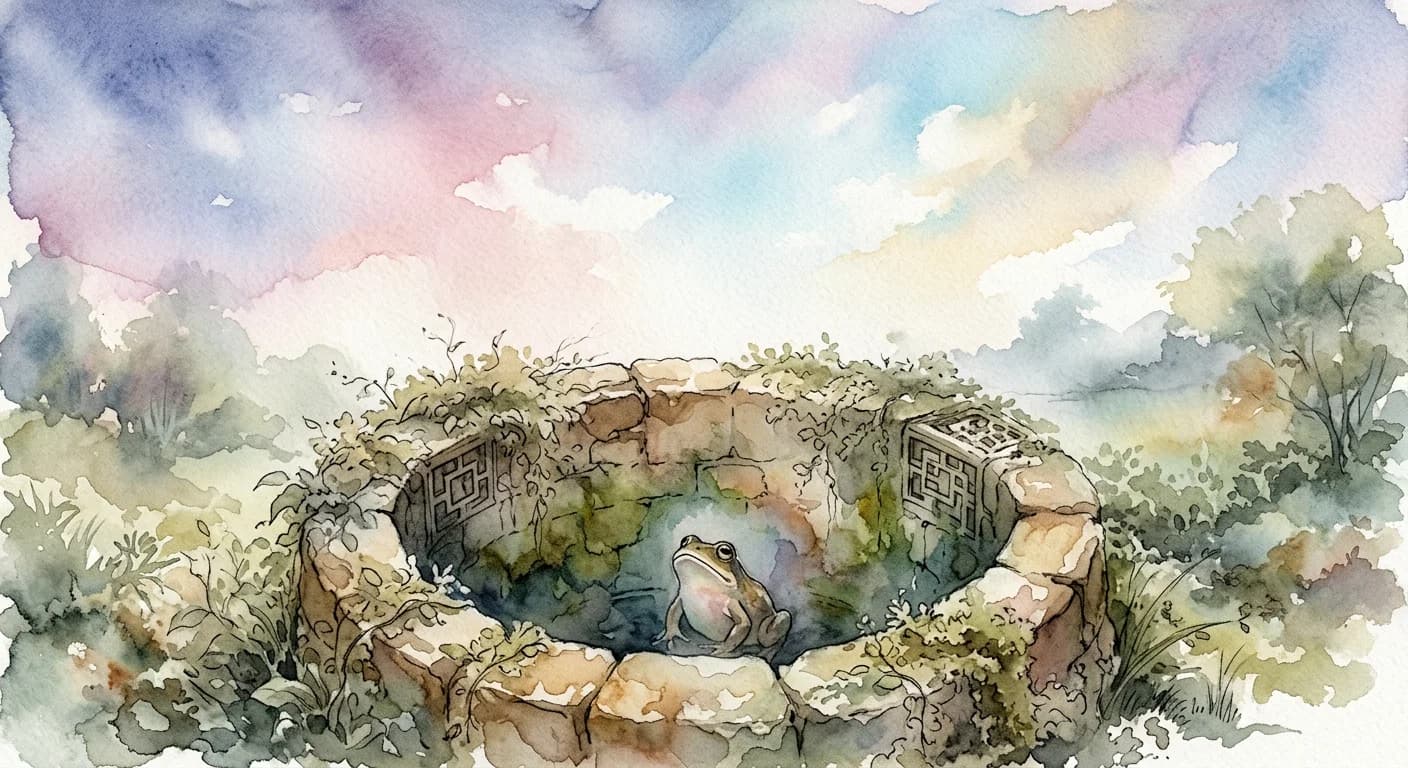
    Artistic representation of 井底之蛙 (jǐngdǐzhīwā)
    Mandarin Chinese•
    🇨🇳China

    井底之蛙 (jǐngdǐzhīwā)

    /jing-dee-zhee-wah/

    Meaning

    This evocative idiom paints a vivid picture of extreme myopia, likening an individual's restricted worldview to a frog trapped within the narrow confines of a well. Such a person, having never glimpsed the vastness beyond their immediate, limited environment, genuinely believes their small world encompasses all existence. It serves as a gentle yet firm caution against intellectual complacency and the dangers of unexamined assumptions, highlighting the profound ignorance that stems from a lack of exposure to diverse experiences and ideas.

    Literal Translation

    well-bottom-of frog

    The Story Behind the Word

    The idiom "jǐngdǐzhīwā" originates from ancient Chinese fables, notably from the Zhuangzi, a fundamental text of Taoist philosophy. In one such story, a frog in a well boasts about its comfortable life to a sea turtle, only to be humbled when the turtle describes the boundless ocean. This narrative underscores a core tenet in Chinese thought: the importance of seeking broader knowledge and not being content with limited understanding. It reflects a cultural value placed on humility, continuous learning, and the recognition that one's own perspective is just a tiny part of a much larger reality. The phrase subtly critiques provincialism and intellectual arrogance, encouraging an expansive worldview and an openness to new experiences, which were crucial for scholars and officials in a vast and diverse empire.

    Experience It

    The Village Elder's Advice

    A young man refused to leave his remote village, convinced that everything worth knowing existed within its borders. His grandmother, sighing, told him, "My dear, if you never see the world, you will remain a 'jǐngdǐzhīwā,' never knowing the true sky."

    Corporate Tunnel Vision

    The CEO, having only ever worked for his family's small company, dismissed all international market trends as irrelevant. His marketing director privately lamented, "He's truly a 'jǐngdǐzhīwā,' convinced our tiny pond is the entire ocean of commerce."

    The Deeper Meaning

    This phrase encapsulates a profound philosophical warning against intellectual arrogance and the dangers of epistemic closure. It suggests that true wisdom begins with an acknowledgement of one's own limitations and the vastness of the unknown. It promotes an open-minded pursuit of knowledge, urging individuals to transcend their immediate, comfortable realities to gain a more comprehensive and accurate understanding of the world, echoing themes of humility and experiential learning central to East Asian thought.

    Did You Know?

    This idiom is so ancient that its roots can be traced back to the Warring States period (475–221 BC), featuring in the classic Taoist text, Zhuangzi.

    How It's Used

    Used to describe someone who is ignorant due to their limited experience or perspective, often in a critical or cautionary context.

    Emotions
    anger,compassion,melancholy
    Contexts
    education,personal growth,social interaction
    🇨🇳China

    by Dr. Kenji Tanaka·Written Mar 10, 2026·Updated Apr 3, 2026

    Related Words

    Explore more
    SaudadePortuguese

    Saudade encapsulates a profound, melancholic longing for something or someone cherished that is absent, often with the bittersweet knowledge that it may never return. It's a deep emotional state tinged with nostalgia, evoking a sense of loss for past experiences, places, or people, yet also holding a tender appreciation for the beauty of what once was. This yearning is not merely sadness, but a complex tapestry of desire, memory, and a poignant acceptance of absence, holding the beloved in a warm, persistent embrace within the heart.

    Wabi-sabiJapanese

    Wabi-sabi is the profound appreciation for the ephemeral, the imperfect, and the incomplete aspects of existence. It is about discovering beauty in the subtle textures of age, the unique character of flaws, and the gentle decay that marks the passage of time. This philosophy encourages a quiet acceptance of impermanence and a mindful connection to the natural world, finding elegance in simplicity and authenticity.

    IkigaiJapanese

    Ikigai is more than just a reason to get out of bed; it's a deeply personal and evolving sense of purpose that brings genuine fulfillment and joy to one's life. It represents the sweet spot where your passions, talents, needs of the world, and what you can be paid for beautifully converge. Discovering your ikigai often leads to a life lived with intentionality, resilience, and a profound connection to one's contributions. It's the intrinsic motivation that fuels a meaningful existence, regardless of external circumstances.

    NunchiKorean

    Nunchi is the sophisticated, almost telepathic, ability to instantly grasp the unspoken dynamics of any social situation, anticipating others' thoughts and feelings, and then responding with impeccable grace and timing. It's an acute form of social intuition, allowing one to navigate complex interpersonal landscapes by reading subtle cues like body language, tone, and context. Possessing good nunchi means effortlessly understanding the underlying emotional currents and adjusting one's behavior to maintain harmony and effectiveness, often without a single word exchanged.