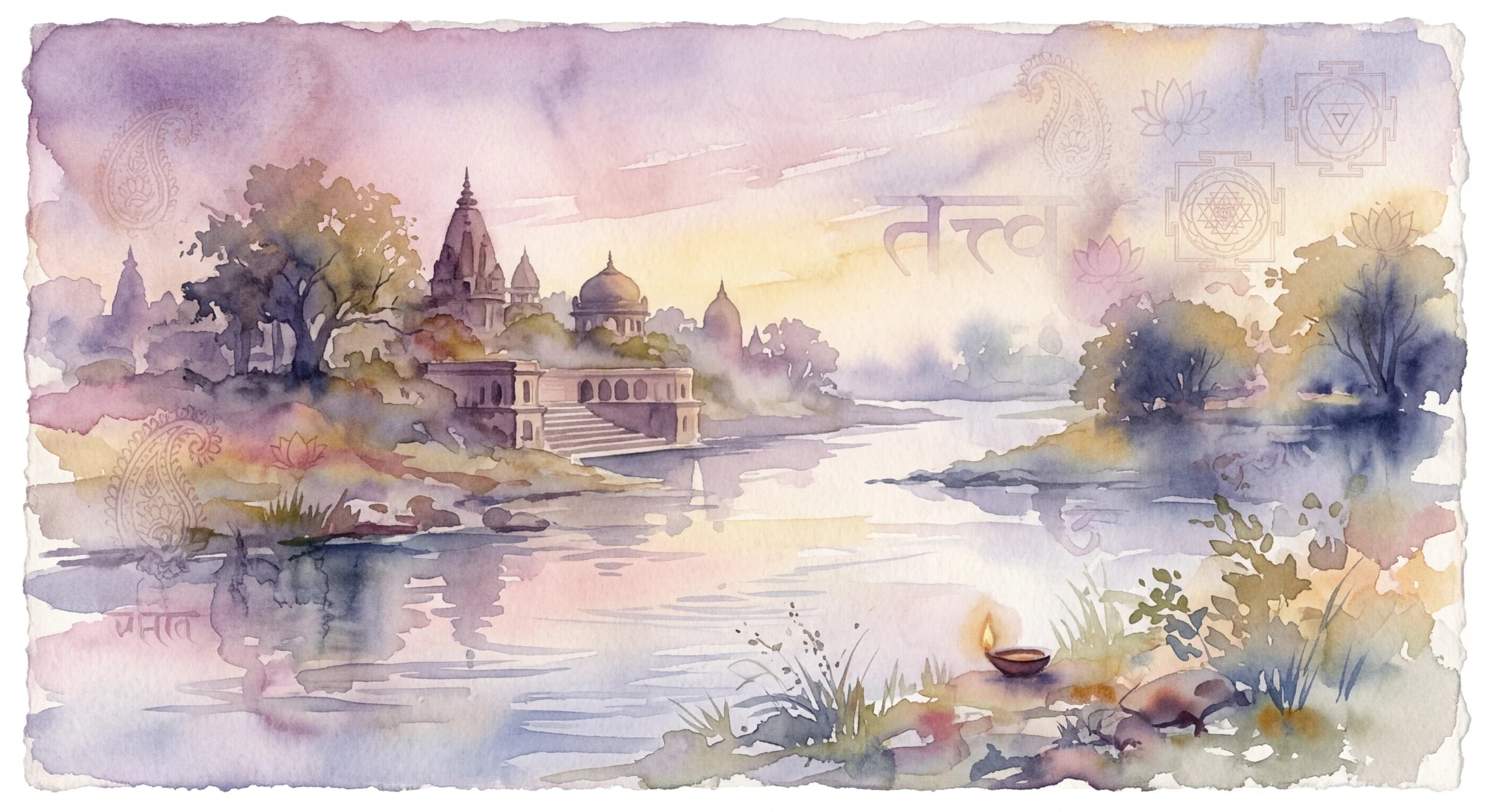
Tattva
/TAHT-vuh/
Meaning
Tattva, from Sanskrit, encapsulates the profound 'thatness' or essential truth of existence, revealing the fundamental principles that constitute reality itself. It's not merely a concept, but the very building blocks of the cosmos, from the subtlest consciousness to gross matter, as understood in Indian philosophical systems like Samkhya and Vedanta. Grasping tattva involves a deep spiritual inquiry into the nature of what is truly real, distinguishing it from illusion, and forms the core path towards liberation and enlightenment.
Literal Translation
Thatness, reality, principle
The Story Behind the Word
The concept of Tattva is deeply woven into the fabric of Indian thought, reflecting an ancient civilization's persistent quest to understand the universe and humanity's place within it. Its existence highlights a worldview where reality is not taken at face value but is systematically analyzed into constituent principles. This analytical approach, evident in philosophical schools like Samkhya's 24 or 25 tattvas, provided a framework for mapping the journey from primordial matter (Prakriti) to pure consciousness (Purusha). It reveals a culture that values introspection, categorization, and the pursuit of ultimate truth, believing that understanding these fundamental principles is key to spiritual freedom and transcending the cycle of rebirth (samsara). The very act of discerning tattvas is a spiritual practice, aiming to see beyond superficial appearances to the underlying essence.
Experience It
Meditating on Tattva
A yogi sits in deep meditation, focusing on the five elements (pancha-mahabhutas) as tattvas. He contemplates how earth, water, fire, air, and space are not just physical phenomena but fundamental categories of manifestation, seeking to experience their pure essence beyond their sensory forms.
Discerning Illusion
During a philosophical discourse, a student asks their guru about the nature of suffering. The guru explains that much suffering arises from mistaking the non-eternal for the eternal, the unreal for the real. Understanding the tattva of the Self (Atman) as distinct from the transient body and mind is crucial for liberation.
The Deeper Meaning
Tattva unveils a holistic and systematic approach to reality, postulating that the universe is not chaotic but governed by discernible, interconnected principles. It promotes a worldview where spiritual liberation is contingent upon intellectual and experiential discrimination, urging individuals to look beyond the ephemeral to grasp the unchanging essence. This pursuit of 'thatness' underscores a profound commitment to understanding existence at its most fundamental level, leading to a transformative realization of one's true nature and the nature of the cosmos.
Did You Know?
In some Tantric traditions, the human body is seen as a microcosm of the universe, with each chakra corresponding to different tattvas, allowing practitioners to explore cosmic principles within themselves.
How It's Used
Used in philosophical and spiritual discussions, particularly within Hindu and Buddhist traditions, to describe fundamental principles of reality, elements of existence, or spiritual truths.