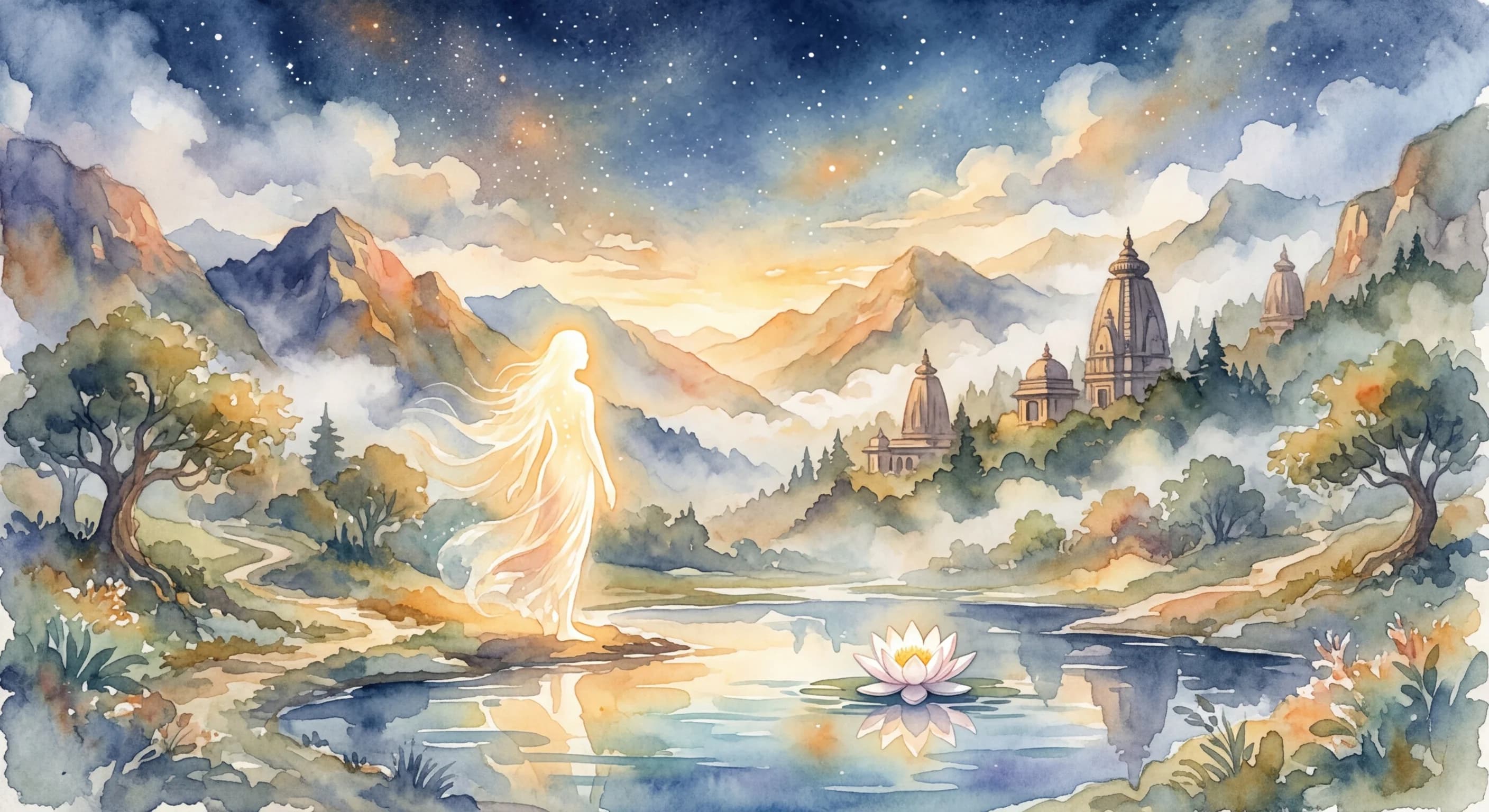
Jiva
/JEE-vah/
Meaning
Jiva, in Sanskrit, signifies the eternal, individual soul or life principle that animates all existence, from the simplest microbe to the most complex human. It is the sentient essence that transmigrates through endless cycles of birth, death, and rebirth (samsara), driven by karma, seeking ultimate liberation (moksha). This core concept underscores the inherent, divine spark within every living being, forming the ethical bedrock for non-violence (ahimsa) and the recognition of universal interconnectedness.
Literal Translation
living being, soul, life
The Story Behind the Word
The concept of Jiva is foundational to the spiritual landscape of India, deeply embedded in Hinduism, Jainism, and certain schools of Buddhism. Its existence reveals a civilization profoundly concerned with the nature of consciousness, reality, and ethical living. For millennia, sages and philosophers have debated its characteristics, its relationship to the universal Brahman, and the path to its liberation. This emphasis on an eternal, transmigrating soul provides a framework for understanding karma and reincarnation, where every action has cosmic consequences, shaping the Jiva's future journey. It cultivates a worldview where respect for all forms of life is paramount, as each harbors the same essential Jiva, albeit in different shells.
Experience It
Respecting All Life
A Jain monk meticulously sweeps the path before him, not to clean, but to ensure he doesn't inadvertently harm even the smallest insect. This action stems from the deep understanding that each tiny creature possesses a Jiva, a precious life-force deserving of respect and protection, just like his own.
Understanding Suffering
When a devotee witnesses suffering, they reflect on the Jiva's journey through samsara. They understand that the current state is a consequence of past actions (karma), and that the ultimate goal is for the Jiva to break free from this cycle and attain spiritual liberation, not just alleviate immediate pain.
The Deeper Meaning
Jiva unveils a profound philosophical insight: that life is not merely a biological phenomenon but a spiritual journey of an eternal consciousness. It posits that true identity lies beyond the transient body and mind, residing in this immutable soul. This perspective fosters a sense of unity with all beings and elevates ethical conduct as a direct path to understanding and realizing one's own divine nature and ultimate freedom.
Did You Know?
In Jainism, there are believed to be an infinite number of Jivas, each distinct and eternal, and even plants and water bodies are considered to possess their own Jiva.
How It's Used
Used in philosophical and religious contexts, particularly within Hinduism, Jainism, and Buddhism, to denote the soul or life force.