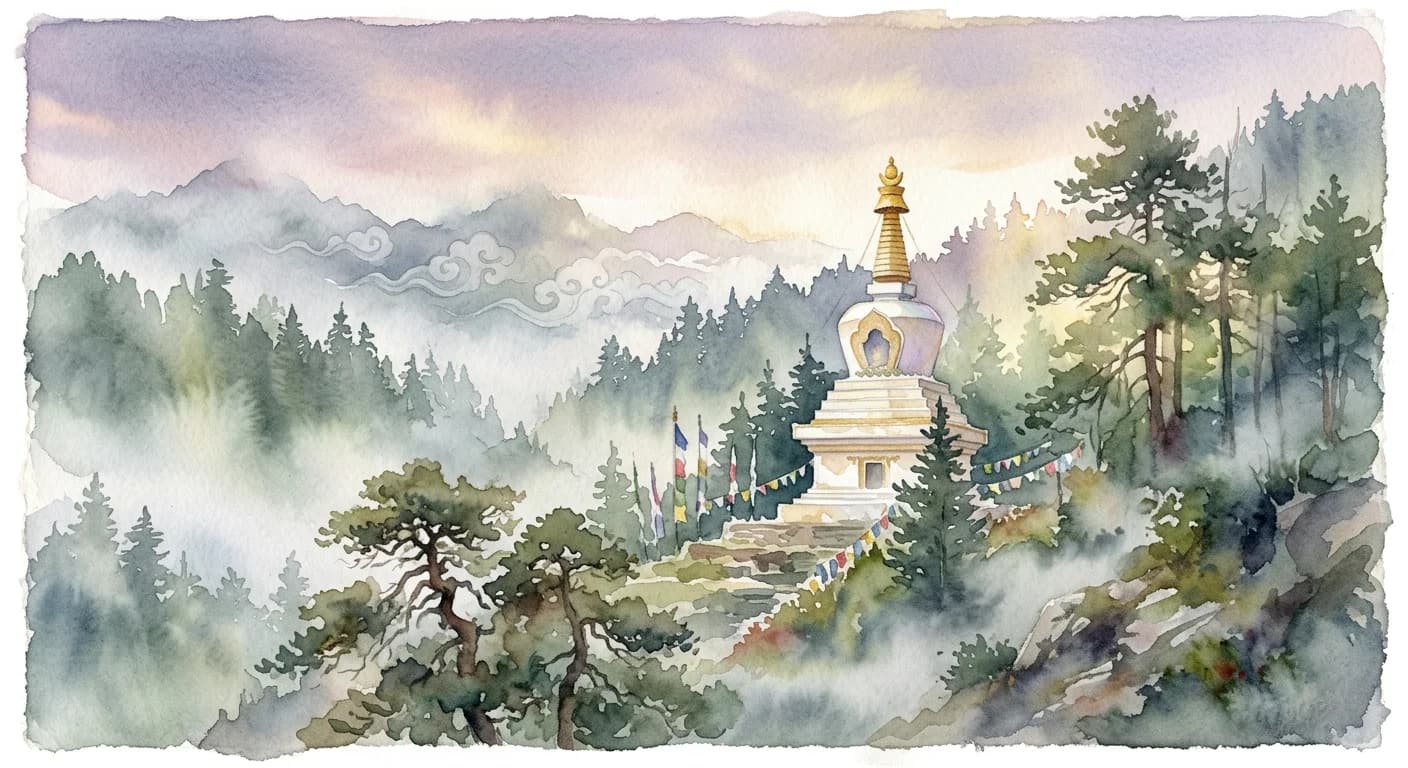
Chorten
/CHOR-ten/
Meaning
A chorten, deeply rooted in Tibetan Buddhist tradition, is far more than a mere dome-shaped monument; it is a living symbol of the Buddha's enlightened mind and the entire path to liberation. These sacred structures, often housing relics of enlightened beings or sacred texts, serve as potent focal points for devotion, prayer, and meditation. Their presence transforms the landscape into a sacred space, inviting pilgrims and practitioners to engage in circumambulation, a profound act believed to accumulate merit, purify negative karma, and foster deep spiritual connection and inner peace.
Literal Translation
The word 'chorten' is derived from the Tibetan word 'mchod rten', which literally translates to 'offering receptacle' or 'vessel for offerings'.
The Story Behind the Word
The chorten embodies the Tibetan Buddhist worldview, where the physical and spiritual are inextricably linked. Its existence reflects a profound reverence for enlightened beings and the belief that their essence, even after physical death, can continue to inspire and confer blessings. The chorten's architectural elements are not arbitrary; each part symbolizes aspects of the Buddha's body, speech, and mind, as well as the five elements, ultimately representing the fully enlightened state. Building or maintaining a chorten is an act of great merit, believed to benefit not only the individual but all sentient beings. It reveals a culture that sees spiritual progress as a tangible, ongoing journey, with sacred objects and practices serving as vital guides and facilitators on the path to liberation from suffering.
Experience It
Pilgrim's Devotion
Under the vast Himalayan sky, an elderly woman, her face weathered by sun and prayer, slowly circumambulates the towering chorten, her prayer wheel a blur in her hand. Each step is an offering, each revolution of the wheel a prayer, as she seeks blessings and purification for herself and her family.
Village Gathering
At the heart of the village stands a whitewashed chorten, its golden spire glinting in the morning light. Villagers gather around it for morning prayers, their soft chants harmonizing with the fluttering prayer flags, a collective act of faith grounding their community in spiritual tradition.
The Deeper Meaning
The chorten encapsulates the Buddhist philosophy of impermanence and the potential for enlightenment inherent in all beings. By containing relics, it reminds practitioners of the possibility of transcending suffering, while its architectural form serves as a cosmic diagram, guiding the mind towards the ultimate reality of emptiness and compassion. It reveals a worldview where even inanimate objects can be imbued with profound spiritual meaning and serve as powerful tools for transformation.
Did You Know?
The design of a chorten symbolically represents the entire path to enlightenment, with each architectural layer corresponding to different stages of spiritual realization, culminating in the jewel at the very top.
How It's Used
Used to refer to Buddhist reliquary monuments, particularly in Tibetan Buddhism. They are often found on pilgrimage routes, monasteries, and significant spiritual sites.