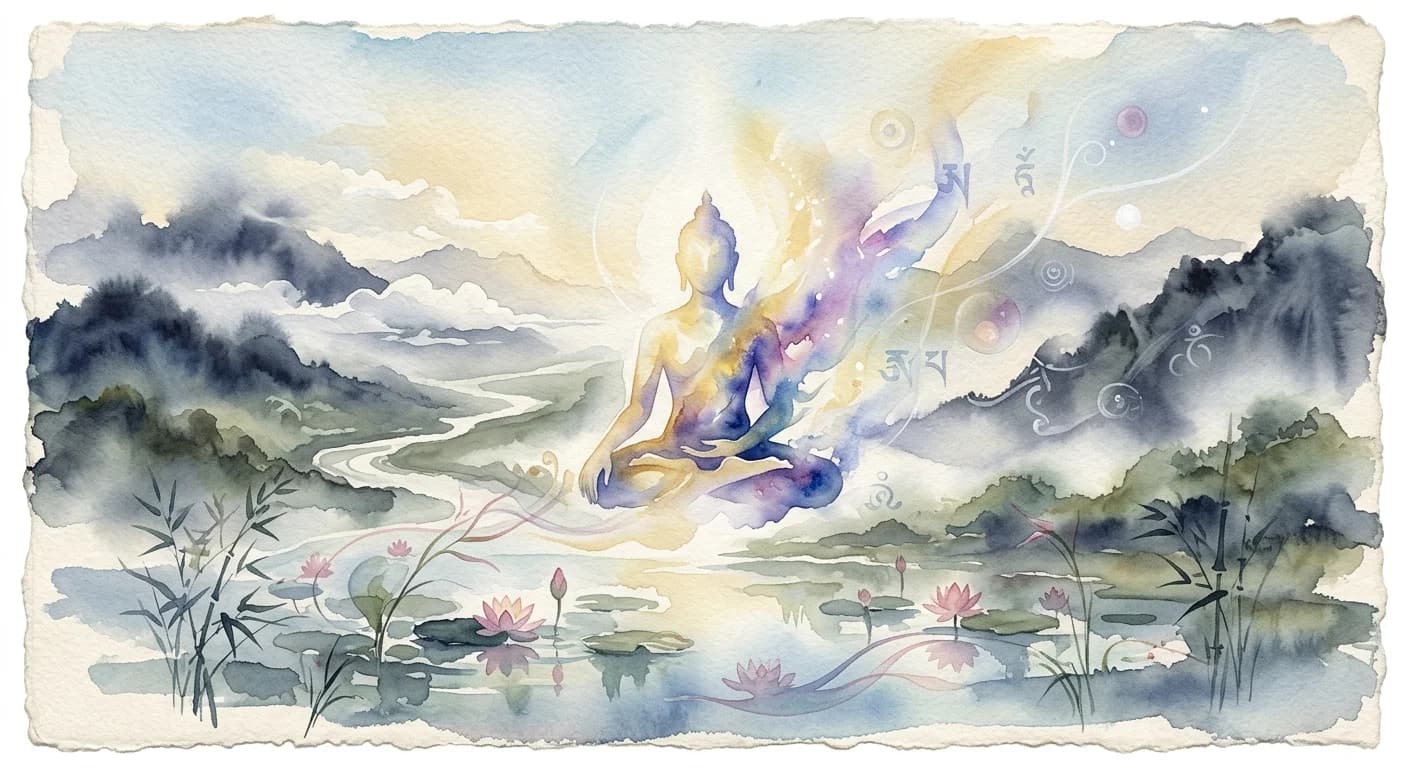
Dzog rim
/DZOK-reem/
Meaning
Dzog rim, the 'completion stage' in Tibetan Buddhist tantra, marks the profound integration of wisdom cultivated during visualization practices. It's a transformative journey where the practitioner dissolves the meticulously constructed luminous forms of deities and mandalas back into their primordial emptiness, realizing their inherent non-duality with one's own mind. This stage is not merely intellectual comprehension but a deep, embodied realization of the ultimate nature of reality, leading to an unshakable experience of clear light and profound liberation from conceptual constraints.
Literal Translation
completion stage
The Story Behind the Word
The concept of dzog rim is central to the Vajrayana tradition, particularly within schools like the Nyingma, Kagyu, and Gelug, where it represents the pinnacle of tantric practice. Its existence reflects a worldview deeply concerned with the ultimate nature of reality and the path to liberation from suffering, not through mere renunciation, but through the skillful transformation of perception and energy. The meticulous stages of tantric practice, culminating in dzog rim, reveal a culture that values profound inner work, disciplined meditation, and direct experiential understanding over dogma. It underscores the belief that enlightenment is not an external gift but an inherent potential to be fully realized through specific, often esoteric, methods passed down through an unbroken lineage of enlightened masters.
Experience It
Monk's Dawn Meditation
As the first rays of dawn touched the monastery walls, Lama Tenzin sat in deep meditation. Having spent years perfecting the vivid visualization of a chosen deity, he now entered dzog rim, allowing the intricate forms to dissolve, one by one, into the boundless expanse of his own mind, experiencing a profound sense of interconnectedness and clarity.
Scholar's Realization
Dr. Wangmo, a renowned scholar of Buddhist philosophy, found her academic understanding transform during a retreat. After years of intellectual study, engaging in dzog rim practices allowed her to move beyond conceptual knowledge, realizing the emptiness and luminosity of all phenomena not as an abstract idea, but as a living, direct experience that permeated her entire being.
The Deeper Meaning
Dzog rim reveals a profound philosophical insight: that the elaborate structures of the phenomenal world, including our own perceived self, are ultimately illusory and arise from the mind. It posits that true liberation comes not from escaping this world, but from understanding its true nature as empty yet luminous, a non-dual reality where subject and object, samsara and nirvana, are ultimately one. This transcends dualistic thought, pointing to an inherent perfection and purity within all existence.
Did You Know?
While often associated with advanced practitioners, some foundational elements of dzog rim, such as resting in the nature of mind, are introduced to dedicated students relatively early in their tantric journey.
How It's Used
Used within the context of Tibetan Buddhism, particularly in Vajrayana traditions, to describe the advanced stages of meditation and spiritual realization.