Siddhi
/SID-hee/
Meaning
Siddhi refers to extraordinary and often supernatural abilities attained through profound spiritual discipline, such as rigorous yoga, deep meditation, and ascetic practices. These are not mere parlor tricks but profound manifestations of a highly refined consciousness, reflecting mastery over the mind, senses, and the subtle energies of the universe. While indicative of significant spiritual advancement, the ultimate objective in traditions like Hinduism and Buddhism is liberation (moksha or nirvana), with siddhis often viewed as potential distractions or byproducts rather than the final goal. They symbolize a practitioner's deep connection to the spiritual realm and the underlying fabric of existence.
Literal Translation
accomplishment, attainment, perfection
The Story Behind the Word
The concept of siddhi is deeply woven into the spiritual fabric of India, appearing in ancient Vedic texts, the Yoga Sutras of Patanjali, and countless Puranic narratives. Its existence reflects a worldview where the physical and spiritual realms are not rigidly separate, and human potential, when properly cultivated, can transcend ordinary limitations. The pursuit of siddhis was often intertwined with ascetic practices (tapas) and the belief that intense self-discipline could unlock latent cosmic powers. While revered as signs of spiritual prowess, sages frequently cautioned against attachment to these powers, seeing them as potential obstacles on the path to true enlightenment. This duality highlights a culture that acknowledges the allure of power but ultimately values self-realization above all else, viewing the universe as fundamentally interconnected and responsive to consciousness.
Experience It
Yogi's Levitation
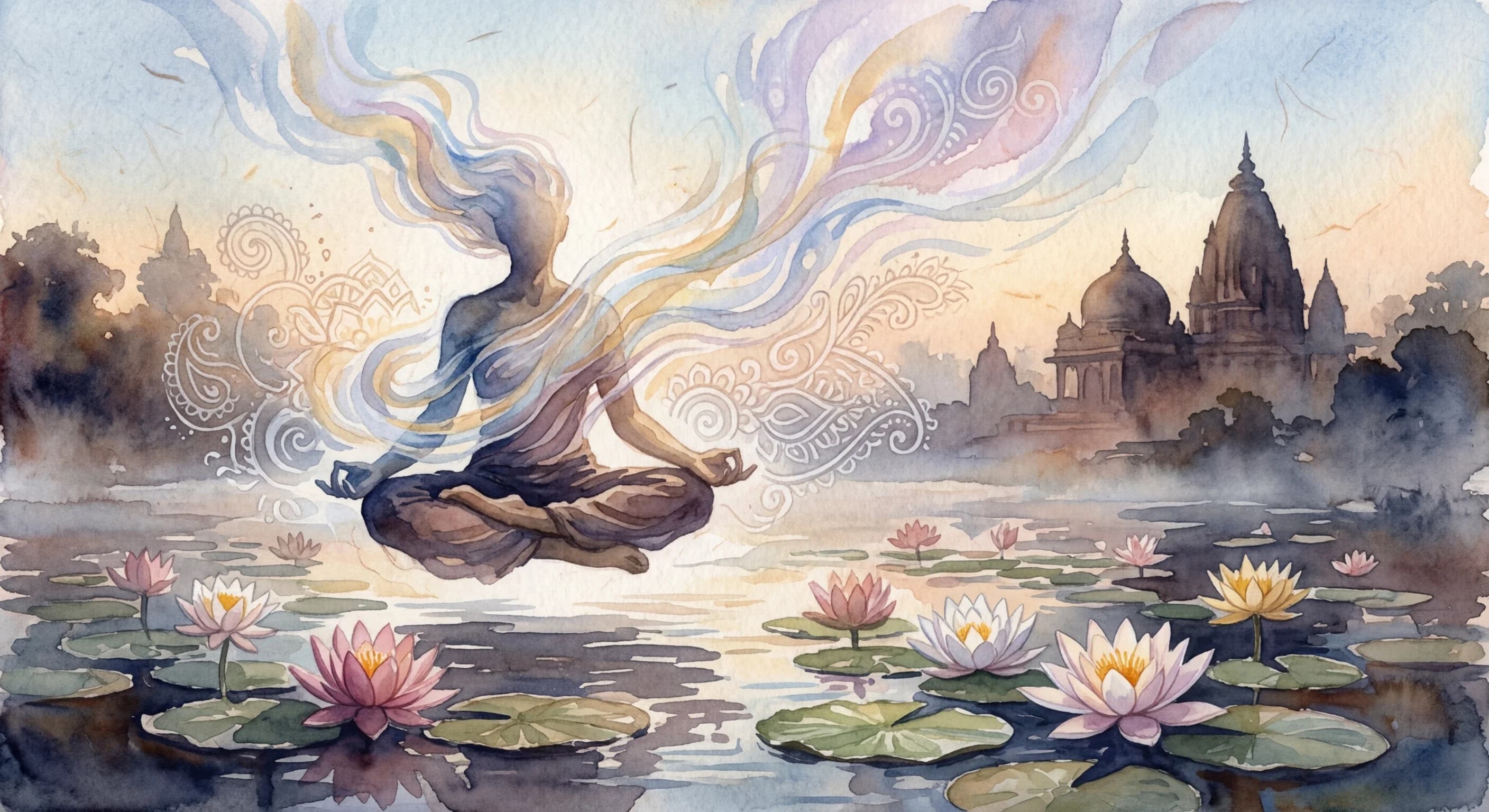
After decades of intense meditation in the Himalayas, the yogi sat in profound samadhi. Slowly, his body began to rise a few inches above the ground, a subtle siddhi manifesting not from effort, but as a natural overflow of his perfected state of mind.
Healing Touch
A village elder, known for her deep spiritual practice, laid her hands on a child suffering from a mysterious ailment. Through her cultivated siddhi of healing, a warmth spread, and the child's fever began to recede, a tangible sign of her inner power.
The Deeper Meaning
The concept of siddhi reveals a profound philosophical stance that the human mind is not merely a product of the body but a potent force capable of influencing reality itself. It suggests that the perceived limitations of the physical world are largely self-imposed or products of an unawakened consciousness. This worldview posits that true mastery lies not in external control, but in the internal discipline and purification that allows one to tap into the fundamental energies and laws governing the cosmos, blurring the lines between the ordinary and the miraculous.
Did You Know?
Some ancient texts list specific categories of siddhis, including 'anima' (the ability to become infinitely small) and 'laghima' (the ability to become weightless).
How It's Used
Used in spiritual and philosophical contexts, particularly within yogic, Hindu, and Buddhist traditions, to describe extraordinary abilities gained through spiritual practice.