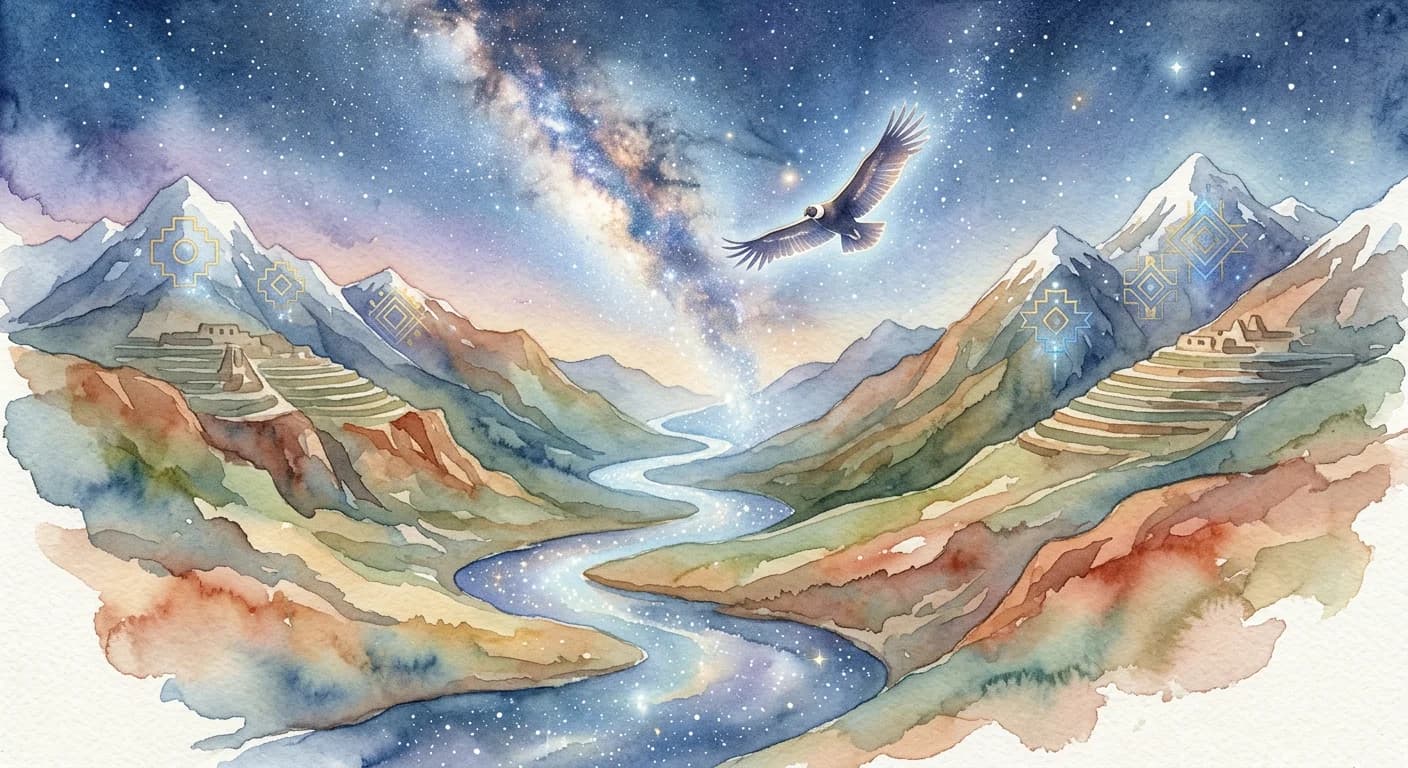
Pacha Kuti
/PAH-chah KOO-tee/
Meaning
Pacha Kuti is a cataclysmic yet sacred turning of the cosmos, a profound reordering of both time and space. It signifies not merely change, but a fundamental upheaval where the old order collapses to give rise to a new era, often accompanied by immense social and environmental shifts. This concept embodies the Andean belief in cyclical history, marking an epochal recalibration of the world and a moment of powerful renewal, even if born from destruction.
Literal Translation
World/time/space (Pacha) + turning/overturning/new era (Kuti)
The Story Behind the Word
The concept of Pacha Kuti is central to Andean cosmology, reflecting a worldview where time is not linear but cyclical, and the universe is in a constant state of flux and transformation. It emerged from centuries of observing natural cycles – the seasons, the rise and fall of empires, and catastrophic events like earthquakes and droughts. For the Quechua people, Pacha Kuti explains the inherent impermanence of all things and offers a framework for understanding profound societal changes, including the Spanish conquest, which was interpreted by some as a Pacha Kuti. This word reveals a deep cultural resilience and an understanding that creation often follows destruction, fostering a perspective of both reverence for the past and adaptability to an ever-changing future.
Experience It
The Conquistador's Arrival
As the Spanish conquistadors marched into Cusco, an elder whispered, 'This is a Pacha Kuti.' The world as they knew it was overturning, their sacred order giving way to an incomprehensible new one, marking a profound and painful transformation of their civilization.
Ecological Rebirth
After decades of deforestation, the community began a massive reforestation project, restoring the mountain's springs and wildlife. 'This is a Pacha Kuti for our land,' remarked a young farmer, seeing the barren slopes slowly return to life, a testament to renewal.
The Deeper Meaning
Pacha Kuti reveals a profound philosophical understanding that life is an ongoing process of destruction and creation. It challenges linear notions of progress, emphasizing that true renewal often requires a complete dismantling of existing structures. This cyclical worldview fosters an acceptance of impermanence and recognizes the inherent interconnectedness of cosmic, natural, and social transformations, seeing upheaval not just as an end, but as a necessary precursor to a new beginning.
Did You Know?
The Inca Empire's expansion and consolidation was sometimes referred to as a Pacha Kuti, as it unified diverse peoples and brought a 'new order' to the Andean world under their rule.
How It's Used
Used in Quechua culture to describe periods of great change, cosmic renewal, or historical turning points. It can refer to both destructive and creative transformations, signifying a 'new age' or the end of an era.