Ehecatl
/eh-eh-CATL/
Meaning
Ehecatl transcends the simple notion of wind, embodying the very breath of life and the animating spirit that permeates the cosmos. It is the invisible, powerful force that brings motion to the world, from the gentle rustle of leaves to the mighty hurricane. This concept reflects the Nahua understanding of existence as a dynamic interplay of vital energies, where 'ehecatl' is the essential force that connects and enlivens all beings, both physically and spiritually.
Literal Translation
wind, breath
The Story Behind the Word
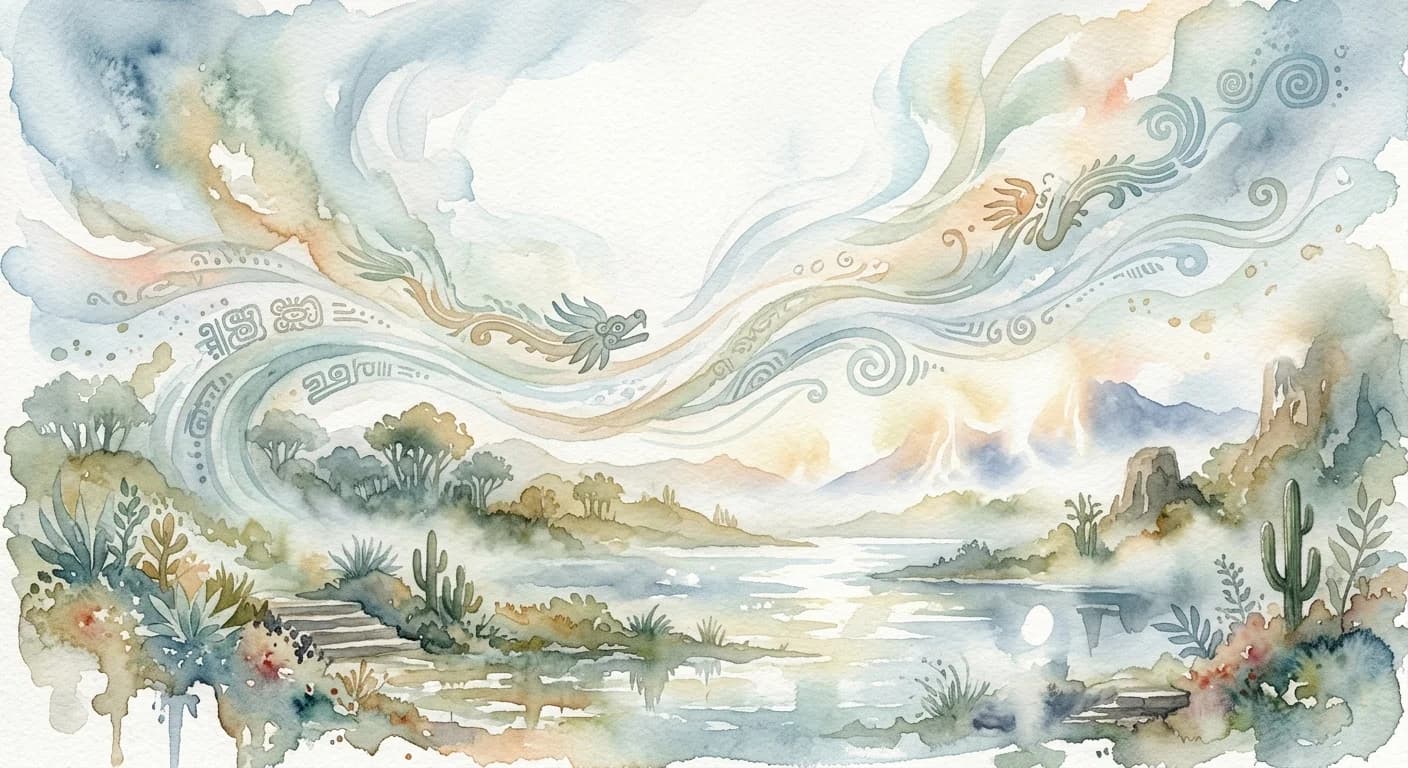
In Nahuatl cosmology, Ehecatl is intrinsically linked to Quetzalcoatl, the feathered serpent deity, often appearing as one of his manifestations or as the god who cleared the path for the rain gods. Ehecatl's role was crucial in creation myths, particularly in breathing life into the Maguey plant, from which humanity was said to have originated, and also in bringing forth the Fifth Sun, our current cosmic era. The continuous presence of 'ehecatl' in their language and worldview highlights a profound understanding of the interconnectedness of all life through a shared, vibrant, and invisible force, emphasizing breath not just as a biological function but as a divine essence. This concept reveals a world where the natural elements are imbued with personhood and sacred power.
Experience It
The Breath of Creation
During a ceremonial recounting of the creation myth, the elder spoke of how Quetzalcoatl, in his aspect as Ehecatl, blew life into the first humans. The listeners imagined the divine wind sweeping across the nascent world, awakening consciousness and movement.
Whispers in the Cornfield
A farmer walked through his maize field, feeling the gentle breeze rustle the tall stalks. He murmured, 'Ehecatl, may your breath nourish these plants,' recognizing the wind not just as a weather phenomenon, but as a living force vital for his harvest.
What Gets Lost in Translation
English speakers often reduce 'ehecatl' to merely 'wind,' missing its profound spiritual and cosmological dimensions. It's not just air moving, but an active, divine agent of creation, transformation, and life itself. The nuance of it being the *animating principle* is frequently lost, leading to an incomplete understanding of its significance.
Across Cultures
Similar concepts of a life-giving breath or wind can be found in various cultures. The ancient Greek 'pneuma' encompassed breath, spirit, and soul. In Sanskrit, 'prana' refers to the vital life force or breath. Hebrew 'ruach' also signifies wind, breath, and spirit, much like 'ehecatl', underscoring a shared human intuition about the unseen forces that animate existence.
The Deeper Meaning
Ehecatl reveals a worldview where the sacred is not separate from the natural world but is deeply embedded within it. It posits that life is not a static state but an ongoing process of being animated by a universal, invisible force. This concept emphasizes interconnectedness and highlights breath as a fundamental, shared essence that binds all living things, from humans to the very cosmos.
Did You Know?
Ehecatl-Quetzalcoatl temples were uniquely circular or cylindrical, designed to offer no resistance to the wind, symbolizing the deity's ubiquitous and unhindered movement across the earth and sky.
How It's Used
Used in cosmology, mythology, and to refer to the wind.