Teotlac
/teh-OHT-lahk/
Meaning
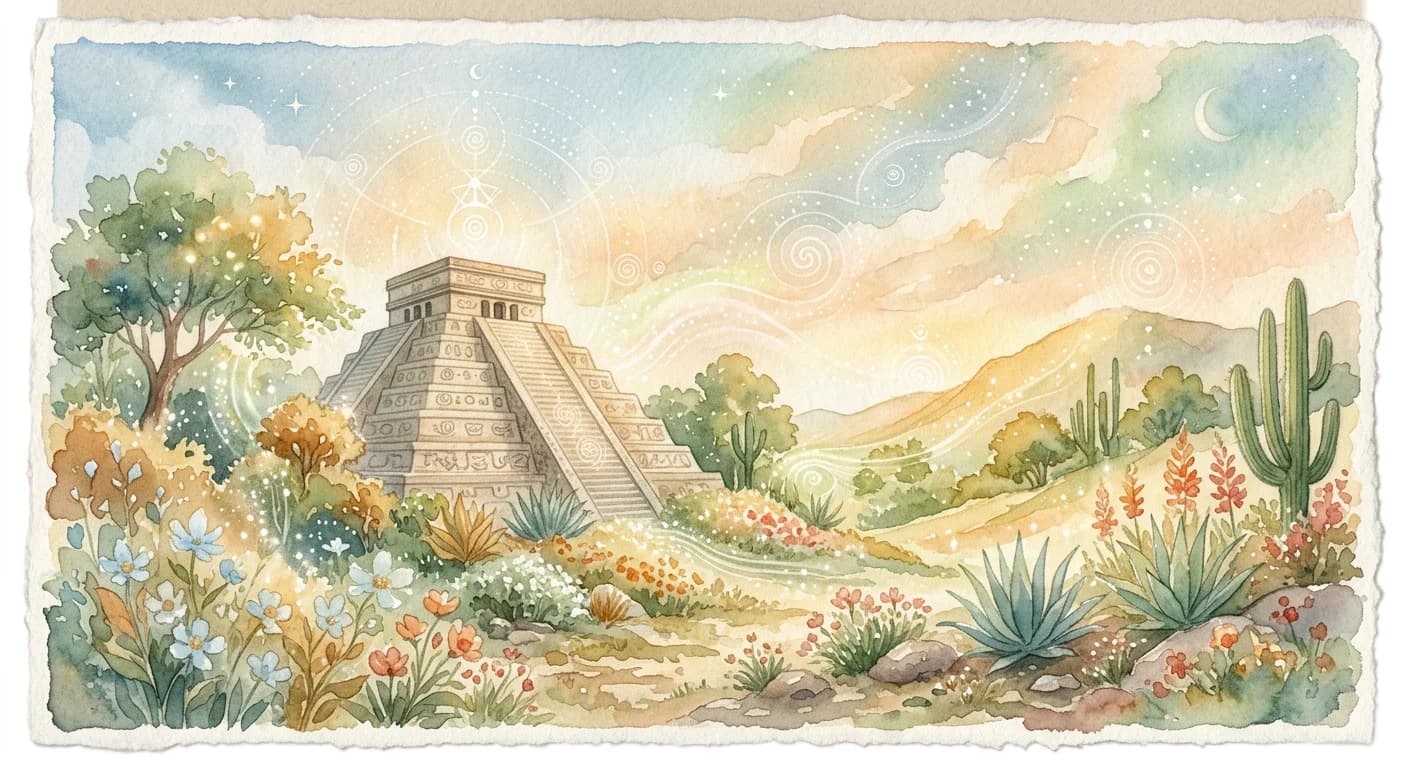
Teotlac transcends the simple Western concept of a 'god,' embodying the sacred, dynamic essence that pulses through the cosmos. It refers to the animating, divine force immanent in all existence – from the rustling leaves and the soaring eagle to the very breath of human life and the intricate dance of the stars. This power is not just observed but experienced, shaping destiny, influencing natural cycles, and revealing the profound interconnectedness of the universe. It is the very fabric of the sacred woven into the tapestry of reality.
Literal Translation
divine being / god
The Story Behind the Word
The concept of 'teotlac' is foundational to the Nahua worldview, reflecting a profound understanding of the universe as a living, interconnected entity. Its existence reveals a culture that perceived the divine not as a distant creator, but as an active, ever-present force permeating every aspect of existence – from the growth of maize to the cycle of life and death, and the very act of speaking. This word encapsulates a cosmology where humans are not separate from the sacred but are active participants in its continuous unfolding. It underscores a philosophy of immanence, where the sacred is found within the material world, demanding respect, reciprocity, and ritual engagement to maintain cosmic balance. This perspective shaped everything from religious practices and social structures to art and poetry, emphasizing flow, transformation, and the constant interplay of forces.
Experience It
A Sacred Harvest
As the maize stalks swayed gently in the breeze, an elder looked out over the fields. He felt the 'teotlac' in the fertile soil, in the nourishing rain, and in the life-giving sun, understanding that the harvest was a gift from the sacred essence that permeated all creation.
Whispers of the Wind
A young Nahua poet sat by a flowing river, listening to the murmurs of the water and the rustle of leaves. She composed verses about the 'teotlac' that spoke through the wind, danced in the sunlight, and flowed within the river's current, connecting all things in an eternal rhythm.
What Gets Lost in Translation
English speakers often mistakenly equate 'teotlac' directly with 'god' or 'deity,' imposing a monotheistic or anthropomorphic framework. This overlooks its pervasive, impersonal, and immanent nature, which is more akin to a sacred energy or principle rather than a singular, personified being. The nuance of 'teotlac' lies in its non-transcendent quality; it is not 'above' the world but deeply embedded within it.
Across Cultures
Similar concepts appear in various animistic and pantheistic traditions. The Hawaiian 'mana' describes a pervasive spiritual power, while the Daoist 'Dao' speaks of the fundamental, unnamable cosmic order. The Sioux concept of 'Wakan Tanka' (Great Mystery) also echoes the idea of a sacred force that animates all things, though it often includes specific spirit beings. These terms all point to a worldview where the divine is not separate from the natural world.
The Deeper Meaning
The concept of 'teotlac' reveals a deeply holistic and animistic philosophy, where there is no strict separation between the sacred and the profane, or between nature and spirit. It posits that the universe is imbued with a living, intelligent force, making all existence inherently meaningful and interconnected. This worldview encourages a profound sense of reverence for the natural world and a recognition of humanity's integral role within the cosmic order, emphasizing harmony and balance over dominion.
Did You Know?
The word 'teotl' (the root of 'teotlac') is so fundamental that it can be combined with other Nahuatl words to describe various aspects of the divine, like 'Teotl-Tlacatl' (divine person) or 'Teotl-In Yolotl' (divine heart).
How It's Used
Used in indigenous communities and academic studies of Nahuatl culture and religion to refer to divine forces or sacred principles.