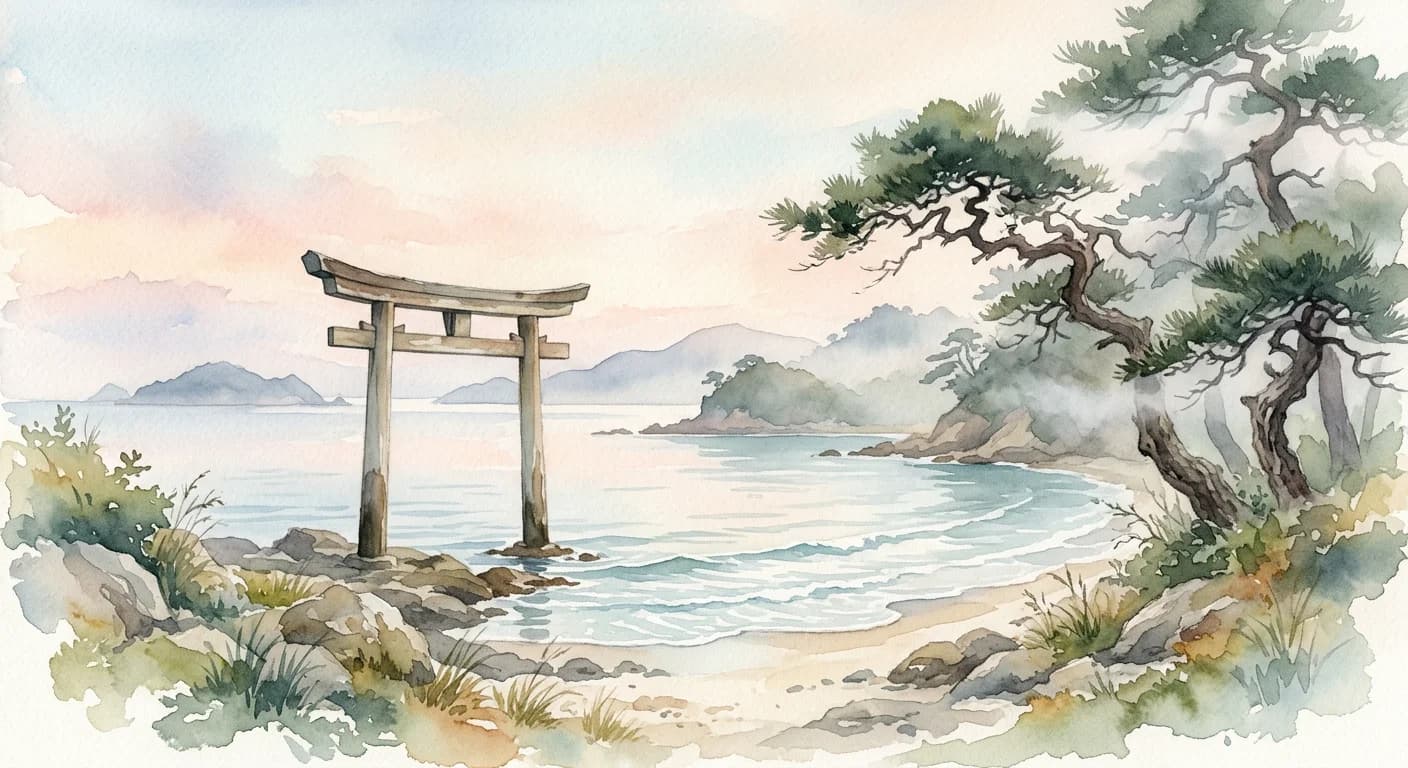
Amakusa
/ah-mah-KOO-sah/
Meaning
Amakusa is far more than a geographical designation for a cluster of islands off Kyushu; it's a living testament to a profound historical narrative. It evokes a landscape steeped in natural beauty, where rugged coastlines meet serene seas, but more significantly, it resonates with the enduring spirit of the Kakure Kirishitan, Japan's 'hidden Christians.' This name encapsulates centuries of clandestine faith, persecution, and remarkable resilience, shaping a unique regional identity forged in the crucible of religious devotion and survival.
Literal Translation
Amakusa (天草) literally translates to 'heavenly grass'.
The Story Behind the Word
The very name 'Amakusa' is steeped in the dramatic narrative of Japan's Christian century (16th-17th) and the subsequent era of prohibition. Following the Shimabara Rebellion (1637-1638), a pivotal event where Amakusa played a central role, Christianity was brutally suppressed. For over 250 years, the islands became a sanctuary and a crucible for the Kakure Kirishitan, who secretly maintained their faith, meticulously adapting Christian practices to blend with Buddhist and Shinto rituals. This unique syncretism, born out of necessity, reveals a profound Japanese capacity for adaptation and perseverance in the face of extreme adversity. The word 'Amakusa' thus embodies a deep cultural memory of sacrifice, unwavering belief, and the ingenious ways in which a suppressed community preserved its identity, reflecting a worldview where spiritual conviction could transcend political decree and cultural assimilation.
Experience It
A Pilgrimage to Sakitsu
An elderly woman from Tokyo visits Sakitsu Village in Amakusa, a UNESCO World Heritage site. As she walks past the Gothic church built atop the site of a former magistrate's office, she reflects, 'To think, for generations, people here nurtured their faith in secret, right under the authorities' noses. Amakusa truly tells a story of enduring spirit.'
Discussing Local Identity
During a cultural exchange, a young Amakusa islander explains to a foreign visitor, 'When we say 'Amakusa,' it's not just about the beautiful sea or delicious seafood. It's about our history, our 'hidden Christian' ancestors, and the unique resilience that defines us. It's who we are.'
The Deeper Meaning
Amakusa embodies the philosophical concept of 'endurance through adaptation' (忍耐と適応). It illustrates how a community can maintain its core identity and beliefs not through overt resistance, but by ingeniously integrating and concealing them within the dominant culture. This reveals a worldview where spiritual conviction is not rigid, but fluid and resourceful, capable of surviving centuries of suppression by transforming its outward expression while preserving its inner essence.
Did You Know?
Despite its association with Christianity, the literal translation of Amakusa (天草) is 'heavenly grass,' suggesting an ancient connection to the islands' lush, natural landscape long before the arrival of foreign faiths.
How It's Used
Amakusa is used as a proper noun to refer to the Amakusa Islands and the surrounding region in Kumamoto Prefecture, Japan. It is also used to denote the culture, history, and people associated with this area, particularly in discussions of its unique Christian heritage.