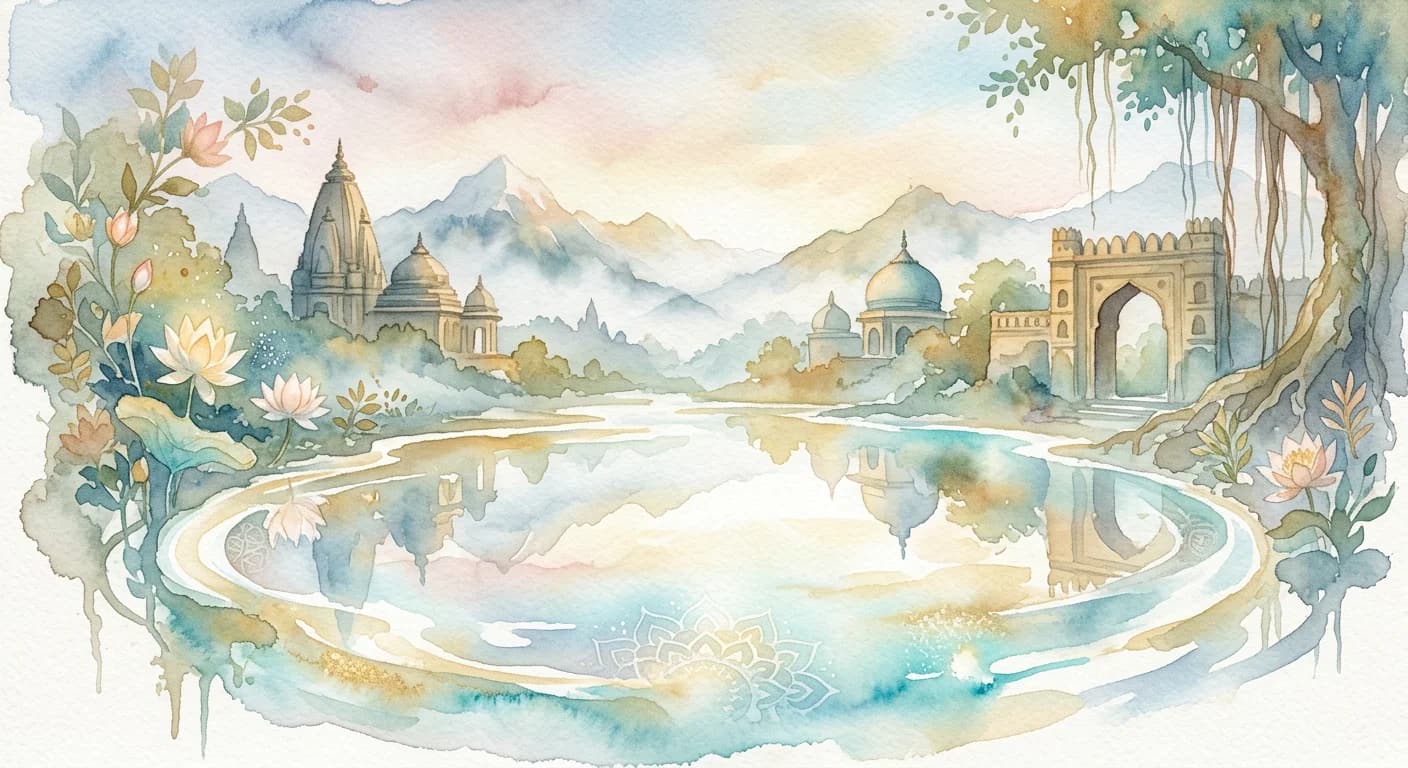
Amrita
/AHM-ri-tah/
Meaning
Amrita, far more than a mere 'nectar of the gods', embodies the ultimate divine elixir that bestows immortality and liberation from the endless cycle of birth, death, and rebirth (samsara) across Indian spiritual traditions. It is the very essence of spiritual perfection, a state of profound enlightenment and blissful transcendence. The quest for Amrita symbolizes humanity's deepest yearning for ultimate truth, spiritual awakening, and freedom from all worldly suffering, representing the pinnacle of spiritual attainment.
Literal Translation
immortal, not dead
The Story Behind the Word
The concept of Amrita is deeply woven into the fabric of Indian cosmology and spirituality, particularly in Hinduism. Its most famous mythological origin story, the Samudra manthan (churning of the cosmic ocean) by devas (gods) and asuras (demons), illustrates the immense effort and struggle required to obtain this divine substance. This narrative reflects a fundamental worldview where immortality and spiritual liberation are not easily granted but must be earned through rigorous spiritual practice, penance, and a profound understanding of cosmic principles. The existence of Amrita signifies a belief in a transcendent reality beyond mortal limitations, where purity, devotion, and wisdom can lead to a state of eternal bliss and freedom. It underscores the Indian emphasis on spiritual evolution as the ultimate purpose of life.
Experience It
The Yogi's Quest
After decades of intense meditation in the Himalayas, the old yogi felt a profound shift within. He realized his pursuit was not just for worldly knowledge, but for a sip of the inner Amrita, the divine essence that promised liberation from all earthly attachments.
Divine Blessing
In the ancient epic, Lord Vishnu, in his Mohini form, distributed the Amrita to the gods, ensuring their eternal life and victory over the demons. This act secured cosmic balance, a testament to Amrita's power to uphold dharma and sustain divine order.
The Deeper Meaning
Amrita reveals a profound philosophical insight: true immortality isn't merely the absence of physical death, but a state of spiritual liberation (moksha) and enlightenment. It signifies that the ultimate goal of existence is to transcend the material realm and realize one's inherent divine, deathless nature, thereby uniting with the cosmic consciousness.
Did You Know?
The legendary 'Samudra manthan' (churning of the cosmic ocean) to obtain Amrita is a central myth, symbolizing the arduous spiritual struggle required to achieve ultimate wisdom and immortality.
How It's Used
The term 'Amrita' is used in religious texts, philosophical discussions, mythological narratives, and spiritual practices. It is often invoked in contexts related to cosmology, divine beings, and the ultimate goal of spiritual attainment.