Karesansui
/KAH-reh-SAHN-soo-ee/
Meaning
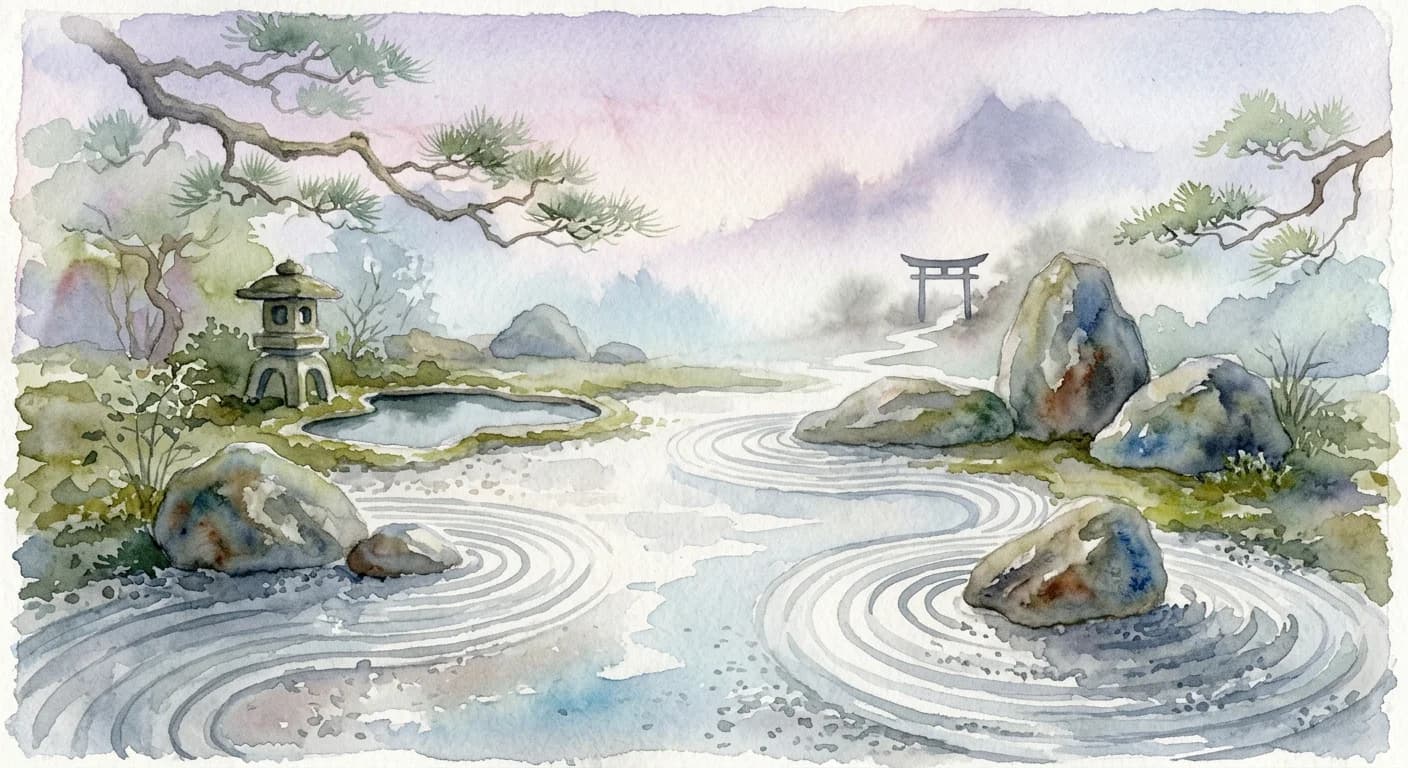
Karesansui, literally 'dry mountain water,' is a profound Japanese garden style where meticulously raked sand or gravel symbolizes water, and carefully placed rocks represent mountains or islands. Far more than mere aesthetics, these gardens are three-dimensional koans, designed to invite deep contemplation and evoke a sense of profound tranquility. The deliberate absence of actual water or verdant flora compels the viewer to engage their imagination, fostering a spiritual stillness and a direct connection to nature's fundamental essence and the boundless universe.
Literal Translation
dry mountain water
The Story Behind the Word
The karesansui garden is deeply rooted in Zen Buddhism, emerging as a distinct art form during the Muromachi period (1336-1573) in Japan. Monks, seeking aids for meditation and enlightenment, developed these gardens as miniature, abstract representations of the cosmos. The raking of gravel, known as 'samon,' is itself a meditative practice, symbolizing the flowing water, ripples, or even emptiness. This practice reflects the Zen principles of austerity, simplicity (wabi-sabi), and the belief that profound truths can be found in the most understated forms. Karesansui reveals a worldview that values inner perception over outer spectacle, where the absence of elements can be more powerful than their presence, encouraging introspection and a direct experience of the interconnectedness of all things.
Experience It
Morning Meditation
A monk kneels before the karesansui garden at Ryoan-ji, his gaze tracing the perfectly raked patterns in the white gravel. The arrangement of the fifteen rocks, seemingly random yet meticulously placed, guides his mind into a state of quiet contemplation, each ripple a pathway to inner stillness.
Urban Oasis
In a bustling Tokyo high-rise, a minimalist karesansui garden on a balcony offers a respite. A busy executive sips tea, watching the subtle interplay of light and shadow on the raked gravel, finding a moment of peace amidst the urban chaos, a miniature universe to calm her mind.
The Deeper Meaning
Karesansui embodies the Zen Buddhist philosophy of 'mu' (emptiness) and 'enlightenment through absence.' By stripping away superfluous elements, it forces the mind to fill the void, to imagine the water, the mountains, the universe within. This process cultivates an appreciation for simplicity, impermanence, and the profound interconnectedness of nature, encouraging a meditative state where inner peace is found through external austerity.
Did You Know?
The most famous karesansui, at Ryoan-ji temple in Kyoto, is designed so that from any vantage point, one of its fifteen rocks is always hidden from view, symbolizing that enlightenment or true understanding is always just beyond our full grasp.
How It's Used
Used to describe a specific style of Japanese Zen garden, often found at temples and private residences, as well as in art and design contexts inspired by this aesthetic.