U.
HomeRegionsLanguagesEmotionsCollections
Find Your Word

“The limits of my language mean the limits of my world.”

— Ludwig Wittgenstein, Philosopher

Untranslatable

A curated collection of the world's most beautiful expressions—words that remind us language is humanity's greatest invention.

  • Home
  • Collections
  • Regions
  • Countries
  • Emotions
  • Tags
  • Contexts
  • Finder
  • Europe
  • Asia
  • Americas
  • Africa
  • Middle East
  • About
  • Contact
  • Privacy Policy
  • Terms of Service

2026 © Untranslatable. All rights reserved.

    /
    /
    1. Home
    2. /
    3. Asia
    4. /
    5. Thangka
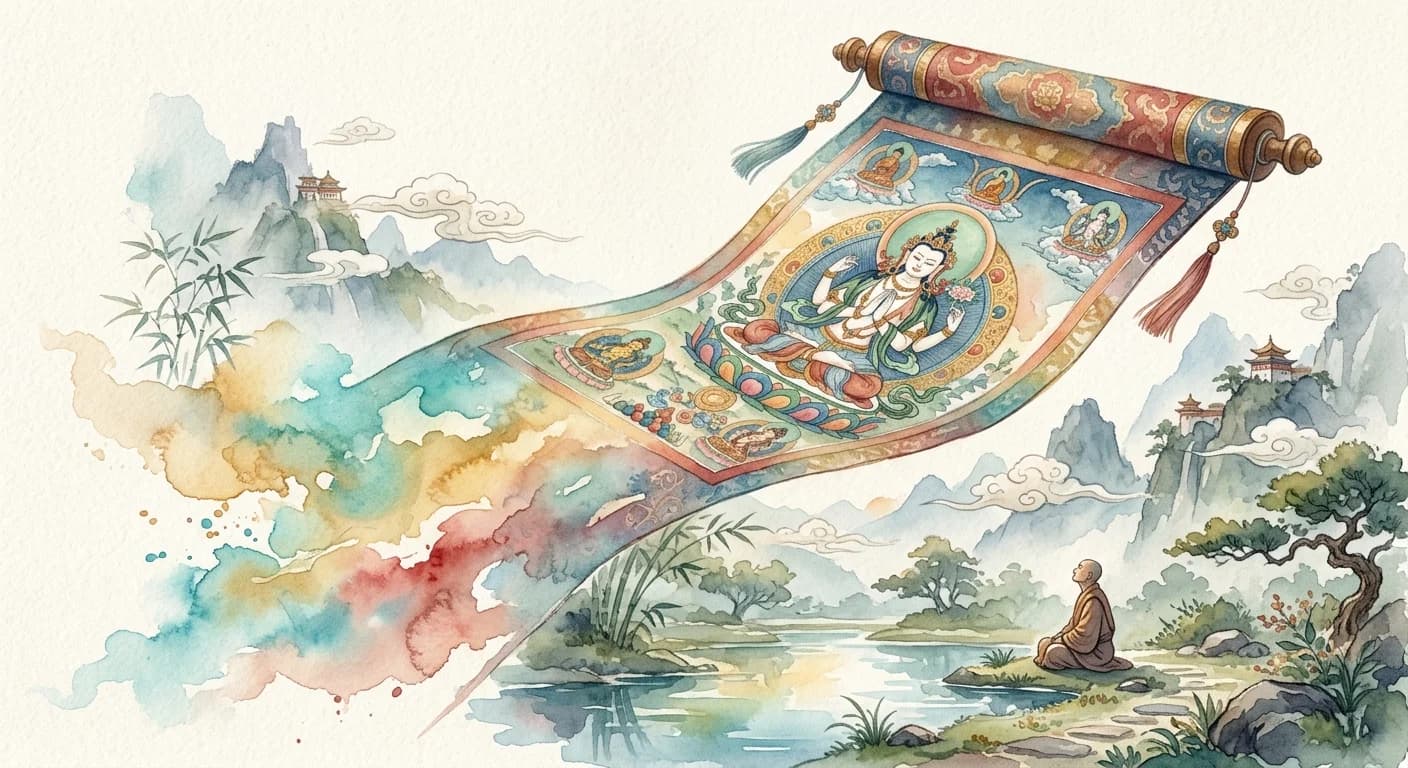
    Artistic representation of Thangka
    Tibetan•
    🇨🇳China

    Thangka

    /TAHN-kah/

    Meaning

    A Thangka is far more than a mere painting; it is a sacred scroll, meticulously crafted to serve as a conduit to the divine in Tibetan Buddhism. These vibrant artworks, often depicting deities, mandalas, or profound spiritual narratives, are visual scriptures, each brushstroke imbued with intention and prayer. They function as portable temples, guiding practitioners through complex meditative visualizations and embodying the teachings of the Dharma, bridging the earthly realm with the enlightened state.

    Literal Translation

    Scroll painting

    The Story Behind the Word

    The Thangka's existence is deeply rooted in the practical and spiritual needs of Tibetan Buddhism. Historically, as a nomadic culture, easily portable religious artifacts were essential, and the rollable Thangka perfectly fit this requirement, allowing sacred imagery to travel with monks and devotees. Philosophically, it reflects the Buddhist emphasis on visual aids for meditation and teaching, making abstract concepts like the interconnectedness of all phenomena or the path to enlightenment tangible. The creation of a Thangka is itself a spiritual practice, requiring immense discipline, devotion, and adherence to iconographic rules passed down through generations, embodying the belief that art can be a direct path to liberation. They reveal a worldview where the sacred is not confined to temples but can be brought into everyday life, transforming any space into a place of contemplation and prayer.

    Experience It

    Meditation with Thangka

    In a dimly lit monastery cell, a young monk sits before a beautifully unfurled Thangka depicting Avalokiteshvara. He gazes intently at the deity's compassionate eyes, using the intricate details of the painting as a focal point for his meditation, visualizing the deity's presence and absorbing its qualities into his own being.

    Pilgrim's Offering

    An elderly woman, after a long pilgrimage, carefully unrolls a small, worn Thangka of the Medicine Buddha in her humble home. She places offerings before it, seeking blessings for her family's health, her devotion pouring into the sacred image that has traveled with her for decades.

    The Deeper Meaning

    The Thangka embodies the Buddhist principle of 'skillful means' (upaya), where art serves as a powerful pedagogical tool to convey profound spiritual truths. It reflects a worldview where visual representation isn't mere decoration but a living, breathing aspect of spiritual practice, guiding the mind towards enlightenment. Each symbol and color points beyond itself, urging the viewer to look inward and understand the interconnectedness of all existence and the potential for liberation.

    Did You Know?

    Traditionally, Thangka artists undergo rigorous training for many years, often starting as apprentices at a young age, learning not just painting techniques but also Buddhist philosophy and iconography by heart.

    How It's Used

    Used to refer to Tibetan Buddhist scroll paintings, often displayed in monasteries or homes for religious purposes or artistic appreciation.

    Emotions
    gratitude,peace,serenity,wonder
    Contexts
    art,cultural identity,meditation,religion
    🇨🇳China

    by Annelise Dubois·Written Mar 14, 2026·Updated Apr 3, 2026

    Related Words

    Explore more
    Dolce far nienteItalian

    Dolce far niente captures the profound joy and effortless pleasure derived from simply existing without obligation or purpose. It's the art of savoring moments of pure, unadulterated idleness – lying in the sun, watching the clouds drift, or enjoying a leisurely coffee – not as a break from work, but as a valuable state in itself. This 'sweetness of doing nothing' is a conscious embrace of stillness and contentment, allowing the soul to breathe and the senses to fully engage with the present.

    Wabi-sabiJapanese

    Wabi-sabi is the profound appreciation for the ephemeral, the imperfect, and the incomplete aspects of existence. It is about discovering beauty in the subtle textures of age, the unique character of flaws, and the gentle decay that marks the passage of time. This philosophy encourages a quiet acceptance of impermanence and a mindful connection to the natural world, finding elegance in simplicity and authenticity.

    IkigaiJapanese

    Ikigai is more than just a reason to get out of bed; it's a deeply personal and evolving sense of purpose that brings genuine fulfillment and joy to one's life. It represents the sweet spot where your passions, talents, needs of the world, and what you can be paid for beautifully converge. Discovering your ikigai often leads to a life lived with intentionality, resilience, and a profound connection to one's contributions. It's the intrinsic motivation that fuels a meaningful existence, regardless of external circumstances.

    NunchiKorean

    Nunchi is the sophisticated, almost telepathic, ability to instantly grasp the unspoken dynamics of any social situation, anticipating others' thoughts and feelings, and then responding with impeccable grace and timing. It's an acute form of social intuition, allowing one to navigate complex interpersonal landscapes by reading subtle cues like body language, tone, and context. Possessing good nunchi means effortlessly understanding the underlying emotional currents and adjusting one's behavior to maintain harmony and effectiveness, often without a single word exchanged.