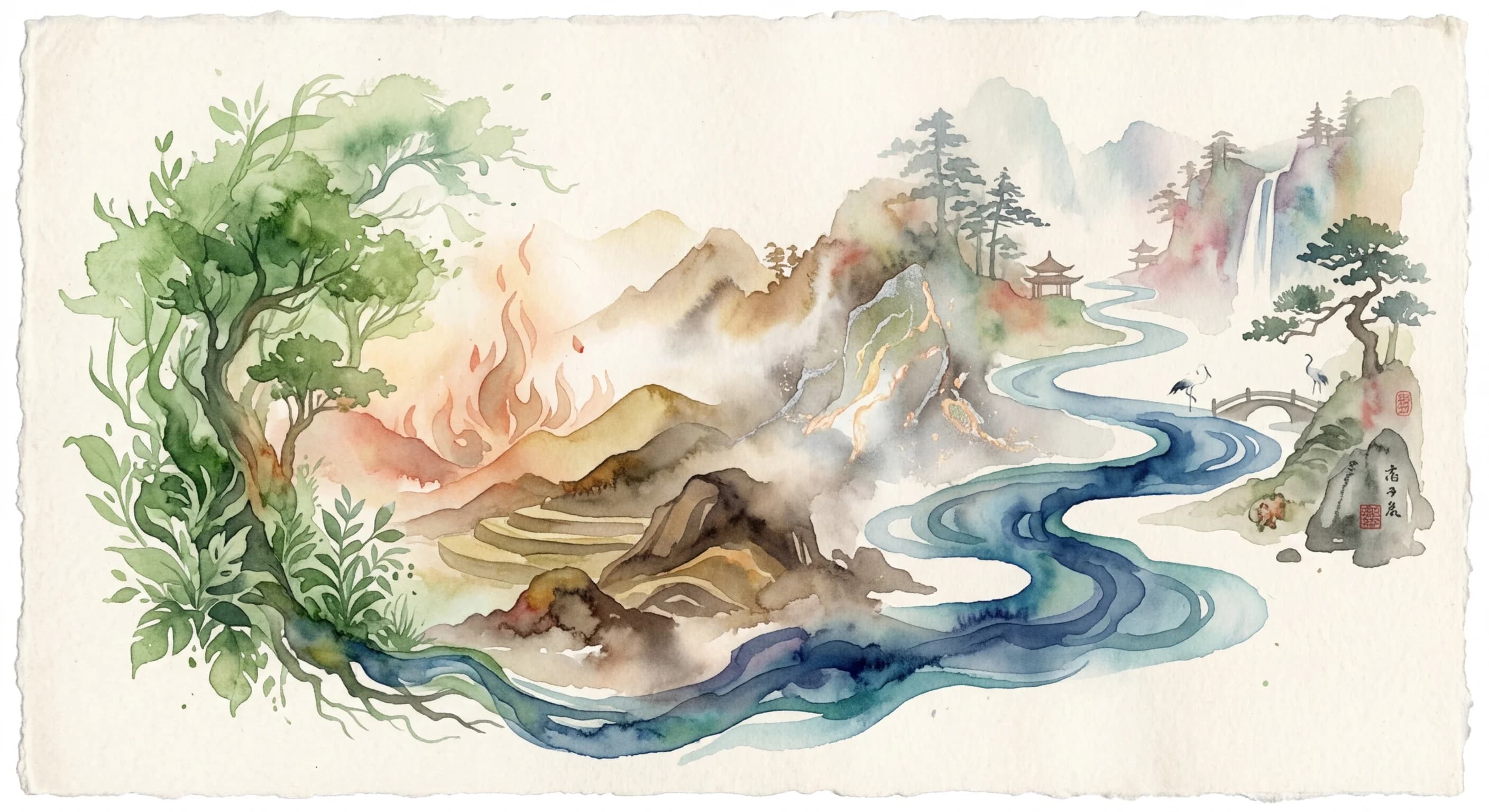
五行 (wǔxíng)
/woo shing/
Meaning
Wǔxíng, or the Five Phases, is a cornerstone of traditional Chinese thought, depicting the universe not as static elements but as dynamic, interconnected processes. It categorizes all phenomena—from the seasons and human organs to emotions and directions—into Wood (木), Fire (火), Earth (土), Metal (金), and Water (水). These phases are in constant, rhythmic interaction, generating and overcoming each other in an endless cosmic dance. This holistic framework illuminates the intricate balance of nature, health, and society, emphasizing cyclical transformation over linear progression.
Literal Translation
five rows / five movements
The Story Behind the Word
The concept of Wǔxíng emerged during the Warring States period, solidifying as a comprehensive cosmological framework during the Han Dynasty. It reflects a profound ancient Chinese belief in an ordered, cyclical cosmos where everything is interrelated and constantly transforming. Rather than a distinct set of 'elements' in the Western sense, Wǔxíng represents active 'phases' or 'movements' that describe processes and relationships. This worldview underpins traditional Chinese medicine, where imbalances in the Wǔxíng within the body are seen as the root of illness, and Feng Shui, which seeks to harmonize human environments with these natural forces. It reveals a culture deeply attuned to patterns, cycles, and the interconnectedness of all existence, where health and prosperity stem from aligning with these universal rhythms.
Experience It
Acupuncturist's Diagnosis
A patient complains of anxiety and restless sleep. The acupuncturist observes their reddish complexion and rapid pulse, diagnosing an excess of 'Fire' element in the heart meridian. To restore balance, needles are placed at points associated with 'Water' (which overcomes Fire) and 'Earth' (which absorbs Fire's intensity), aiming to calm the spirit.
Feng Shui Harmony
A homeowner consults a Feng Shui master about their office. The master notes an abundance of metal furniture in a south-facing room. Since Fire (south) melts Metal, this arrangement can create energetic conflict. Advice is given to introduce more wood and water elements – perhaps a wooden plant stand and a small water feature – to generate and nourish the space more harmoniously.
The Deeper Meaning
Wǔxíng embodies a non-dualistic, relational philosophy where reality is understood through dynamic interactions and transformations rather than discrete, independent entities. It posits that everything is in a continuous state of flux, governed by predictable cycles of generation and control. This perspective encourages a holistic approach to understanding the world, emphasizing balance, harmony, and adaptation over rigid categorization or reductionism, and seeing conflict as an integral part of maintaining equilibrium.
Did You Know?
Despite being commonly translated as 'Five Elements,' the original Chinese character '行' (xíng) actually means 'to move,' 'to walk,' or 'a phase,' highlighting the dynamic, process-oriented nature of Wǔxíng, not static substances.
How It's Used
Wu Xing is a foundational concept in traditional Chinese culture, appearing in fields such as medicine, astrology, martial arts, geomancy (Feng Shui), and philosophy. It's used to understand and predict natural cycles, diagnose imbalances in the body, and guide harmonious living.