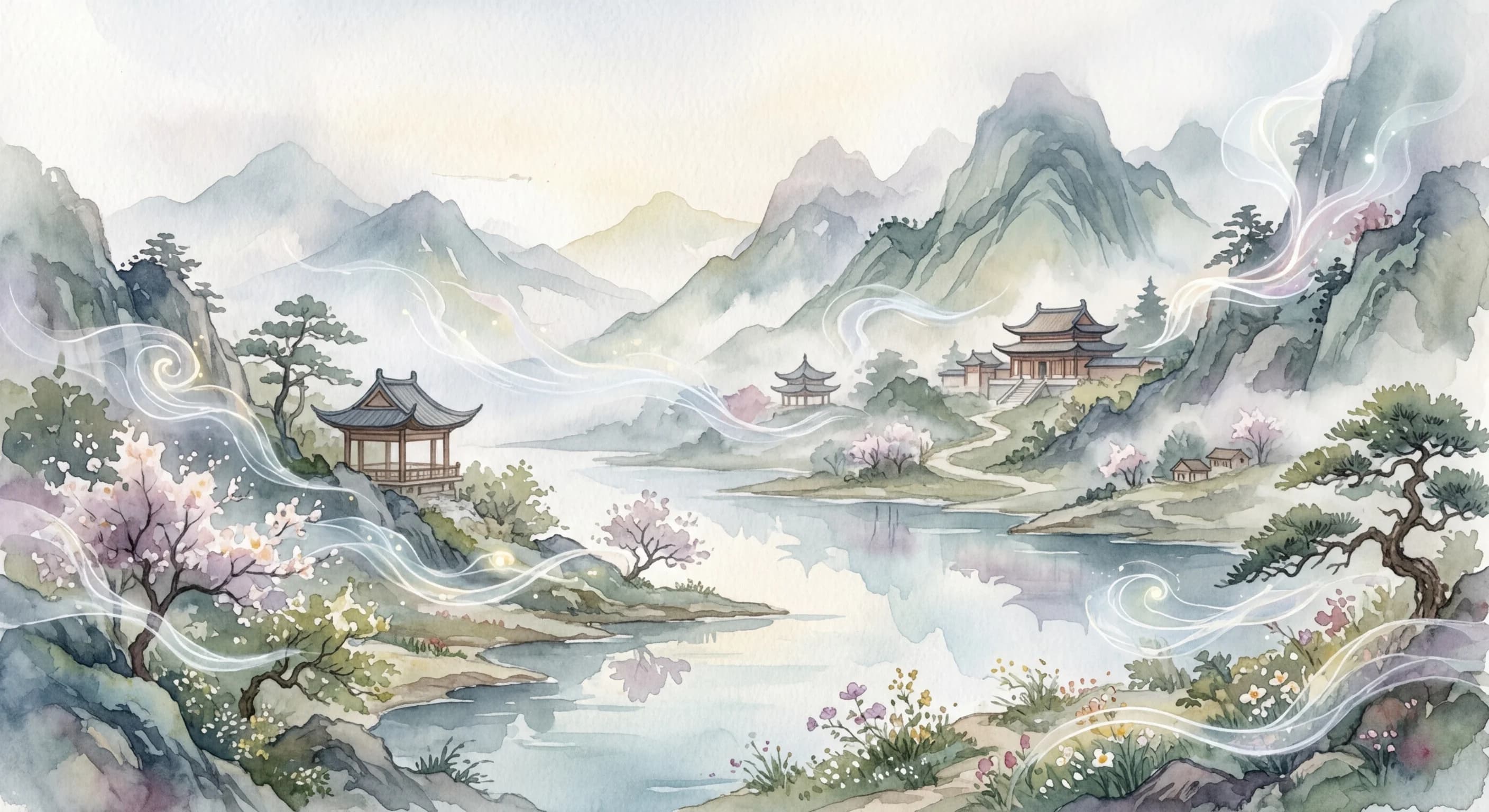
Lung
/LOONG/
Meaning
In Tibetan culture, 'lung' transcends a simple breath; it is the dynamic, invisible life force that animates all existence, both within the body and throughout the cosmos. It represents the subtle currents of energy that govern our physical and mental well-being, influencing mood, health, and even the weather. 'Lung' is intricately linked to the impermanence of all phenomena and the profound interconnectedness of every living thing, embodying the very essence of life's fluid and ephemeral nature.
Literal Translation
wind, breath
The Story Behind the Word
The concept of 'lung' is foundational to Tibetan Buddhism and traditional Tibetan medicine (Sowa Rigpa). Its existence reflects a worldview that sees the universe and the human body as integrated systems of energy flows. In Buddhist philosophy, 'lung' is one of the five elements and is crucial for the movement of consciousness and the realization of enlightenment. Its emphasis on balance and subtle energy reveals a culture deeply attuned to internal states and environmental harmony, where physical ailments are often understood as manifestations of energetic blockages or imbalances. This holistic perspective underscores the interconnectedness of mind, body, and environment, shaping practices from meditation to dietary regimens.
Experience It
A Healer's Diagnosis
The patient complained of persistent anxiety and cold extremities. The Amchi (Tibetan doctor) gently felt her pulse, discerning an agitated 'lung' energy. He prescribed specific herbal remedies and advised meditation to calm the internal winds, explaining that her emotional distress was manifesting as a disruption in her vital currents.
Monastic Meditation
During a deep meditation session, a young monk focused on his breath, not merely as air, but as 'lung' – the subtle energy flowing through his central channel. He sought to harmonize these internal winds, believing it essential for clearing mental obscurations and achieving higher states of consciousness and compassion.
The Deeper Meaning
The concept of 'lung' reveals a profound philosophical insight into the non-duality of mind and body, and the interconnectedness of internal experience with external reality. It posits that all phenomena are impermanent, dynamic, and arise from the interplay of subtle energies. This encourages a holistic approach to life, emphasizing balance, awareness, and the recognition that our inner state profoundly influences our outer world and vice-versa.
Did You Know?
Did you know that 'lung' is one of the three 'nyepa' or humors in Tibetan medicine, alongside 'tripa' (bile/heat) and 'beken' (phlegm/cold), whose balance is crucial for good health?
How It's Used
Used in philosophical and spiritual discussions, as well as in traditional Tibetan medicine to describe physiological and energetic imbalances.