Chakari
/CHAH-kah-ree/
Meaning
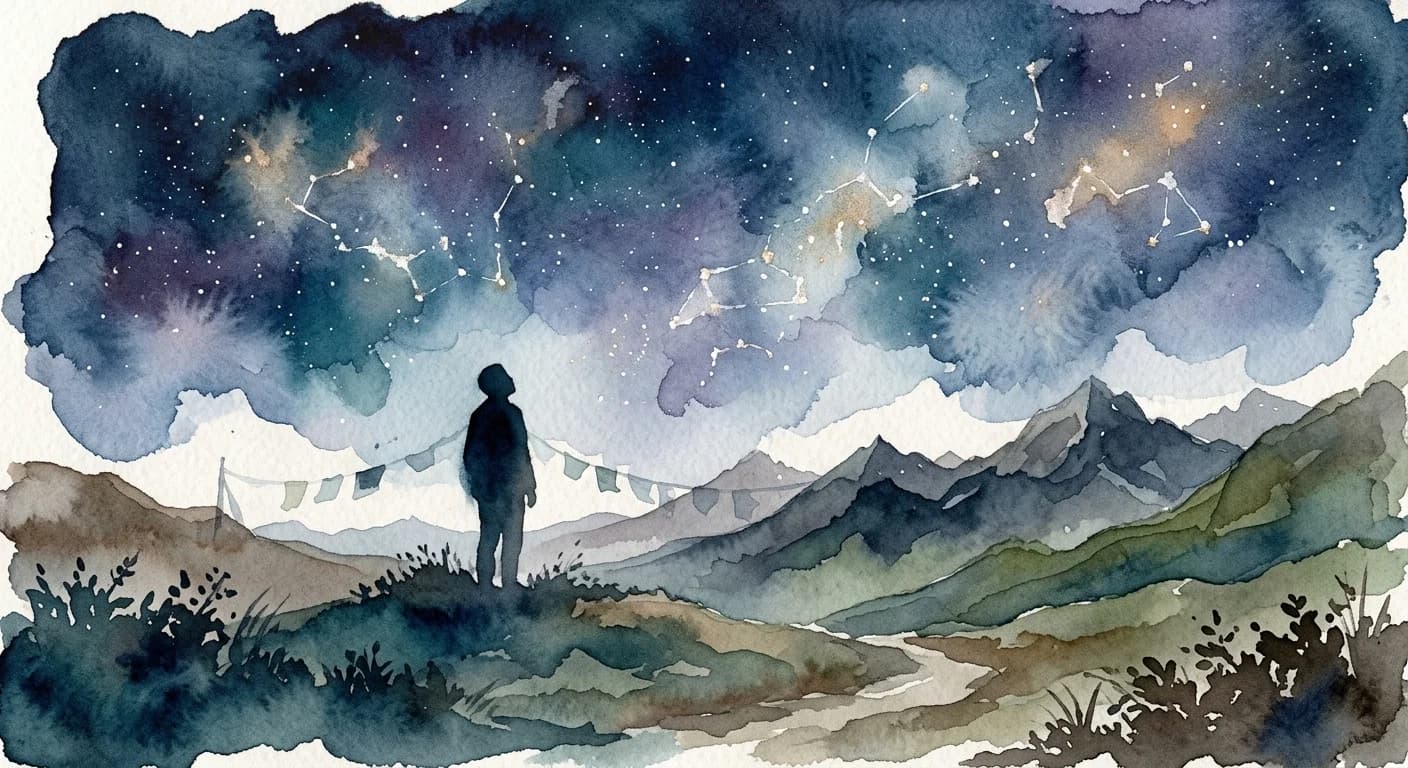
Chakari encapsulates the profound, almost spiritual, peace and deep satisfaction that arises from observing the natural world, particularly the boundless, star-studded night sky. It's an immersive experience that transcends mere aesthetic appreciation, fostering a visceral sense of belonging to the vast cosmos. This feeling involves a humbling realization of one's interconnectedness within the universe, leading to a unique blend of awe, serenity, and quiet contemplation that touches upon existential peace and profound wonder.
Literal Translation
While not a direct literal translation, 'chaka' can refer to a plate or a round object, and 'ri' is a suffix. The meaning is derived from the context of the roundness of the sky and the feeling it evokes.
The Story Behind the Word
The existence of 'chakari' in Nepali culture is deeply rooted in the Himalayan people's historical connection to nature and their spiritual traditions. Living amidst towering mountains, where the night sky often appears unblemished and overwhelmingly vast, fosters a perspective that emphasizes humility and interconnectedness. Traditional Nepali philosophies, influenced by Hinduism and Buddhism, often stress the transient nature of individual existence and the eternal cycle of the cosmos. 'Chakari' reflects this worldview, where observing the grand scale of the universe isn't just about beauty, but a direct path to understanding one's place in the cosmic dance, offering solace and a sense of unity with something far greater than oneself. It reveals a culture that values contemplation and finds spiritual resonance in the natural world.
Experience It
Himalayan Starry Night
After a long day of trekking in the Annapurna foothills, Maya lay on her back, gazing at the Milky Way stretching across the dark sky. A profound sense of 'chakari' washed over her, making the cold air and physical exertion disappear as she felt utterly at peace and connected to everything.
Riverside Contemplation
Sitting by the Trishuli River, watching the endless flow of water and the distant, unchanging mountains, Ramesh felt a deep 'chakari'. The immensity of the landscape dwarfed his daily worries, replacing them with a quiet, satisfying sense of belonging to the ancient earth.
The Deeper Meaning
This word reveals a worldview where humanity is not separate from nature, but an integral, albeit small, part of a grand cosmic order. 'Chakari' suggests that true peace and understanding come from recognizing and embracing this interconnectedness, finding profound meaning not in human achievements, but in the overwhelming majesty and cyclical permanence of the natural world. It underscores a philosophy of humility and reverence for the universe.
Did You Know?
While literally connecting to 'roundness,' the 'chakari' feeling is not limited to spherical objects, but rather the encompassing, boundless 'roundness' of the sky or horizon, evoking a sense of completion and infinity.
How It's Used
Used to describe the feeling of peace and awe experienced when looking at the night sky or vast natural landscapes.