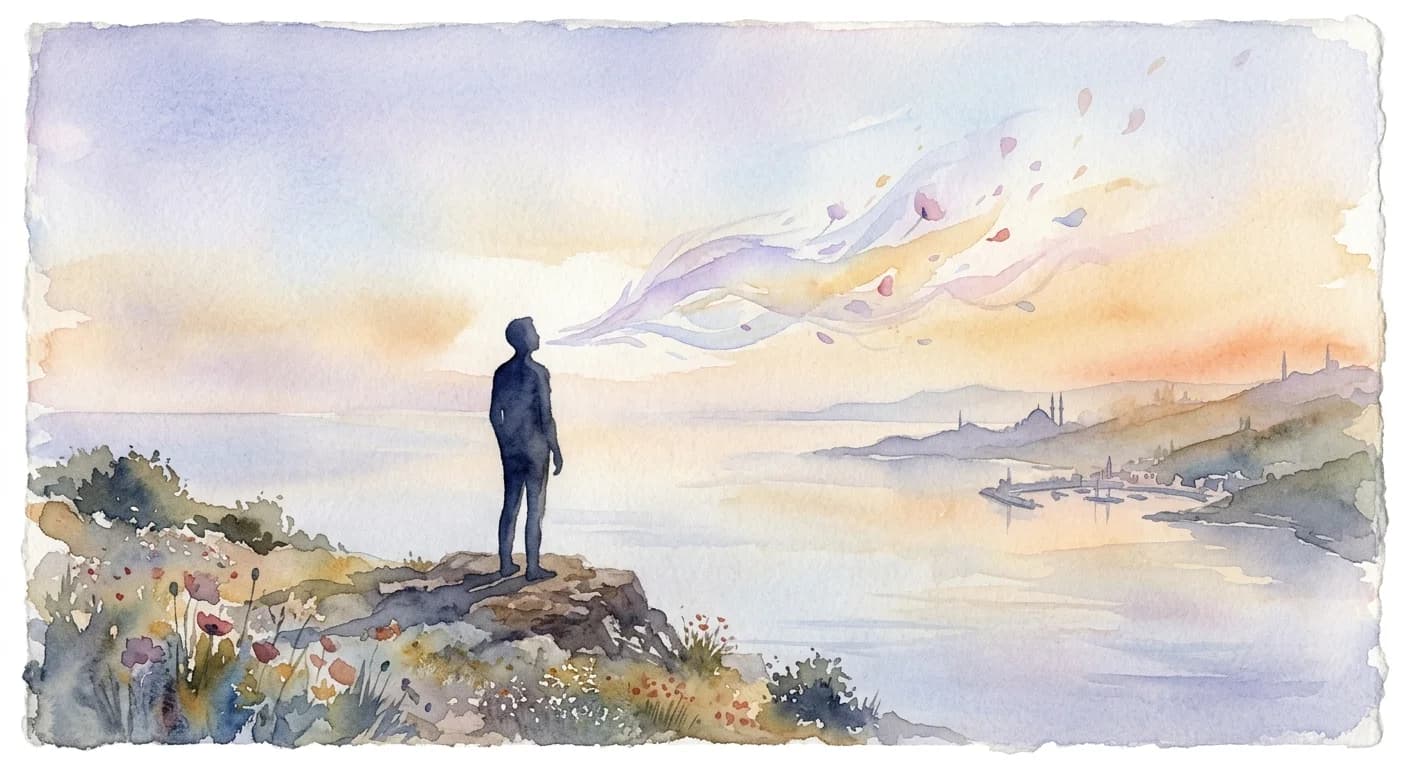
Ferah
/FEH-rah/
Meaning
Ferah is more than mere relief; it's an expansive breath of the soul, a profound sense of inner spaciousness that emerges after constraint or distress. It signifies a delightful liberation, where mental clutter dissipates, replaced by clarity and an unburdened spirit. This feeling isn't just fleeting happiness, but a deeply calming and optimistic state, likening the mind to an open, sunlit landscape after a storm, inviting renewed well-being and a joyful exhale of freedom.
Literal Translation
Spaciousness, openness, relief, cheerfulness
The Story Behind the Word
The prevalence of 'ferah' in Turkish culture reflects a deep-seated appreciation for inner tranquility and the ability to find solace amidst life's challenges. In a society that has historically navigated periods of complexity and often values resilience, the capacity to cultivate internal spaciousness becomes a vital coping mechanism and a marker of well-being. It speaks to a worldview where the inner state is paramount, and true freedom is found not just in external circumstances, but in the mind's ability to expand and find peace, even in constrained environments. It embodies the aspiration for mental and emotional lightness, a cultural antidote to burdens.
Experience It
After a Long Confinement
After weeks of being confined indoors during a severe winter, Elif finally stepped out onto her balcony as the sun broke through. The fresh air, the vast blue sky, and the distant sound of birds filled her with a profound 'ferah'. Her spirit felt light and boundless.
Unburdening the Mind
For months, Ayşe had been consumed by a complex project. The moment she submitted the final report, a wave of 'ferah' washed over her. Her mind, previously cluttered with deadlines and details, suddenly felt clear, light, and expansive, ready to embrace new thoughts.
What Gets Lost in Translation
English speakers might equate 'ferah' simply with 'relief' or 'cheerfulness,' missing its core emphasis on internal spaciousness and mental clarity. It's not just about feeling good, but about feeling unburdened and expanded from within, a quality of being rather than just an emotion. The nuance of a 'mental exhale' or 'soul's expansion' is often lost.
Across Cultures
While direct equivalents are rare, 'ferah' shares kinship with concepts like the Japanese 'yutori' (ゆとり), implying a sense of space, peace, and ample time, often after a period of rush. The Portuguese 'desafogo' also touches upon relief from pressure, though without the same spiritual spaciousness. In some spiritual traditions, achieving a 'clear mind' or 'open heart' resonates with the expansive, unburdened quality of ferah.
The Deeper Meaning
Ferah reveals a philosophy that values inner liberation as much as, if not more than, external freedom. It suggests that true well-being stems from the mind's capacity to transcend limitations and find spaciousness within, regardless of outward circumstances. This word underscores a belief in the human spirit's ability to create pockets of peace and expansion, even when faced with pressure or confinement, highlighting resilience and internal mastery.
Did You Know?
The word 'ferah' is often used in Turkish to describe not just a feeling, but also physical spaces. A 'ferah oda' (spacious room) implies a bright, airy, and inviting atmosphere that evokes a similar sense of ease.
How It's Used
Used to describe the feeling of relief from stress, a sense of mental spaciousness, or the joy of being in an open, expansive environment.