Sefirot
/SEH-fee-roht/
Meaning
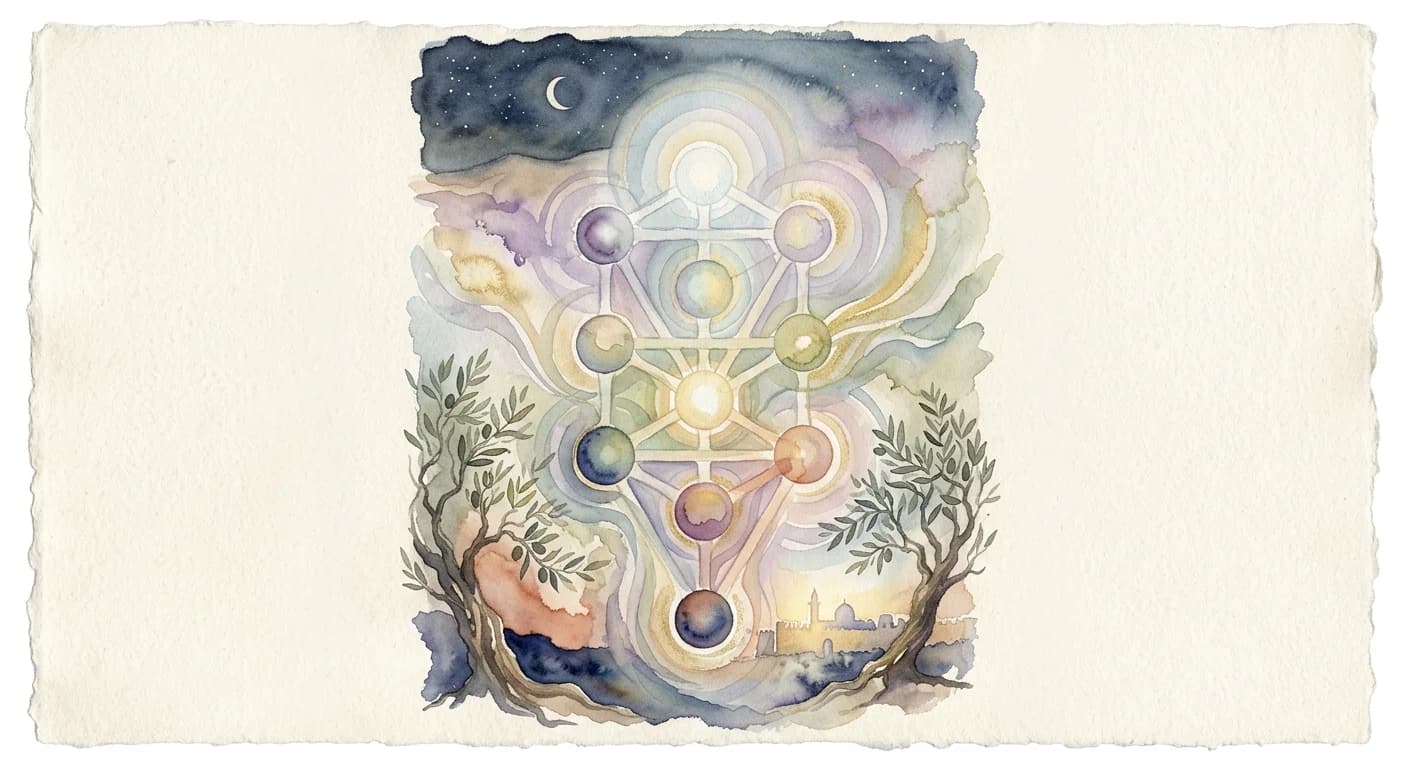
Sefirot refers to the ten luminous divine emanations, not separate deities, but facets of the singular, infinite God (Ein Sof), through which the divine essence manifests and interacts with the cosmos. These attributes, such as Wisdom, Understanding, and Loving-Kindness, form a dynamic blueprint for creation and a ladder for human spiritual ascent, guiding the flow of divine consciousness into existence. They are often visualized as a cosmic tree (Etz Chaim) or a complex system of interconnected spheres, illustrating the intricate dance between hidden divinity and revealed reality.
Literal Translation
Emanations, divine attributes
The Story Behind the Word
The Sefirot are the cornerstone of Kabbalistic thought, offering a profound mystical framework that emerged in medieval Jewish communities, particularly in Spain and Provence. This concept arose from a deep spiritual yearning to understand God's hidden nature and His relationship with a seemingly imperfect world, providing a bridge between the unknowable divine and human experience. It reflects a worldview where divinity is not distant but intimately involved in creation, cascading through these ten channels to bring everything into being. The Sefirot provide a map for understanding the universe, human psychology, and the path to spiritual rectification (Tikkun Olam), revealing that by refining our own attributes, we can mirror and draw closer to the divine.
Experience It
Kabbalist's Meditation
A student of Kabbalah sits in contemplation, visualizing the Sefirah of Chesed (Loving-Kindness) expanding within their heart. They focus on embodying unconditional love and generosity, believing this act helps to draw divine light into the world, aligning their soul with the cosmic flow.
Explaining Creation
A Rabbi teaches a class on the creation story, explaining how God didn't just 'poof' the world into existence, but rather, the Sefirot unfolded sequentially, like a divine blueprint, from the hidden Keter (Crown) down to Malkhut (Kingdom), bringing order and structure to reality step by step.
What Gets Lost in Translation
English speakers often mistakenly perceive the Sefirot as distinct 'gods' or a polytheistic pantheon due to the concept of multiple divine attributes. However, Kabbalah strictly maintains their unity as expressions of a single divine essence. Another misconception is viewing them as merely abstract philosophical concepts, rather than dynamic, active forces that shape reality and offer a path for human spiritual engagement and transformation.
Across Cultures
While unique in its Kabbalistic formulation, the concept of divine emanations or attributes has parallels in other traditions. The 'Logos' in Hellenistic philosophy and early Christianity, representing divine reason or word, bears some resemblance. Hindu traditions feature various deities as manifestations of a singular Brahman, and Sufi mysticism explores divine attributes (Asma al-Husna) as facets of Allah. These all grapple with the challenge of describing an infinite, transcendent divine interacting with a finite, immanent world.
The Deeper Meaning
The Sefirot reveal a dynamic, relational understanding of divinity, challenging static notions of God. They posit that the divine is not a monolithic, inaccessible entity but a complex, interconnected system of energies that are both transcendent and immanent. This framework suggests that human beings, created in the 'image of God,' possess these same Sefirotic qualities, implying a profound responsibility to cultivate them and participate in the ongoing process of creation and spiritual cosmic repair (Tikkun Olam).
Did You Know?
The order and interrelationships of the Sefirot are often depicted as the 'Tree of Life' (Etz Chaim), a complex diagram that has become one of the most recognizable symbols of Kabbalah, influencing art and esoteric thought far beyond Judaism.
How It's Used
Primarily used in the context of Jewish mysticism (Kabbalah) to describe the divine attributes and their role in creation and spiritual development.