Qì
/chee/
Meaning
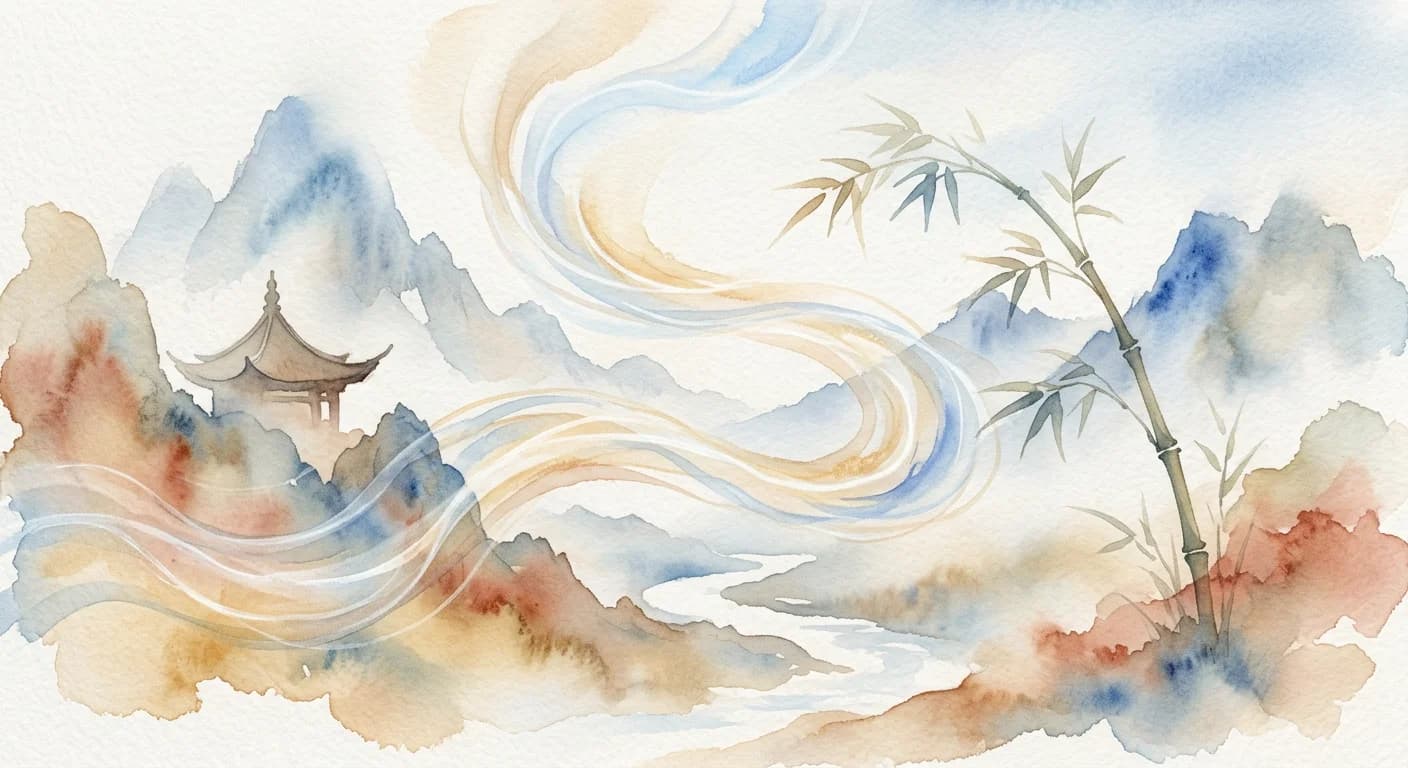
Qì embodies the fundamental life force and cosmic energy that permeates all existence, from the universe's vastness to the intricate workings of a human body. It is not merely breath or physical energy but a dynamic, invisible current that animates life, sustains health, and influences one's mental and spiritual vitality. In traditional Chinese thought, the balanced and harmonious flow of Qì is essential for well-being, with disruptions leading to illness and discomfort, which practices like Tai Chi and acupuncture aim to restore.
Literal Translation
energy, spirit, breath
The Story Behind the Word
The concept of Qì is ancient, deeply embedded in Chinese philosophy, medicine, and martial arts for over two millennia. Originating from observations of natural phenomena and human vitality, it became a cornerstone of Taoism, which views Qì as the fundamental substance of reality and the basis for all transformations. Confucians also integrated Qì into their understanding of human nature and moral cultivation. This pervasive concept reflects a holistic worldview where mind, body, and spirit are inseparable, and humans are seen as microcosms within a larger, energetic universe. It explains not just health, but also artistic expression, martial prowess, and even geomancy (Feng Shui), revealing a culture that seeks harmony and balance in every aspect of life.
Experience It
Acupuncture for Stagnant Qi
A woman complains of persistent headaches and fatigue. Her Traditional Chinese Medicine practitioner explains that her Qì flow is stagnant, like a dammed river, causing pain and sluggishness. Fine needles are inserted at specific points to unblock these energetic pathways, aiming to restore the smooth circulation of her vital energy.
Cultivating Martial Qi
During a Tai Chi class, the master instructs students to 'sink their Qì to their Dantian,' a point below the navel. This isn't just about physical posture; it's about concentrating internal energy, building a stable core, and channeling vital force for both self-defense and internal health, leading to greater power and resilience.
What Gets Lost in Translation
English speakers often reduce Qì to a purely physical 'energy' or 'breath.' However, it's far more nuanced, encompassing mental, emotional, and spiritual aspects, and is not directly measurable by Western scientific instruments. It's also not a static entity but a dynamic, constantly flowing and transforming force.
Across Cultures
Similar concepts of a vital life force exist in many cultures. In India, 'Prana' is the cosmic life energy, central to Yoga and Ayurveda. Ancient Greek philosophy had 'Pneuma,' a vital breath or spirit. The Japanese 'Ki' (from Qì) is fundamental to martial arts like Aikido and practices like Reiki, while Polynesian cultures speak of 'Mana' as a supernatural force or power.
The Deeper Meaning
Qì reveals a profoundly interconnected worldview where everything in the cosmos, from the smallest atom to the largest galaxy, is composed of and animated by a singular, ever-flowing energy. This perspective emphasizes balance, harmony, and the dynamic interplay of opposing forces (Yin and Yang) as fundamental to existence, encouraging a life lived in resonance with natural rhythms and universal flow.
Did You Know?
The character for Qì is often depicted as steam rising from rice, symbolizing the subtle, unseen energy derived from food and breath, essential for life and vitality.
How It's Used
Qi is a fundamental concept in traditional Chinese culture, influencing everything from martial arts and medicine to philosophy and daily life. It is discussed when referring to health, vitality, spiritual well-being, and the balance of energy within the body and the environment.