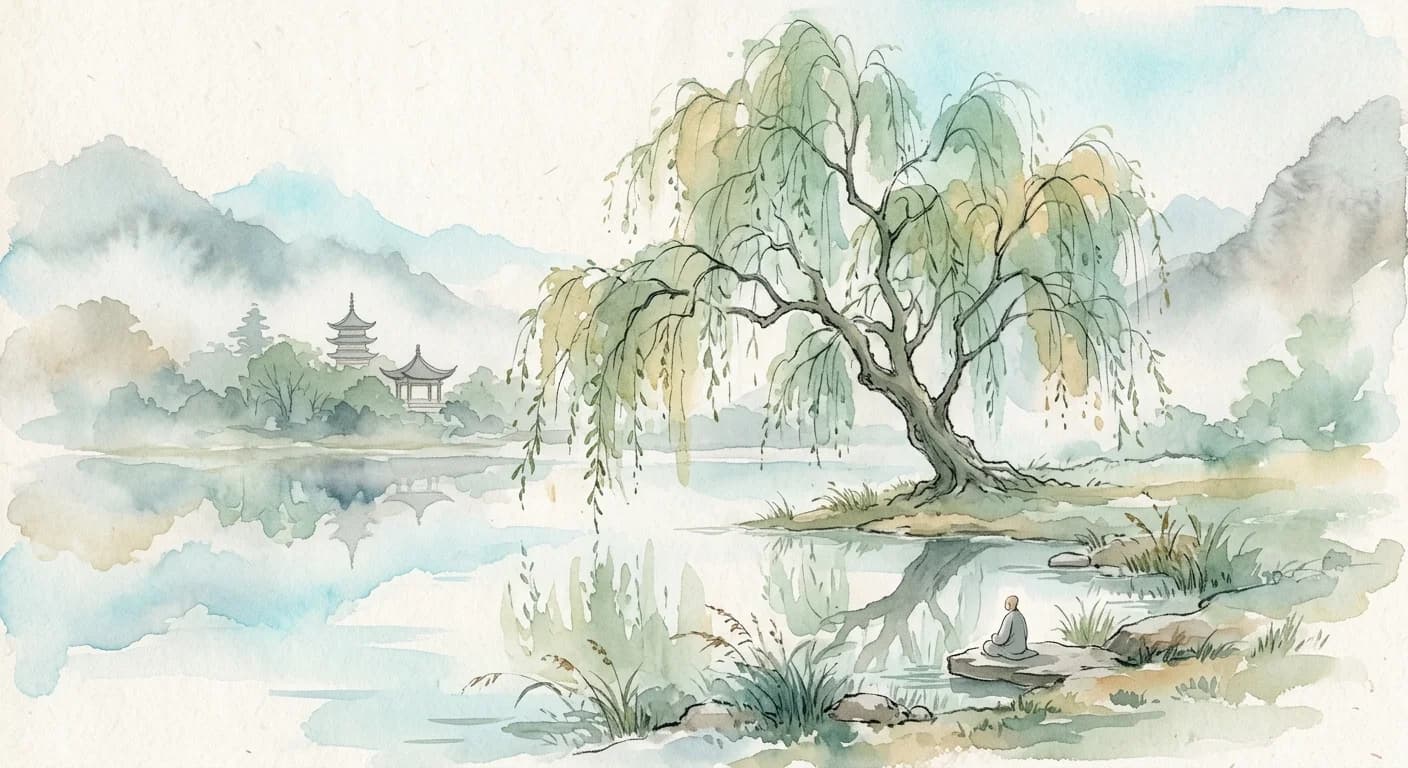
Wuwei
/WOO-way/
Meaning
Wuwei is the profound Taoist principle of 'non-coercive action' or 'effortless action,' signifying a state of harmonious alignment with the natural rhythms of the universe. It's not about idleness, but rather acting spontaneously and intuitively, much like water flowing around obstacles, finding the path of least resistance to achieve its purpose. This approach emphasizes letting go of ego-driven control and striving, allowing actions to arise naturally from a deep understanding of timing and circumstances, leading to outcomes that feel organic and without struggle.
Literal Translation
non-action, effortless action
The Story Behind the Word
Wuwei is a cornerstone of Taoist philosophy, deeply rooted in ancient Chinese thought, particularly through the teachings of Laozi and Zhuangzi. It emerged as a counter-narrative to the rigid societal structures and moralistic governance advocated by Confucianism, proposing a more fluid and natural way of living and leading. The concept reflects a worldview that sees the universe as a dynamic, self-organizing system (the Tao), and human flourishing as contingent upon aligning with this inherent flow rather than imposing artificial order. It reveals a cultural appreciation for adaptability, subtlety, and the power of yielding, emphasizing that true strength often lies in gentleness and indirectness, a perspective that has permeated Chinese art, medicine, and strategic thinking for millennia.
Experience It
The Master Chef
A master chef prepares a complex dish, moving with fluid grace. He doesn't force the ingredients or rush the process; his actions are precise yet unhurried, as if the dish is assembling itself through his hands. The result is a perfect harmony of flavors, achieved with an almost invisible effort.
Governing with Ease
A wise leader governs with Wuwei, not through strict decrees and constant intervention, but by creating an environment where people naturally thrive. She sets clear principles, empowers her community, and allows solutions to emerge organically, fostering a sense of collective purpose without heavy-handed control.
The Deeper Meaning
Wuwei unveils a profound rejection of anthropocentric control and a deep trust in the inherent wisdom of the cosmos. It suggests that true effectiveness comes from understanding and embodying the principles of the natural world, recognizing that excessive human intervention often creates more problems than it solves. This philosophy advocates for a humility that acknowledges our place within a larger, self-regulating system, encouraging a shift from forceful manipulation to cooperative participation with the flow of existence.
Did You Know?
The concept of Wuwei has even been applied to martial arts, particularly Tai Chi, where practitioners learn to harness internal energy and yield to an opponent's force, redirecting it rather than directly opposing it.
How It's Used
Wuwei is a philosophical and spiritual concept, often discussed in the context of Taoist teachings, personal cultivation, and effective leadership. It's used to describe a way of living and acting that is in harmony with the Tao (the Way).