U.
HomeRegionsLanguagesEmotionsCollections
Find Your Word

“The limits of my language mean the limits of my world.”

— Ludwig Wittgenstein, Philosopher

Untranslatable

A curated collection of the world's most beautiful expressions—words that remind us language is humanity's greatest invention.

  • Home
  • Collections
  • Regions
  • Countries
  • Emotions
  • Tags
  • Contexts
  • Finder
  • Europe
  • Asia
  • Americas
  • Africa
  • Middle East
  • About
  • Contact
  • Privacy Policy
  • Terms of Service

2026 © Untranslatable. All rights reserved.

    /
    /
    1. Home
    2. /
    3. Asia
    4. /
    5. Anjali
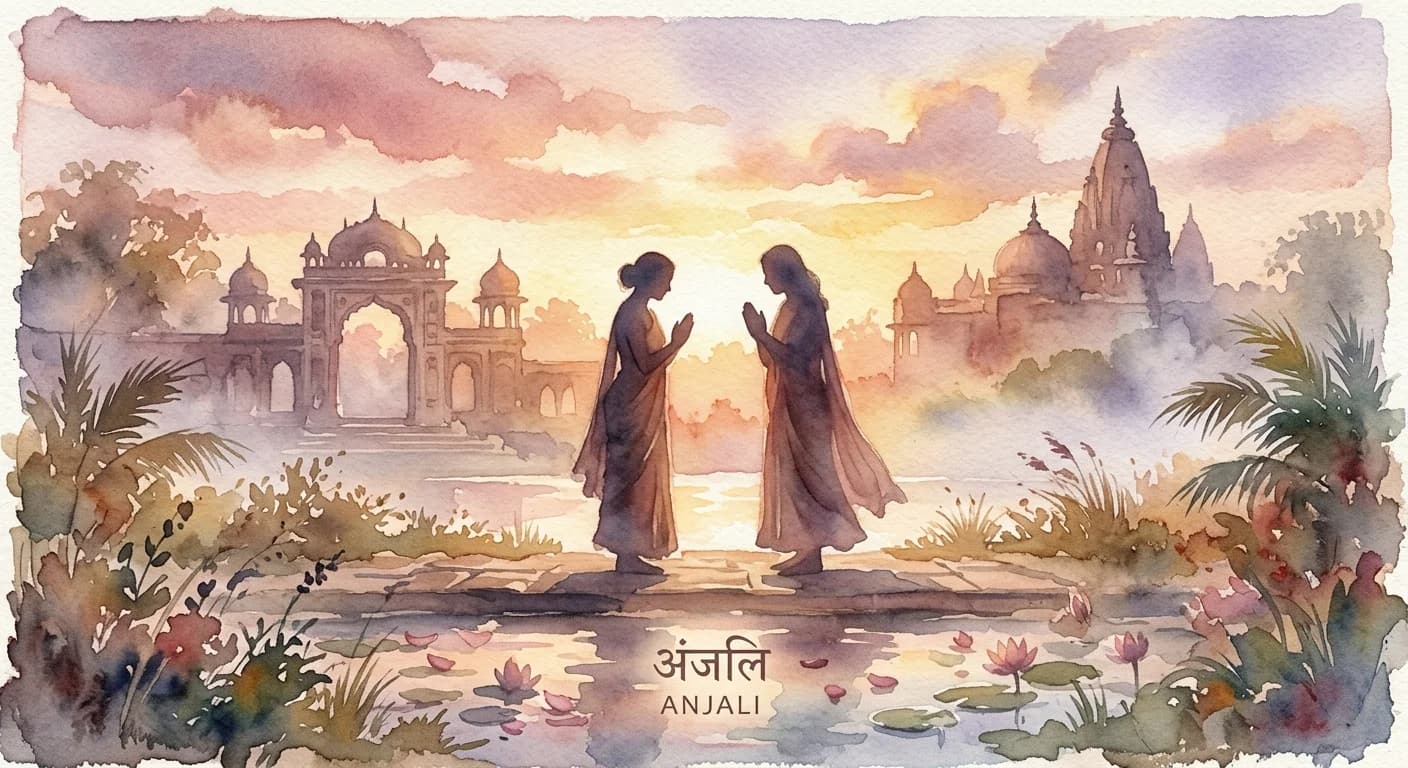
    Artistic representation of Anjali
    Sanskrit•
    🇮🇳India🇳🇵Nepal

    Anjali

    /AHN-jah-lee/

    Meaning

    Anjali transcends a mere greeting; it is a profound Sanskrit gesture where palms meet at the heart, symbolizing the convergence of body, mind, and spirit. This sacred offering acknowledges the divine spark within oneself and reverently bows to the same essence in another, fostering unity and mutual respect. It embodies humility, devotion, and a deep spiritual salutation, making it a cornerstone of Indian cultural interaction that extends far beyond a simple 'hello'.

    Literal Translation

    offering

    The Story Behind the Word

    The concept of Anjali is deeply rooted in the ancient Vedic traditions of India, where every action, even a greeting, can be imbued with spiritual significance. Its existence reflects a worldview where the divine is not confined to temples or deities, but resides within every living being (Atman). This gesture, therefore, is an external manifestation of an internal recognition of shared divinity and interconnectedness. It underscores the cultural value placed on respect, humility, and the spiritual dimension of human relationships, fostering harmony and understanding in daily interactions. The act of bringing the hands together also signifies neutralizing duality, merging the left (often associated with the material, feminine) and right (spiritual, masculine) sides of the body, expressing a desire for balance and wholeness in the interaction.

    Experience It

    Greeting an Elder

    Young Maya approached her grandmother, her hands instinctively coming together in a gentle Anjali. Her grandmother returned the gesture with a warm smile, acknowledging not just the greeting, but the deep respect and love embedded in Maya's action.

    Offering at Temple

    Inside the bustling temple, a devotee stood before the deity, eyes closed in silent prayer. Their hands were held in a perfect Anjali, a silent offering of devotion and humility, connecting their inner self to the divine presence.

    The Deeper Meaning

    Anjali embodies the advaitic philosophy prevalent in India, which posits the oneness of all existence. By recognizing the divine in another through this gesture, one implicitly acknowledges the universal spirit that connects all beings. It's a daily practice of seeing beyond superficial differences to the fundamental unity of consciousness, promoting empathy and a profound sense of shared humanity.

    Did You Know?

    Did you know that the word 'Anjali' literally means 'to offer' or 'to salute' in Sanskrit, and the gesture itself is often referred to as 'Namaste' or 'Namaskar Mudra' in yoga and spiritual practices?

    How It's Used

    Used as a respectful greeting, a gesture of prayer or worship, and a sign of reverence towards elders, deities, or esteemed individuals. It is also a common given name for females in India and Nepal.

    Emotions
    gratitude,peace,serenity
    Contexts
    celebration,farewell,greeting,religion
    🇮🇳India🇳🇵Nepal

    by Dr. Kenji Tanaka·Written Mar 14, 2026·Updated Apr 3, 2026

    Related Words

    Explore more
    Dolce far nienteItalian

    Dolce far niente captures the profound joy and effortless pleasure derived from simply existing without obligation or purpose. It's the art of savoring moments of pure, unadulterated idleness – lying in the sun, watching the clouds drift, or enjoying a leisurely coffee – not as a break from work, but as a valuable state in itself. This 'sweetness of doing nothing' is a conscious embrace of stillness and contentment, allowing the soul to breathe and the senses to fully engage with the present.

    Wabi-sabiJapanese

    Wabi-sabi is the profound appreciation for the ephemeral, the imperfect, and the incomplete aspects of existence. It is about discovering beauty in the subtle textures of age, the unique character of flaws, and the gentle decay that marks the passage of time. This philosophy encourages a quiet acceptance of impermanence and a mindful connection to the natural world, finding elegance in simplicity and authenticity.

    IkigaiJapanese

    Ikigai is more than just a reason to get out of bed; it's a deeply personal and evolving sense of purpose that brings genuine fulfillment and joy to one's life. It represents the sweet spot where your passions, talents, needs of the world, and what you can be paid for beautifully converge. Discovering your ikigai often leads to a life lived with intentionality, resilience, and a profound connection to one's contributions. It's the intrinsic motivation that fuels a meaningful existence, regardless of external circumstances.

    NunchiKorean

    Nunchi is the sophisticated, almost telepathic, ability to instantly grasp the unspoken dynamics of any social situation, anticipating others' thoughts and feelings, and then responding with impeccable grace and timing. It's an acute form of social intuition, allowing one to navigate complex interpersonal landscapes by reading subtle cues like body language, tone, and context. Possessing good nunchi means effortlessly understanding the underlying emotional currents and adjusting one's behavior to maintain harmony and effectiveness, often without a single word exchanged.