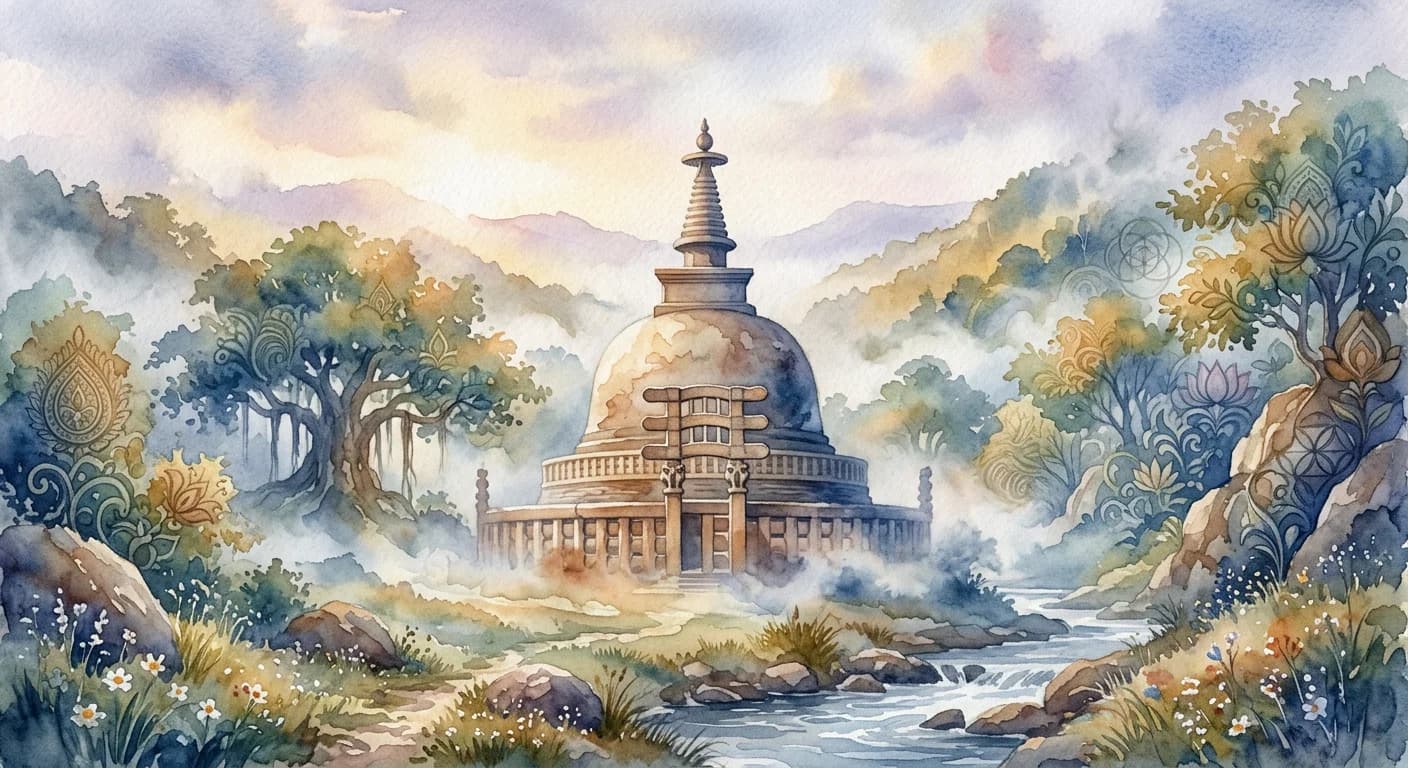
Stupa
/STOO-pah/
Meaning
A stupa is far more than a mere dome; it is a sacred architectural embodiment born from ancient India, primarily within Buddhist and Jain traditions. Initially a humble earthen mound signifying a 'heap' containing revered relics, it evolved into an intricately symbolic structure representing the enlightened mind of the Buddha and the cosmos itself. Its presence invites profound contemplation, serving as a beacon for spiritual aspiration, a poignant reminder of impermanence, and a focal point for silent devotion and pilgrimage across Asia.
Literal Translation
heap, mound
The Story Behind the Word
The concept of the stupa is deeply interwoven with the spiritual fabric of ancient India, reflecting a society profoundly concerned with samsara (the cycle of rebirth) and the path to moksha or nirvana (liberation). Its origins trace back to pre-Buddhist burial mounds, but it was Siddhartha Gautama, the Buddha, who transformed it into a central icon. After his parinirvana, his relics were distributed and enshrined in stupas, turning them into potent symbols of his continued presence and teachings. Each architectural element, from the square base (representing earth and the four directions) to the dome (representing water and the cosmic egg) and the spire (representing fire, air, and space, culminating in enlightenment), is imbued with specific cosmological and metaphysical significance. The circumambulation (pradakshina) of a stupa, performed clockwise, is a devotional act, physically enacting the spiritual journey towards enlightenment and accumulating merit. Thus, the stupa reveals a worldview where the physical structure serves as a mnemonic device and a sacred space for internal transformation, connecting the earthly realm with the transcendental.
Experience It
Pilgrimage to Sanchi
Under the scorching Indian sun, an elderly pilgrim slowly circumambulated the Great Stupa at Sanchi, his prayer beads clutched tightly. Each step was a meditation, a silent offering to the wisdom enshrined within, feeling centuries of devotion echo around him.
Monk's Morning Meditation
A young monk sat in quiet contemplation before a small, ornate stupa in the monastery courtyard. Its serene form, catching the first rays of dawn, served as a perfect visual aid for his mindfulness practice, guiding his thoughts towards emptiness and interconnectedness.
The Deeper Meaning
The stupa embodies the Buddhist philosophy of impermanence (anicca) and non-self (anatta) by containing relics of those who transcended earthly existence, yet simultaneously offers a tangible focal point for the pursuit of enlightenment. It visually represents the path to liberation, from the material world (base) to the formless realms and ultimate nirvana (spire), revealing a worldview where spiritual progress is a journey of ascension and purification.
Did You Know?
The earliest stupas were simple earthen mounds, but over centuries, they evolved into elaborate structures, sometimes even containing smaller stupas within them, like Russian nesting dolls of enlightenment!
How It's Used
The term 'stupa' is used to refer to these specific architectural structures found in Buddhist and Jain traditions, particularly in South and Southeast Asia. They are significant religious monuments and often serve as pilgrimage sites.