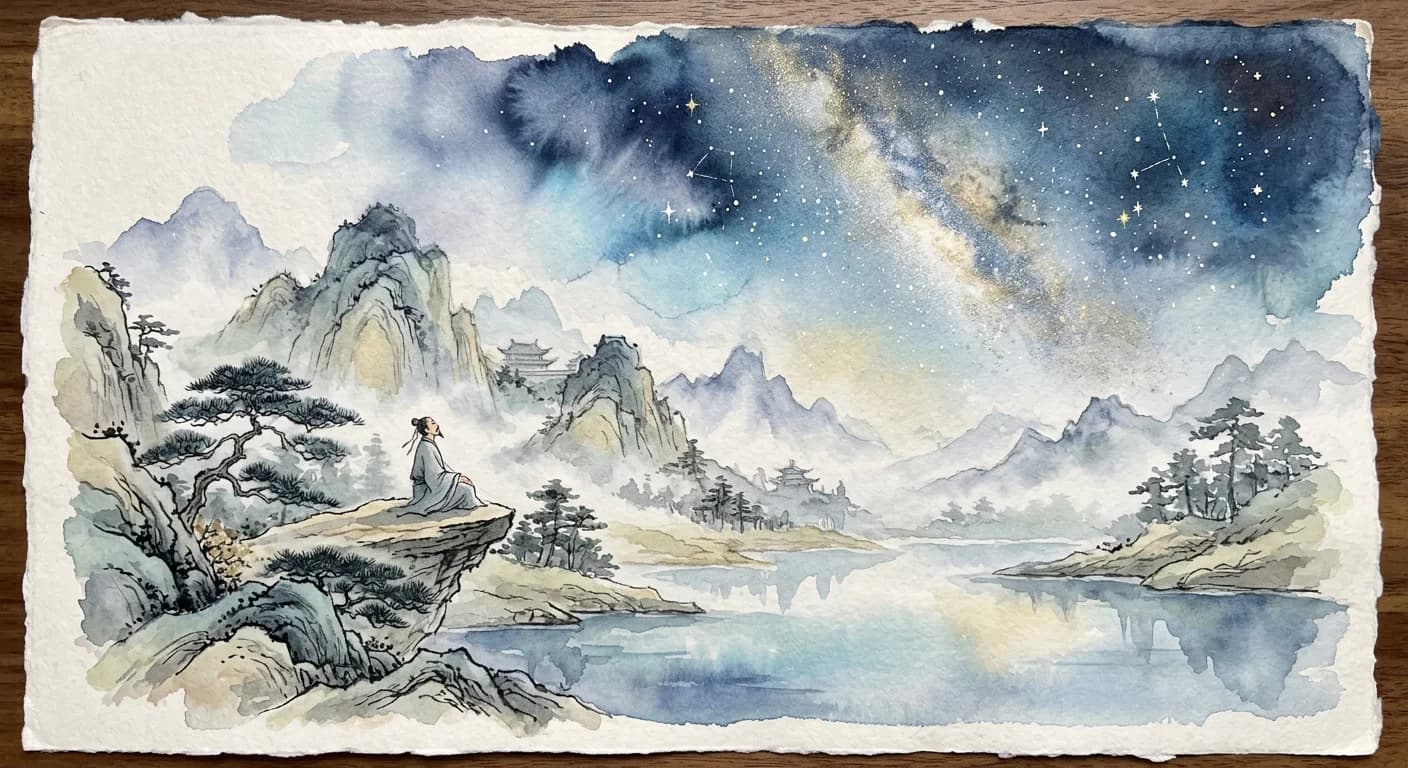
Tiān rén hé yī
/TYEN-run huh-YEE/
Meaning
Tiān rén hé yī encapsulates the profound philosophical notion that humanity is not separate from, but an integral and fluid extension of the cosmos. It urges individuals to align their existence, actions, and inner spirit with the overarching rhythms and principles of the universe, often referred to as the Tao. This ideal state transcends mere ecological awareness, suggesting a deep, almost spiritual fusion where the boundaries between the individual self, society, and the boundless natural world dissolve into a singular, harmonious whole, leading to a life of profound equilibrium and wisdom.
Literal Translation
Heaven/Sky-person-combine-one
The Story Behind the Word
The concept of 'Tiān rén hé yī' is a foundational pillar of classical Chinese thought, deeply rooted in both Taoism and Confucianism, though interpreted differently by each. Its origins can be traced back to ancient texts like the I Ching and the writings of Laozi and Zhuangzi, where the universe (Tian) is seen as a dynamic, interconnected system. This idea emerged from an agrarian society intimately connected to natural cycles, fostering a worldview where human flourishing was inextricably linked to cosmic harmony. It reveals a culture that prioritizes balance, interdependence, and a holistic understanding of existence over anthropocentric dominion. The persistent presence of this concept in philosophy, medicine, art, and even governance throughout Chinese history underscores a continuous quest for ultimate unity and equilibrium, reflecting a deep-seated belief that human well-being is contingent upon alignment with nature's grand design.
Experience It
Meditative Mountain Retreat
An elderly Taoist master sits in silent meditation amidst a bamboo grove, feeling the gentle breeze, hearing the distant stream, and observing the patterns of light filtering through the leaves. He feels a deep, unshakeable sense of connection, his own breath harmonizing with the pulse of the mountain, embodying 'Tiān rén hé yī'.
Artist's Brushstroke
A painter, contemplating a landscape, doesn't just replicate what he sees, but internalizes the essence of the mountains and rivers. With each brushstroke, he merges his inner spirit with the natural world, striving to achieve 'Tiān rén hé yī' in his art, making the painting a living extension of nature itself.
The Deeper Meaning
This phrase reveals a worldview that fundamentally rejects dualism, positing an intrinsic unity between humanity and the cosmos. It suggests that true wisdom and peace arise not from conquering or separating from nature, but from understanding and consciously merging with its inherent rhythms and energy. It's a call to live authentically, in full recognition of our place within a grand, interconnected tapestry of existence, emphasizing integration over individualism.
Did You Know?
This concept isn't just philosophical; it's also a guiding principle in traditional Chinese medicine, where the body is viewed as a microcosm of the universe, and health depends on internal harmony reflecting cosmic balance.
How It's Used
Used in philosophical, spiritual, and artistic contexts to describe a state of ideal harmony between humans and nature or the universe.