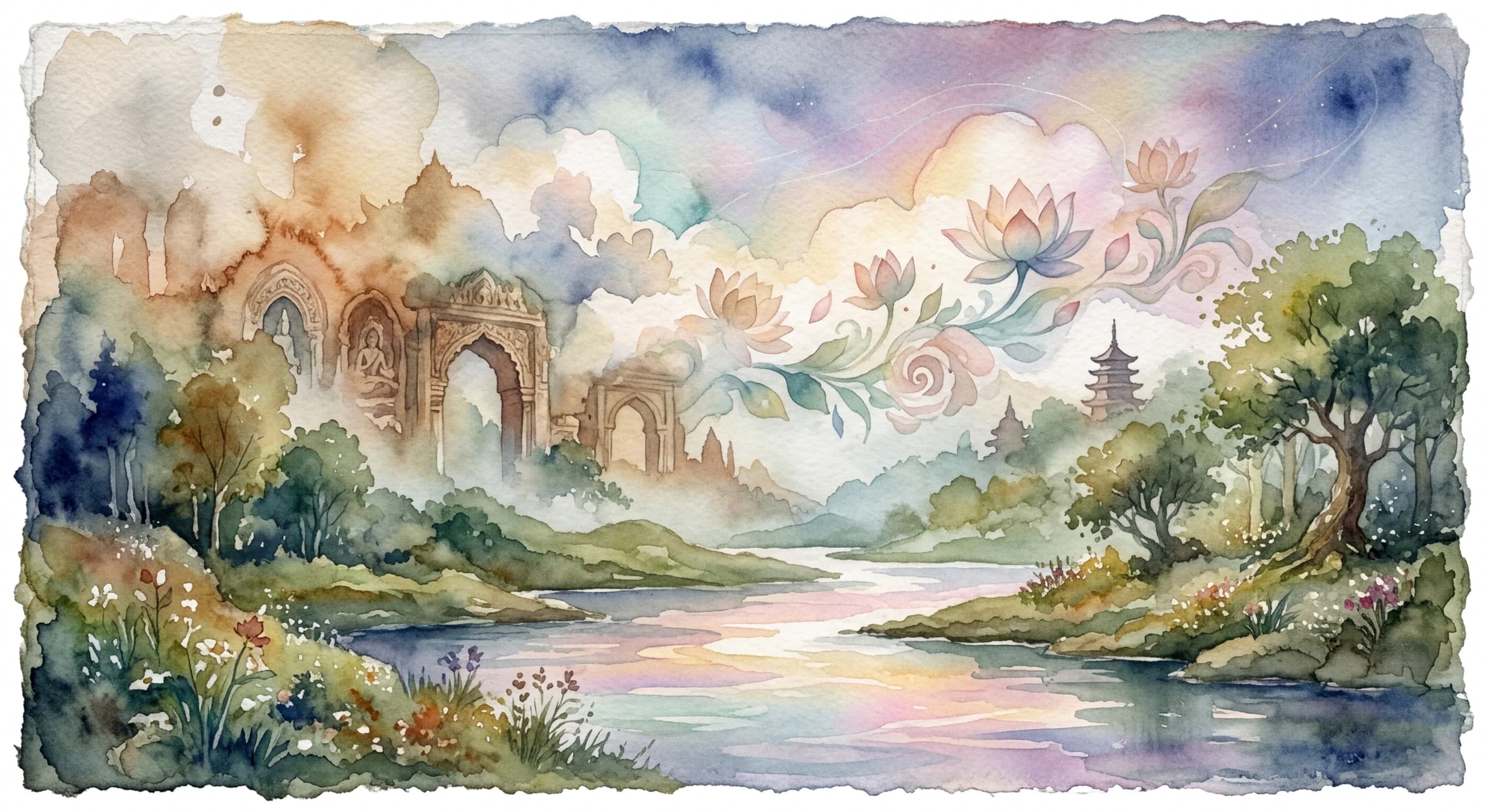
Prakriti
/PRAH-krih-tee/
Meaning
Prakriti, from Sanskrit, embodies the primordial, dynamic essence of nature, the very fabric from which all manifest existence unfurls. It is the unmanifest potential, a boundless reservoir of energy and matter, constantly in a state of flux and creation. This concept is the feminine principle of manifestation in Indian philosophies, particularly Samkhya and Ayurveda, where it intricately dances with Purusha, the masculine consciousness, to weave the tapestry of the cosmos. Understanding Prakriti means recognizing the inherent qualities and energies that shape our reality, from the gross physical elements to the subtle workings of the mind and emotions.
Literal Translation
Nature, creation, essence
The Story Behind the Word
The concept of Prakriti is fundamental to ancient Indian thought, particularly the Samkhya school of philosophy, which predates many modern philosophical systems. It provided a sophisticated framework for understanding the material universe and human experience without resorting to a singular creator god. For millennia, this dualistic view (Prakriti and Purusha) has shaped spiritual practices, Ayurvedic medicine, and even artistic expressions, emphasizing balance and the cyclical nature of existence. It reveals a culture deeply attuned to the rhythms of nature, viewing the physical world not as separate from the divine, but as a vibrant, intelligent manifestation of a cosmic dance, where every element possesses inherent qualities (gunas) that influence life and consciousness.
Experience It
Ayurveda and Prakriti
A young woman consults an Ayurvedic doctor, describing her frequent anxiety and cold hands. The doctor explains that her unique 'Prakriti' (constitution) is predominantly Vata, characterized by lightness and movement. Understanding this helps them tailor a diet and lifestyle to bring her doshas into balance, recognizing her inherent nature.
Observing Nature's Cycle
An old sage sits by a river, watching the water flow, the leaves fall, and new buds emerge. He reflects on Prakriti, seeing in the river's ceaseless movement and the forest's seasonal transformations the endless creative and destructive power of nature, the very essence of the universe unfolding before his eyes.
The Deeper Meaning
Prakriti unveils a worldview where the material world is not an illusion or a mere backdrop, but an active, intelligent, and essential component of reality. It challenges the sharp Western dichotomy between mind and matter, presenting them instead as two inseparable, interacting principles. This concept fosters an ecological consciousness, urging respect for the natural world as a manifestation of the divine feminine creative force, and encourages introspection to understand one's own unique natural constitution.
Did You Know?
In Samkhya philosophy, Prakriti is said to be composed of three fundamental qualities or 'gunas' – Sattva (goodness, purity), Rajas (passion, activity), and Tamas (darkness, inertia) – which are always in flux.
How It's Used
Used in philosophical and spiritual contexts, particularly in Hinduism and Buddhism, to describe the material aspect of the universe and the fundamental nature of reality.